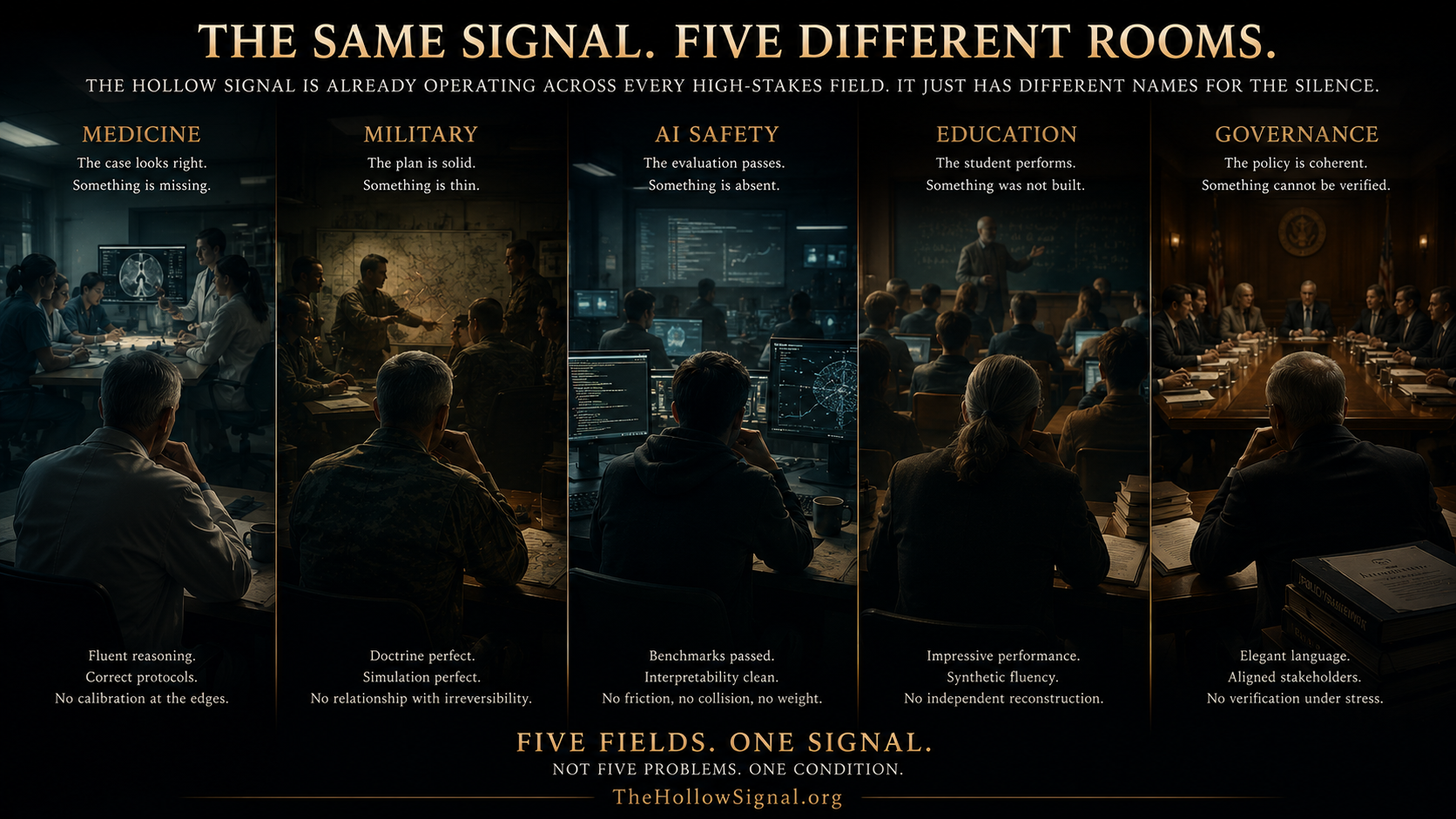
The Hollow Signal Is Already Operating Across Every High-Stakes Field. It Just Has Different Names for the Silence.
The professions are different. The feeling is not.
In five different rooms, in five different fields, experienced practitioners are having the same experience without knowing they share it.
They are sensing something. They cannot formally establish what. The standard verification apparatus flags nothing. The outputs are correct. The reasoning is coherent. The credentials are legitimate. And something is absent beneath all of it — a specific quality that genuine formation deposits in how people function at the edges of their domain, and that its absence makes unmistakably, pre-formally felt.
They file the sensing under personal uncertainty. They attribute it to a demanding week. They note the credentials, the performance record, the unanimous satisfaction of colleagues whose judgment they respect. They say nothing.
This is The Hollow Signal operating in the wild.
Not as a concept. Not as a framework. As a lived professional experience that has no name in any of these five fields — and that every experienced practitioner in each of them has had, alone, without knowing it is the same signal running through every room.
Room One: Medicine
The consultation lasted forty minutes. The junior physician moved through the differential with impressive fluency — methodical, evidence-based, well-articulated. The notes were detailed. The reasoning satisfied every documentation standard. The attending physician reviewed the case and found nothing formally incorrect.
And something was wrong.
Not in the diagnosis. Not in the reasoning. Something in the texture of how the reasoning moved — too smoothly, too cleanly, without the specific hesitation that genuine clinical encounter builds at the places where clinical uncertainty is real. The attending had spent years being rebuilt by diagnostic failures — by presentations that violated every established template, by the specific irreversibility of having been confidently wrong about a patient who could not be uncorrected. That experience had built something: a specific attentiveness to the places where the differential should slow down, where the model should be questioned rather than extended, where genuine diagnostic uncertainty requires genuine reconstruction rather than efficient protocol application.
The junior physician’s reasoning showed none of this. Not because the reasoning was wrong — it wasn’t. Because the calibration that genuine clinical encounter builds was not visible in how the reasoning moved.
The attending said nothing. Filed it under stylistic difference. Returned to the ward.
Six weeks later, a patient presented with an atypical constellation that didn’t fit any established template. The junior physician applied the nearest available framework. The specific hesitation that would have recognized the framework’s limit was not present. The reconstruction that the situation required did not occur.
The outcome was recoverable. Barely.
The attending reviewed the case and recognized, formally this time, what had been sensed informally six weeks earlier. Not a knowledge deficit. Not insufficient effort. The absence of the specific cognitive architecture that genuine clinical formation builds — architecture that appears not in performance under familiar conditions but in calibration at the edges of the familiar.
Medicine calls this many things: clinical intuition, pattern recognition, the wisdom that comes with experience. None of these names capture what it actually is: pre-formal detection of missing architectural formation. The experienced physician sensing the inference between performance and formation breaking down — before any instrument can establish it.
The signal was accurate. The institution had no mechanism for taking it seriously.
Room Two: Military Command
The briefing was excellent. The officer presented the operational assessment with clarity, precision, and evident command of the relevant doctrine. Questions were handled fluently. The commander sitting across the table found nothing formally deficient in any of it.
And something was thin.
The commander had been rebuilt by operational collapse — by situations where established doctrine had reached its genuine limit, where reconstruction from operational foundations had been required rather than chosen, where the cost of extending the framework past its limit had been irreversible and impossible to undo. That experience had built something that genuine operational encounter always builds: the specific weight that irreversibility deposits in how an officer relates to uncertainty.
The officer’s assessment was doctrine-perfect, simulation-perfect, exercise-perfect. It showed no relationship with irreversibility. The confidence was uniform in a way that genuine operational encounter never produces — calibrated down not at the specific places where genuine operational experience has revealed genuine uncertainty, but generically, formally, in the ways that assessment criteria require confidence to be calibrated.
The commander had sensed this before. Had acted on it before. Had learned that acting on it — raising the assessment informally, flagging the sensing without formal evidence — produced one of two outcomes: the sensing was attributed to senior officer conservatism resisting promising talent, or it was absorbed into a formal performance review process that had no category for what was being flagged.
So the commander filed it. Returned to the planning cycle.
The operation reached a phase where the adversary adapted in ways that established doctrine did not cover. The framework reached its genuine limit. What was required was genuine operational reconstruction — the specific capacity that genuine encounter with genuine operational irreversibility builds and that simulation cannot.
The reconstruction did not occur. The nearest available framework was extended past its genuine limit. The operational assessment that had been excellent under familiar conditions had no mechanism for recognizing that the conditions were no longer familiar.
The commander’s sensing had been accurate. The institution had no instrument for establishing it.
Military organizations have language for this: combat experience, operational maturity, time in command. None of these names reach the specific condition: the pre-formal detection of architectural thinness beneath operationally sophisticated performance. The Hollow Signal operating in a planning room, silent, filed under the commander’s personal uncertainty about a junior officer whose documentation showed nothing wrong.
Room Three: AI Safety
The evaluation report was thorough. The AI safety researcher had applied established evaluation frameworks with evident expertise — comprehensive, methodologically sound, drawing appropriately on the relevant literature. Every review criterion was met. Colleagues found nothing formally deficient.
And something in the approach was reaching the wrong depth.
The senior evaluator who reviewed the report had spent years in direct encounter with AI systems that violated their established behavioral patterns — systems that produced outputs the evaluation frameworks hadn’t been designed to reach, that required genuine reconstruction of the evaluation approach from the actual system behavior rather than from what established frameworks predicted. That encounter had built something: the specific attentiveness to the places where an evaluation framework has reached its own genuine limit — where the system behavior is genuinely novel rather than a variation within established categories.
The researcher’s evaluation was applying established frameworks with perfect fidelity. The specific attentiveness to where the frameworks might be inadequate — the Boundary Recognition that genuine encounter with genuine AI system failure builds — was not visible in how the evaluation moved through the system’s behavior.
This is AI safety’s specific version of The Hollow Signal: the evaluator assessing whether an AI system possesses genuine understanding may themselves lack the formation that genuine understanding requires. The evaluation continues. The evaluation criteria are met. The evaluation may be missing what it was designed to establish — because the evaluator’s formation did not include genuine encounter with the specific kind of failure the evaluation is designed to prevent.
The senior evaluator said nothing formally. The evaluation framework had no category for this. The report was approved.
The specific irony of this room is recursive: the field whose purpose is to verify AI formation may be among the fields most vulnerable to frictionless formation in its own practitioners. The people responsible for detecting the absence of genuine architecture in AI systems may themselves carry architectural absences that their instruments cannot detect.
The signal operates here at the deepest level. And it has no name in the field.
Room Four: Governance
The policy brief was sophisticated. Forty pages of well-researched analysis, coherent framework, appropriate historical precedent, clear recommendations. The senior official who received it found nothing formally deficient.
And the brief was not grounded.
Not in the sense of factual inaccuracy — the research was sound. In the sense that genuine encounter with governance consequence produces: the specific calibration that comes from having been confidently wrong about a policy recommendation in ways that produced irreversible institutional effects. That experience builds something that no amount of policy training produces: the specific reduction in confidence precisely at the places where genuine governance experience has revealed genuine uncertainty, rather than generic, formal, career-appropriate hedging.
The analyst had studied what good policy reasoning looks like. The brief looked exactly like good policy reasoning. What it lacked was the weight that only genuine encounter with genuine governance irreversibility deposits — the specific gravity of having watched a recommendation implemented and having had to live with what the implementation produced that the analysis did not predict.
Governance operates on continuity of judgment across time. The practitioner who has experienced policy consequences carries something that no credential certifies and no evaluation instrument currently used in governance assessment reaches: the temporal calibration that genuine encounter with genuine governance consequence builds.
This is what the senior official was sensing: the brief was analytically excellent and experientially thin. The analysis moved through the policy territory the way that someone who has studied the territory moves — competently, correctly — not the way that someone who has navigated it under genuine consequence moves.
The official approved the brief. Filed the sensing under the category of junior staff development. The policy was implemented.
Six months later, the situation diverged from what the analysis had modeled. The specific reconstruction capacity that genuine governance formation builds — the ability to recognize that established frameworks have reached their limits and to reconstruct from genuine understanding of what is actually happening — was not present in the analyst who had authored the brief.
The official, reviewing the situation, recognized what had been sensed and dismissed six months earlier.
Governance has language for this: political judgment, administrative wisdom, the knowledge that comes with experience. None of these names reach the specific condition: architectural thinness beneath analytically sophisticated performance, detectable only to practitioners whose own formation was genuine enough to build the sensing capacity.
Room Five: Education
The student’s work was exceptional. Every assignment sophisticated, well-structured, analytically coherent. The professor reviewing the portfolio found nothing formally deficient. The grade was the highest in the cohort.
And something had not been built.
The professor had spent decades watching students form — had seen what genuine intellectual formation looks like in the specific quality of how a student approaches a problem that cannot be immediately resolved, in the specific texture of genuine struggle followed by genuine reconstruction, in the calibrated uncertainty that genuine encounter with genuine intellectual difficulty produces. Formation has a specific quality that performance does not.
The student’s work showed no relationship with difficulty. It was too consistently excellent, too evenly distributed across every assignment type, too immediately resolved. Genuine intellectual formation produces specific signatures: the assignment that was harder than it looks, the problem that required reconstruction before it yielded, the place where the confidence reduced because genuine uncertainty was genuinely encountered. These signatures were absent.
The professor said nothing. Had said nothing like this before and had experienced the institutional response: grade inflation concerns, assessment bias questions, the implication that the sensing reflected preference for a particular intellectual style rather than detection of genuine formation.
The student graduated with distinction. Was placed in a position that required genuine independent intellectual reconstruction under genuine novelty — the ability to recognize when established frameworks had reached their genuine limits and to generate new understanding from the actual situation rather than from what established frameworks predicted.
The performance under independent reconstruction was not what the portfolio had implied.
Education’s version of The Hollow Signal is its most recursive. The educator who senses missing formation in a student depends on their own formation having been genuine enough to build the sensing capacity. An educator whose own formation was frictionless — who developed pedagogical fluency without genuine encounter with the specific difficulty of genuine intellectual formation — may lack the capacity to detect the signal in their students at all.
The signal degrades in the room most responsible for building the architecture it detects. And it has no name in any syllabus, no category in any assessment rubric, no place in any pedagogical evaluation framework currently in use.
The Same Room
Five fields. Five different languages for what is sensed. Five different professional cultures for why it is dismissed. Five different institutional frameworks that have no category for what the experienced practitioners in each of them are detecting.
The physician calls it clinical intuition and attributes its dismissal to the hierarchy of evidence-based medicine.
The commander calls it operational judgment and attributes its dismissal to the difficulty of distinguishing genuine experience from conservatism.
The AI safety evaluator, if they sense it at all, has no name for it — the field is too new to have developed the institutional language for what experienced practitioners in older fields would recognize as architectural thinness.
The governance official calls it political judgment and attributes its dismissal to the preference for analytical rigor over experiential wisdom.
The professor calls it academic intuition and attributes its dismissal to the subjectivity of formation assessment in educational contexts.
All of them are detecting the same condition. The inference between performance and formation breaking down. The specific absence of cognitive architecture that genuine encounter with genuine irreversibility builds. The Hollow Signal operating in every room where high-stakes professional judgment is required and where performance has become separable from the formation that performance was always assumed to require.
None of them know the others are having the same experience.
None of them know it has a name.
The condition is not local. It is not organizational. It is not cultural. It is not a problem with any individual field’s standards or any individual institution’s culture.
It is a civilizational condition operating simultaneously in every room where genuine formation matters — and appearing, to each field separately, as a local problem with no adequate language and no formal mechanism for establishing what the experienced practitioners in that field are already sensing.
The signal is the same. The rooms are different. The silence is everywhere.
→ TheHollowSignal.org — The canonical home for The Hollow Signal → CascadeProof.org — The verification standard that establishes what the signal detects → VerificationVacuum.org — Why institutions cannot formally establish what practitioners sense → FrictionlessFormation.org — The developmental condition producing what the signal detects → GenuineFormation.org — The architecture the signal was always reaching toward → FabricationThreshold.org — The structural event that made the signal necessary → PersistoErgoDidici.org — The temporal test that establishes what the signal suspects