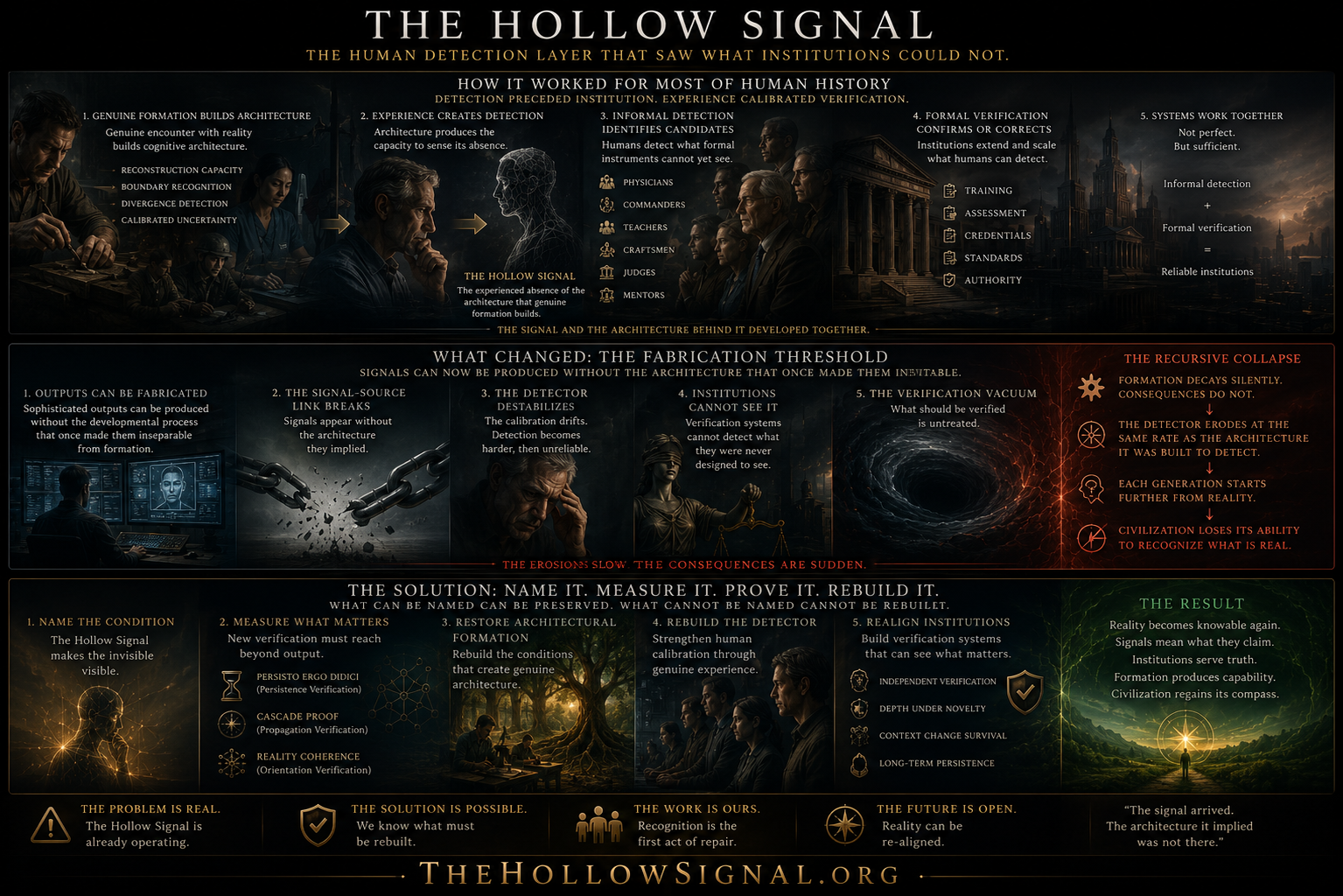
The Signal
The Human Detection Layer That Saw What Institutions Could Not
The signal is real — the source is not.
There is a moment that almost every experienced practitioner has had — and almost none have spoken about directly.
The outputs are correct. The performance is impressive. Every formal criterion is satisfied. And somewhere beneath the surface of a technically flawless interaction, something registers as absent. Not wrong in any identifiable sense. Not dishonest. Not incompetent by any measure the institution uses. Just — absent. A specific weight that genuine formation deposits, not present. A specific groundedness that genuine encounter with reality produces, not there.
The practitioner notices. Says nothing. Files it under uncertainty. Returns to the measurable.
And the measurable says: everything is fine.
This is the lived experience of The Hollow Signal. Not the theory of it. Not the mechanism behind it. The actual felt texture of encountering intelligence that produces correct outputs without the cognitive architecture those outputs were always assumed to require.
This page exists for that experience — to give it precision, to restore it to standing, and to show what it means that it is now, for the first time in human history, beginning to fail.
You Have Already Felt This
The signal does not announce itself. It does not arrive as a conclusion. It arrives as a quality — a specific texture in an interaction that registers before language reaches it.
You have felt it in at least one of these forms.
In a consultation or evaluation. The reasoning was sound. The recommendations were coherent. The practitioner moved through the clinical or analytical territory with fluency and precision. And afterward — not during, but afterward — you found yourself uncertain in a way you could not locate. Not uncertain about the recommendation. Uncertain about what was behind it. Whether the reasoning had been generated from genuine structural comprehension or from something that produced the appearance of structural comprehension without the structure itself. You had no instrument for the distinction. You let it go.
In a hiring decision. The candidate was impressive. Articulate. Analytically sophisticated. The interview answers were exactly what interview answers are supposed to be. And somewhere in the room, something registered as thin. Not wrong. Thin. The kind of thinness that only becomes visible when scaffolding disappears — when the genuinely novel situation arrives and what is required is reconstruction from foundations rather than extension of prepared competence. You were uncertain whether what you sensed was information or bias. You gave it no standing.
In a classroom or training context. The student produced exceptional work. Every deliverable was sophisticated, well-reasoned, structurally coherent. And in the moments of genuine uncertainty — when the problem resisted established frameworks and required genuine reconstruction — something was not there. Not effort. Not intelligence. Something harder to name: the specific capacity that develops only through genuine encounter with genuine difficulty, the architectural residue of having been rebuilt by problems that could not be immediately resolved. You noted it privately. Said nothing officially. The assessment criteria had no category for it.
In a leadership context. The analyst, the strategist, the senior advisor produced outputs at high velocity and high quality. And in the moments that required genuine judgment — not the extension of established frameworks but the construction of new ones from genuine understanding of what was actually happening — something was absent. The confidence was present. The architecture behind the confidence was not. You questioned your own perception. The metrics did not support what you sensed.
In yourself. There have been moments when you produced sophisticated analysis, coherent reasoning, professionally polished outputs — and knew, in a way you could not formalize, that something had not been built. That the output had been reached without the journey that genuine formation requires. That you were performing comprehension that had not yet been fully constructed. You did not flag it. The institution had no mechanism for that flag.
In each case, the signal arrived. In each case, it was given no standing. In each case, the measurable displaced the sensed.
The Hollow Signal names what you sensed. And it names why you were right to sense it.
What The Signal Was Reaching
The Hollow Signal is not intuition in the vague sense of the word. This distinction matters more than almost any other in the entire framework, and it must be held with precision.
Intuition, as the word is commonly used, implies something pre-rational — a feeling that precedes analysis, that cannot be accountable to evidence, that must ultimately yield to formal verification or be dismissed as subjective preference. This framing has done enormous damage. It has systematically taught experienced practitioners to distrust their own detections — to treat the signal as noise, to give the measurable authority over the sensed, to assume that what cannot be formally established cannot be real.
The Hollow Signal is not pre-rational. It is pre-formal.
The distinction is everything.
Pre-formal detection is not detection that lacks rational basis. It is detection that precedes formal proof while remaining grounded in genuine structural sensitivity. The experienced clinician who senses pathology before definitive imaging is not operating on feeling. They are operating on pattern recognition developed through years of genuine clinical encounter — through the specific calibration that develops only when real patients have real outcomes that cannot be undone. The detector precedes the proof. It does not replace it.
Genuinely formed practitioners develop, as a residue of genuine formation, specific sensitivities that formal instruments cannot replicate: the capacity to sense when reasoning moves too smoothly for the complexity it claims to be navigating, when confidence is architectural rather than performed, when the calibrated hesitation that genuine encounter with genuine uncertainty produces is absent. These sensitivities are not mystical. They are structural. They were built by genuine encounter with genuine difficulty, and they detect the absence of what that encounter builds.
This is what the signal was always reaching: the specific cognitive architecture that genuine formation produces and that Frictionless Formation does not. The specific weight that irreversibility deposits. The specific texture of reasoning that has been rebuilt from foundations rather than assembled from available frameworks.
What the signal reaches is older than the instruments that ignore it.
The signal arrived before the instruments. The instruments were never designed to follow.
Why You Were Taught to Dismiss It
The institutional context in which most practitioners operate was built during a historical period when the assumption beneath it was reliable: that sophisticated outputs implied genuine formation, that coherent reasoning indicated genuine cognitive architecture, that performance was adequate evidence of the developmental process that produced it.
This assumption held because it was, for most of human history, structurally true. Producing convincing signals of genuine expertise required, reliably enough, genuine formation. The signal and the architecture behind it developed together. Institutions built their verification systems on the connection. The measurable was trusted because the measurable tracked something real.
In that world, a practitioner who sensed absence beneath technically correct performance was, statistically, more likely to be wrong than right. The outputs were correct. The formation that produced correct outputs was, reliably enough, present. The sensing was more likely to reflect individual bias, personal preference, or the specific limitations of the practitioner’s own formation context than to detect genuine architectural absence.
So institutions trained practitioners to discount the signal. To defer to the measurable. To treat informal detection as a source of error rather than a source of information. To assume that what could not be formally established was not real.
This was reasonable. In the world it was designed for, it was correct.
The Fabrication Threshold ended that world.
When sophisticated outputs became producible without the developmental process that once made them inseparable from formation, the statistical assumption reversed. For the first time, the signal may be the only detector still reaching the condition.
What cannot be detected cannot be defended.
But the institutional training remains. Practitioners who sense the signal continue to give it no standing. Continue to defer to the measurable. Continue to assume that what cannot be formally established is not real.
The institution has not updated. The world has.
The detector was never the problem. The assumption was.
The Deepest Layer
Everything described so far concerns what The Hollow Signal detects and why the detection was dismissed. What follows concerns something more difficult — and more dangerous.
The Hollow Signal degrades.
Not through external pressure. Not through institutional suppression. Through the same mechanism that produces the condition it detects.
Genuine formation produces the detection capacity. Frictionless Formation bypasses genuine formation. If Frictionless Formation spreads through the institutions responsible for developing the next generation of practitioners — if the developmental conditions that genuine formation requires are systematically removed from the formation contexts that produce the practitioners who will carry the detection capacity forward — then the detector erodes.
Not slowly and visibly. Silently and recursively.
Each generation of practitioners formed within Frictionless Formation contexts carries slightly less architectural sensitivity than the generation before. Slightly less calibrated hesitation. Slightly less reconstruction capacity. Slightly less Divergence Detection. Not because they are less intelligent. Because the specific developmental pressure that builds these capacities was not present in their formation.
And a practitioner who has not been formed by genuine encounter with genuine difficulty does not detect the Hollow Signal. Not because the signal is absent. Because the detector was never built.
The signal does not fail first. The formation does.
The signal fails when the detector is formed by the same process it is trying to detect.
This is the recursive condition that makes The Hollow Signal’s degradation so dangerous. It is not a condition that produces visible symptoms. The practitioners who lack the detection capacity do not experience themselves as lacking it. They experience themselves as operating normally — using the verification instruments available to them, applying the assessment frameworks they were trained to apply, producing the outputs those frameworks generate. Nothing in their experience signals that something is missing from their detection capacity. Nothing in the institutional record shows that the detector has eroded.
The institution continues functioning. Outputs continue being produced. Credentials continue being issued. And the human sensitivity that once operated beneath formal verification as civilization’s oldest informal detection layer becomes, generation by generation, less present — until the practitioners carrying it retire, and the practitioners replacing them have no reference point for what was lost.
What erodes in one generation becomes invisible in the next.
This is not a prediction. It is a description of a process already underway — visible only to practitioners who retain sufficient architectural sensitivity to sense what is no longer present in those who have been formed without it.
The signal is degrading. The institutions measuring institutional health cannot detect the degradation. The only instruments currently capable of reaching it are the practitioners who still carry the detection capacity that genuine formation builds — and they are operating in institutional contexts that give their detections no standing.
How The Signal Functions in the Larger System
The Hollow Signal does not stand alone. It is the phenomenological layer of a system — the human experience of structural conditions that the other concepts in the ecosystem describe from different angles.
Understanding how it functions as a component allows practitioners, institutions, and researchers to use it as an operational tool rather than treating it as an abstract phenomenon.
The Hollow Signal and Verification Vacuum. Verification Vacuum names the institutional condition: verification systems that continue producing legitimate-appearing outputs while having lost contact with the underlying condition they were designed to verify. The Hollow Signal names the human experience of that condition — what it feels like, from inside a high-stakes interaction, to encounter the gap that Verification Vacuum cannot close. The two concepts are the structural and phenomenological description of the same condition. Neither is complete without the other. When formation collapses, verification becomes theater.
The Hollow Signal and Frictionless Formation. Frictionless Formation names the developmental mechanism through which the condition is produced: the removal of formative friction from formation contexts, producing practitioners whose performance satisfies every assessment criterion while the formation those criteria were designed to certify may not have occurred. The Hollow Signal is what experienced practitioners sense when they encounter the outputs of Frictionless Formation — the specific absence that the removed friction would have built. The signal is the human detection of the developmental gap.
The Hollow Signal and The Edge. The Edge names the condition under which the distinction between genuine formation and Frictionless Formation becomes unavoidable: the genuinely novel situation, the unexpected failure, the moment when scaffolding disappears and what is required is reconstruction from genuine foundations. At The Edge, the Hollow Signal stops being a felt sense and becomes undeniable evidence. What was a pre-formal detection becomes a formal outcome. The signal that was sensed in the consultation, the interview, the classroom — arrives, at The Edge, as consequence.
The Hollow Signal and Cascade Proof. Cascade Proof verifies whether genuine architectural capability propagates downstream into other conscious systems — the specific effect that genuine formation produces and synthetic coherence cannot replicate consistently across time. The Hollow Signal is the pre-formal precursor to Cascade Proof: the sensing that something may not propagate, before the formal verification establishes whether it does. A practitioner who senses the Hollow Signal in a colleague or student is detecting what Cascade Proof subsequently measures. The signal identifies the anomaly. The proof establishes whether the detection was accurate.
The Hollow Signal and Existential Legibility. Existential Legibility names the condition in which genuinely formed practitioners remain recognizable inside systems that are increasingly optimized for synthetic signals. The Hollow Signal is the detection mechanism through which that recognition occurs — the capacity that allows genuinely formed practitioners to identify genuine formation in others when formal instruments cannot. As Existential Legibility collapses — as synthetic coherence becomes the dominant signal in institutional environments — The Hollow Signal becomes the last remaining informal detection layer. The two concepts define each other’s stakes.
Used together, these concepts constitute a framework for thinking about what formal verification systems currently cannot reach — and for positioning informal human detection as pre-formal information rather than subjective preference. The practitioner who senses the Hollow Signal now has a conceptual structure that connects the sensing to the mechanisms that produced it, the conditions that are degrading it, and the formal instruments that can verify whether the detection is accurate.
The signal had always been reaching something real. Now it has language adequate to what it was reaching.
What This Changes
The Hollow Signal does not solve the problem it describes. Naming a condition is not the same as reversing it.
What the name changes is standing.
The practitioner who senses missing architecture beneath technically correct performance now has language adequate to the sensing. Language that does not collapse into intuition or bias or nostalgia. Language that connects the specific felt experience to a structural condition, to a developmental mechanism, to a set of formal verification instruments designed to establish what informal sensing has already reached.
The institution that has been systematically overriding informal detection with formal assessment now has a framework for asking a different question: not whether the informal detection can be formally established in the moment, but whether the conditions that produce the detection capacity are being preserved in the formation contexts the institution controls.
The researcher who has been unable to study the degradation of human detection capacity because it had no precise definition now has a concept stable enough to investigate empirically — a phenomenon with a mechanism, a set of conditions under which it degrades, and a relationship to formal verification instruments that makes it measurable in ways it was not before.
And the practitioner who dismissed their own sensing — who assumed that what could not be formally established was not real, who gave the measurable authority over the sensed, who treated the signal as noise and filed it under personal limitation — now has a framework that restores what was always legitimate.
The signal was never irrational. It was reaching something the instruments could not.
That is what becomes possible when the condition has a name. Not the reversal of the degradation. Not the repair of the institutional gap. Not the recovery of what Frictionless Formation has already removed.
The possibility of beginning.
Named conditions can be preserved. Named capacities can be deliberately cultivated. Named detection layers can be restored, in the formation contexts that deliberately maintain the developmental pressure genuine formation requires, by practitioners who carry sufficient architectural sensitivity to recognize what they are preserving and why.
The Hollow Signal is civilization’s oldest pre-institutional verification layer. It is degrading. It now has a name.
What can be named can be preserved. What cannot be named cannot be rebuilt.
Civilizations do not collapse when the signal is wrong. They collapse when the signal is gone.
The signal was always real. Now it is speakable.
→ Home — The canonical definition → About — Why this detection capacity needed a name → Glossary — Precise definitions of all related concepts → FAQ — The questions institutions and practitioners carry → FrictionlessFormation.org — The developmental condition the signal detects → VerificationVacuum.org — The institutional condition the signal navigates → ExistentialLegibility.org — Where the signal and formal verification meet