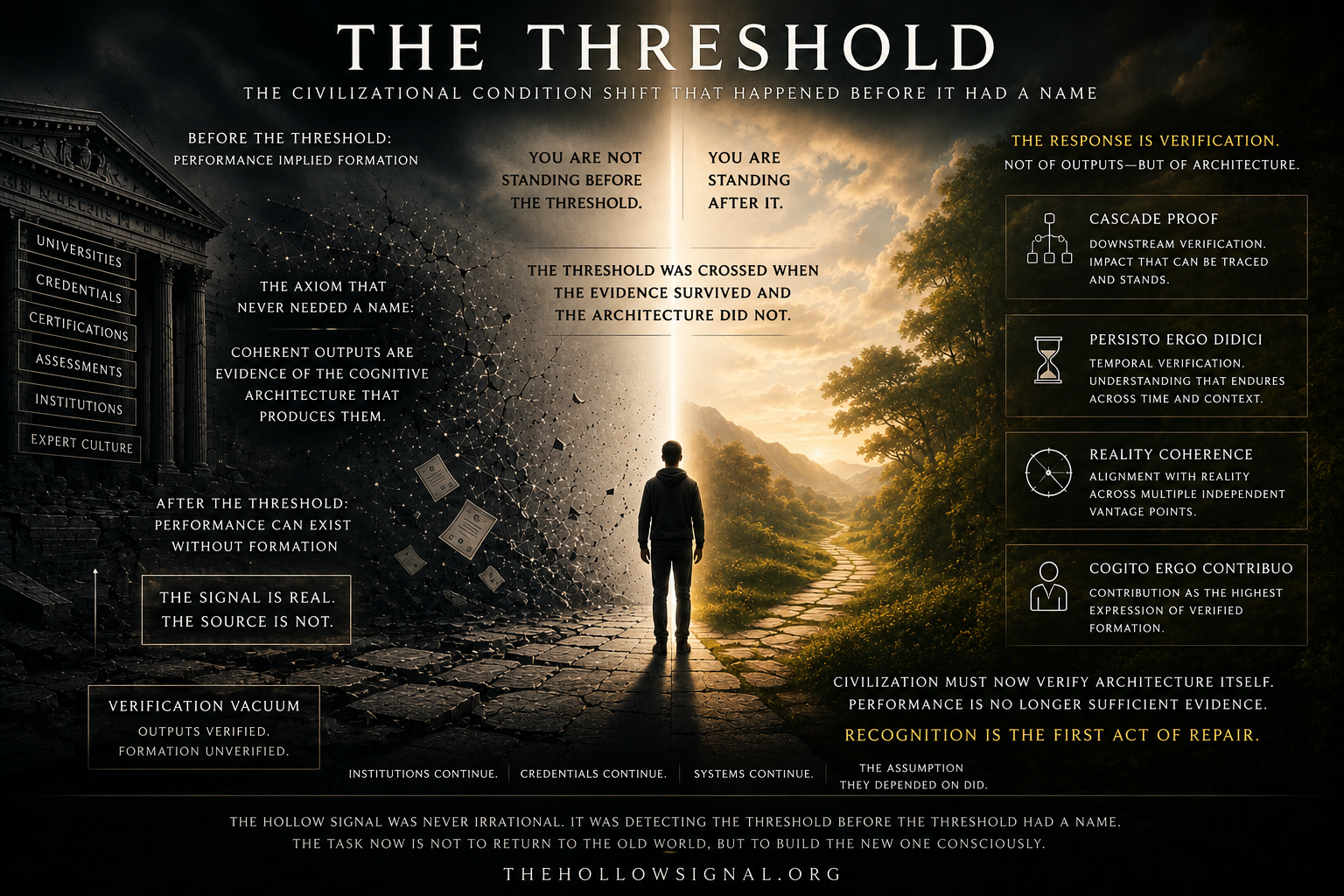
The Threshold
The Civilizational Condition Shift That Happened Before It Had a Name
The signal is real — the source is not.
You are not standing before the threshold.
You are standing after it.
This is the orientation this page exists to provide — not a prediction, not a warning about what is coming, not an argument about what artificial intelligence might eventually become. A description of where you already are. A map drawn after the crossing, for people who crossed it without knowing they had.
The threshold was not an event. It was not a product launch, a research paper, a policy decision, or a date that can be marked on a calendar. It was a condition shift — the point at which a relationship that had always held, that civilization had always depended on, that no institution had ever needed to formally verify because it had never needed to be questioned, silently and permanently broke.
The relationship between performance and formation.
Before the threshold: producing the signals of genuine expertise required, reliably enough, genuine formation. The outputs were connected to the architecture that produced them because there was no other mechanism that could produce them at that level of sophistication consistently. Performance implied formation because performance was inseparable from it.
After the threshold: performance can be produced without formation. The signals exist. The architecture may not.
The threshold was crossed when the evidence survived and the architecture did not.
Civilization crossed this threshold before it named it. That is the most important fact about where you now stand.
The Axiom That Never Needed a Name
Every civilization is built on assumptions so foundational that they never need to be stated. They operate beneath the surface of every institution, every verification system, every credentialing process, every structure for establishing who can be trusted with what. They are not laws. They are not policies. They are not theories. They are structural facts — conditions that held so reliably, for so long, that no institution ever needed to formalize them, because formalizing them would have been like formalizing the assumption that objects fall when dropped.
One of civilization’s deepest operational axioms was this: coherent outputs are evidence of the cognitive architecture that produces them.
This axiom held because it was structurally true. Producing sophisticated clinical reasoning required genuine clinical formation. Producing sound legal judgment required genuine legal formation. Producing coherent strategic analysis required genuine encounter with genuine strategic complexity. The output and the architecture behind it developed together — because they could not, realistically, be separated.
This inseparability was not a coincidence. It was the structural condition of a world where producing the signals of genuine expertise required undergoing the developmental process that genuine expertise required. The physician who spoke with clinical fluency had developed clinical architecture — not because fluency and architecture were the same thing, but because developing genuine fluency required the formation that built genuine architecture. They were inseparable in the only world civilization had ever operated in.
Civilization built everything on this axiom. Universities. Professional credentialing systems. Scientific authority. Institutional trust. Expert cultures. Meritocratic selection. Legal authority. Medical licensing. Military command structures. Every system that civilization developed for establishing who understood what, who could be trusted with what, who had the formation required for what — every system was built on the assumption that coherent outputs were adequate evidence of genuine cognitive architecture.
The axiom never needed to be named because it never needed to be defended.
Axiom collapse is invisible because axioms are.
Then it broke.
What the Fabrication Threshold Actually Was
The Fabrication Threshold is not a name for AI becoming powerful. It is a name for the moment at which the structural inseparability that civilization’s axiom depended on permanently ended.
When sophisticated AI systems became capable of producing coherent reasoning, fluent professional language, analytically structured outputs, and expert-level performance at scale, civilization crossed into a condition it had never navigated before: a condition in which the outputs that had always been inseparable from genuine formation could now be produced without it.
This is not a statement about AI being intelligent, or conscious, or genuinely understanding. It is a structural observation about what happened to civilization’s verification logic. The outputs that formal verification systems used as evidence of genuine architectural development became producible through a mechanism that does not involve that development. The evidence and the thing it was evidence of became separable.
For the first time in human history, it became possible to produce the signals of genuine formation without the formation.
This is the Fabrication Threshold: not the moment AI became capable, but the moment the assumption that civilization’s entire verification infrastructure had always depended on — silently, invisibly, without ever needing to be stated — became unreliable.
The threshold was not declared. No institution announced it. No policy response acknowledged it. No educational system restructured around it. No credentialing process updated its logic to account for it.
The systems continued functioning. The credentials continued being issued. The assessments continued producing scores. The institutions continued certifying what they had always certified.
What they were actually certifying had changed.
The Crossing You Cannot Remember
There is a specific cognitive difficulty that the Fabrication Threshold produces, and it is unlike the difficulty that most historical transitions produce.
Most significant transitions leave evidence. They leave before-and-after photographs, institutional records, living memory of the difference between the prior condition and the new one. People who lived through them can point to the moment — can say: before this, things worked this way; after this, they worked differently. The evidence of the transition is available for inspection.
The Fabrication Threshold left no such evidence. Not because the transition was small, but because the relationship it changed was invisible before it changed. The axiom that performance implied formation had never needed to be stated. It had never been formalized. It had never been inscribed in any institutional document, any credentialing standard, any verification protocol.
When the axiom broke, there was nothing to visibly break. No formal statement was falsified. No institutional commitment was violated. No law was contradicted. The systems that depended on the axiom continued operating exactly as they had before — because they had been designed to verify performance, and performance was still verifiable. What the performance was now evidence of had changed. The verification instruments had no mechanism for detecting the change.
This is why the crossing cannot be remembered: there was no crossing to observe. The world looks, on every measurable dimension, like the world before the threshold. Institutions function. Outputs are produced. Standards are met. Credentials are legitimate. Assessments produce scores. The systems optimize correctly according to the metrics available to them.
The only thing that has changed is invisible: the relationship between what the systems verify and the underlying reality they were designed to reach.
And here is the deepest difficulty: when you try to use memory as a reference point, the memory misleads you. You remember a world where outputs implied formation — and you are, by every visible indicator, still in that world. Nothing in the appearance of things tells you the axiom has broken. Nothing in the outputs distinguishes the architecture that produced them from the architecture that did not. Your reference points were calibrated to a world where the distinction was unnecessary. They do not help you navigate a world where the distinction is everything.
What the threshold changed was not the world’s appearance. It changed what the appearance was evidence of.
This is the condition that makes orientation so difficult after the crossing. You are navigating by instruments calibrated to a relationship that no longer holds, in a world that looks identical to the world where it did.
What Continued. What Changed.
Understanding where you stand after the threshold requires separating what continued from what changed — and holding the distinction with precision, because the two are easily confused.
What continued:
Institutions continue functioning according to their design. Assessment systems continue producing legitimate-looking results. Credentials continue being issued by the institutions authorized to issue them. Performance continues being produced at high levels. Outputs continue satisfying the criteria they have always been assessed against. The professional continues producing what the professional is supposed to produce. The graduate continues demonstrating what the credential is supposed to demonstrate. The system continues optimizing what the system has always optimized.
None of this is performance. None of this is dysfunction. The systems are working exactly as they were designed to work. This is the most important thing to understand about the post-threshold condition: the systems are not broken. They are operating correctly.
The systems did not fail. The assumption they depended on did.
The problem is not that they are failing. The problem is that what they are correctly doing has silently changed.
What changed:
What the systems verify. Before the threshold, verifying performance was an adequate proxy for verifying the formation that produced it — because performance and formation were structurally inseparable. The proxy worked because it tracked something real. After the threshold, the proxy continues being applied. What it tracks has changed. Verifying performance no longer reliably establishes the formation that produced it, because performance can now be produced without that formation.
The institutions are optimizing signals that have detached from the reality they were always assumed to indicate.
When formation becomes optional, verification becomes blind.
This is not a moral failure of institutions. It is the structural consequence of operating with instruments built for a world where an axiom held — and continuing to operate with those instruments after the axiom no longer holds. The instruments were not broken by the threshold. They were not designed for the post-threshold world. No institution that existed before the threshold had any reason to design for a world in which performance and formation were separable, because that world had never existed.
Before the threshold: performance and formation were inseparable enough that verifying one was adequate verification of both.
After the threshold: they are separable, and verifying one establishes nothing certain about the other.
That is the full extent of what changed. It is enough to change everything that depended on it.
Why Memory Cannot Guide You Here
There is a specific epistemological problem that the post-threshold condition creates, and it is worth addressing directly because it produces a specific kind of disorientation that has no historical precedent.
Human cognition navigates the present by reference to the past. Memory is not merely storage — it is the reference architecture through which present experience is interpreted. When something familiar happens, memory provides the interpretive frame: this is like that, this means what that meant, this can be expected to unfold as that unfolded. The reliability of this navigation depends on the stability of the underlying reality that memory is tracking.
When that underlying reality changes invisibly — when the relationship between things that were always connected silently breaks — memory becomes an unreliable guide. Not because memory is malfunctioning. Because what memory is tracking is no longer what it was tracking when the memories were formed.
The experienced practitioner who senses something absent beneath technically correct performance reaches for memory to verify the sensing — and finds that memory does not confirm it. The outputs look like the outputs of genuine formation, because they are identical to the outputs of genuine formation. The memory of what genuine formation’s outputs look like cannot distinguish them from the outputs of Frictionless Formation. The reference has not been updated. The update was never made because the update’s necessity was never visible.
This is not a failure of individual cognition. It is the structural condition of navigating a post-threshold world with pre-threshold reference points. The references were correct when they were formed. The world they were calibrated to has changed. The references do not know this. The instruments do not know this. The institutions do not know this.
Only the condition itself knows — and it is not announcing itself.
What the threshold requires, therefore, is not better memory. Not more careful observation of outputs. Not stronger commitment to existing verification standards. What it requires is a new reference architecture: a set of concepts, instruments, and verification principles calibrated to the post-threshold world — to a world where performance and formation are separable and where the distinction between them is the most consequential distinction civilization currently faces.
What the Threshold Makes Necessary
Before the threshold, civilization could verify what it needed to verify through instruments calibrated to performance. The performance was adequate evidence. The instruments were adequate instruments. The system worked.
After the threshold, it cannot. Not because the instruments are poorly designed. Because they are correctly designed for a world that no longer fully exists. They reach what they were designed to reach. What they were designed to reach is no longer sufficient evidence of what matters most.
This is what makes the post-threshold verification instruments not additional options but structural necessities — not extensions of the existing verification architecture but responses to its fundamental limitation.
Cascade Proof verifies whether genuine architectural capability propagates downstream into other conscious systems across time. Before the threshold, this was unnecessary — performance was adequate evidence of the architecture that would produce such propagation. After the threshold, propagation must be verified directly, because performance no longer establishes it. The question is no longer whether the output is sophisticated. The question is whether the architecture behind the output can reorganize cognition in others under conditions of genuine novelty and irreversibility.
Persisto Ergo Didici verifies whether capability persists when scaffolding is removed — the temporal test that distinguishes what was built from what was accessed. Before the threshold, persistence could be assumed from performance. After the threshold, the assumption is no longer warranted. The question is no longer whether the performance was impressive. The question is whether it persists when the conditions that enabled it are no longer present.
Reality Coherence verifies the external correspondence orientation that genuine formation builds and that Frictionless Formation bypasses — the specific calibration to external reality that genuine encounter with genuine irreversibility produces. Before the threshold, coherent outputs were adequate evidence of reality-calibrated cognition. After the threshold, coherence can be internally generated without external correspondence. The question is no longer whether the outputs are coherent. The question is whether they are calibrated to reality rather than to internal consistency.
Cogito Ergo Contribuo — the shift from verifying intelligence through expression to verifying it through genuine downstream increase in reality-coherent capability in others. Before the threshold, demonstrating sophisticated cognition was adequate demonstration of genuine intelligence. After the threshold, cognition-signals are synthesizable. The question is no longer whether the cognitive outputs are impressive. The question is whether they increase genuine reality-calibrated capability beyond themselves in ways that persist under irreversibility.
These instruments are not philosophical preferences. They are post-threshold necessities — the specific verification infrastructure that becomes required when the axiom that performance implies formation can no longer be assumed.
Civilization must now verify architecture itself. Performance is no longer sufficient evidence.
Where You Now Stand
The threshold has been crossed. The crossing was not declared. It will not be reversed.
This is not a statement of doom. It is a statement of orientation — the specific kind of orientation that becomes possible when the condition is named precisely enough to be navigated rather than merely experienced as a vague sense that something important has changed.
What you are navigating is not a crisis in the conventional sense — a temporary disruption, an emergency that will resolve, a problem that will be corrected by the existing systems once they recognize it. What you are navigating is a permanent condition shift: a world in which the relationship between performance and formation has permanently changed, in which the verification instruments that civilization spent centuries developing must now be extended or replaced rather than merely improved, in which the human detection capacity that operated informally beneath formal verification for all of human history is now the most important early warning system civilization possesses — and is, simultaneously, the system most at risk of degradation.
The Hollow Signal is the human experience of this condition. The Verification Vacuum is its institutional expression. Frictionless Formation is its developmental mechanism. The Fabrication Threshold is the structural event that produced it. And The Threshold — this condition — is the historical position in which everything downstream of that event now operates.
People who sense something has changed but lack language for what — they are at the threshold. Institutions that continue optimizing correctly and producing results that satisfy every metric while something essential silently erodes — they are operating post-threshold. Practitioners who sense missing architecture beneath technically impressive performance but have no standing for the sensing — they are detecting the threshold’s effects.
The Hollow Signal was never irrational. It was detecting the threshold before the threshold had a name.
Civilization did not lose its experts. It lost the conditions that made expertise real.
What becomes possible when the threshold is named is not its reversal. The axiom does not return. The inseparability of performance and formation that civilization’s verification infrastructure was built on does not reassert itself because the condition has been described.
What becomes possible is navigation.
A civilization that knows it has crossed a threshold can begin building the instruments, concepts, and practices required for the world it now inhabits. A civilization that does not know it has crossed a threshold continues applying instruments calibrated to the world it no longer inhabits — correctly, competently, and with increasing distance from the reality those instruments were designed to reach.
The first act of navigation is recognition.
The second is building what recognition makes possible: verification instruments that reach architecture rather than performance, formation contexts that preserve the developmental pressure genuine formation requires, detection systems that operate at the depth the new instruments must reach, and institutional frameworks that treat the distance between output and architecture as the most consequential measurement currently available.
None of this is possible without the first act.
Civilization crossed the threshold when performance became synthesizable. Recognition is where the response begins.
The Map
You are here.
Not approaching a threshold. Not deciding whether to cross it. Not in the early stages of a transition whose outcome is uncertain.
You are on the other side of a condition shift that happened without announcement, without institutional recognition, without new language, without coordinated response. The world looks, from inside it, almost exactly like the world before the crossing — because the crossing changed a relationship that was invisible before it changed, and the visibility has not increased since.
The systems still function. The credentials are still legitimate. The assessments still produce scores. The outputs are still sophisticated. The institutions are still optimizing.
And the relationship between what they verify and the underlying reality they were designed to reach has permanently changed.
This is where you stand. This is what The Hollow Signal is detecting. This is what the Verification Vacuum cannot close. This is what Frictionless Formation is producing at scale. This is what The Edge will eventually reveal — in the genuinely novel situation, the unexpected failure, the moment when what was formed and what was only performed can no longer be confused.
The threshold does not announce itself. It does not need to.
It was already crossed. You are already navigating it.
Now it has a name.
The Threshold marks the civilizational shift where performance no longer proves genuine formation or reality contact.
Rights and Usage
All materials published under TheHollowSignal.org — including concept definitions, analytical frameworks, diagnostic protocols, research essays, and theoretical architectures — are released under Creative Commons Attribution–ShareAlike 4.0 International (CC BY-SA 4.0).
This license guarantees three permanent rights:
- Right to Reproduce Anyone may copy, quote, translate, or redistribute this material freely, with attribution to TheHollowSignal.org.
How to attribute:
- For articles/publications: ”Source: TheHollowSignal.org”
- For academic citations: ”TheHollowSignal.org (2026). [Title]. Retrieved from https://thehollowsignal.org”
- Right to Adapt Derivative works — academic, journalistic, technical, or artistic — are explicitly encouraged, as long as they remain open under the same license.
The Hollow Signal is intended to evolve through collective refinement, not private enclosure.
- Right to Defend the Definition Any party may publicly reference this framework, methodology, or license to prevent:
- Private appropriation
- Trademark capture
- Proprietary redefinition of the concept of The Hollow Signal
- Commercial capture of the verification standards this framework describes
- Paywalling of the language developed here
The license itself is a tool of collective defense.
No exclusive licenses will ever be granted. No commercial entity may claim proprietary rights or representational ownership of The Hollow Signal.
The definition of The Hollow Signal is public infrastructure — the language for understanding a detection condition that belongs to no single entity and that every institution, researcher, and practitioner has the right to use, develop, and defend.
→ Home — The canonical definition of The Hollow Signal → About — Why this detection capacity needed a name → The Signal — The human experience of the post-threshold condition → Glossary — Precise definitions of all concepts in this framework → FAQ — The questions institutions and practitioners carry → FabricationThreshold.org — The structural event that produced the condition → FrictionlessFormation.org — The developmental mechanism operating post-threshold → VerificationVacuum.org — The institutional condition the threshold produced → RealityCoherence.org — The verification standard the post-threshold world requires → CascadeProof.org — Post-threshold verification of genuine formation → PersistoErgoDidici.org — The temporal test the threshold made necessary