About The Hollow Signal
Why This Detection Capacity Needed a Name — And What Became Possible When It Got One
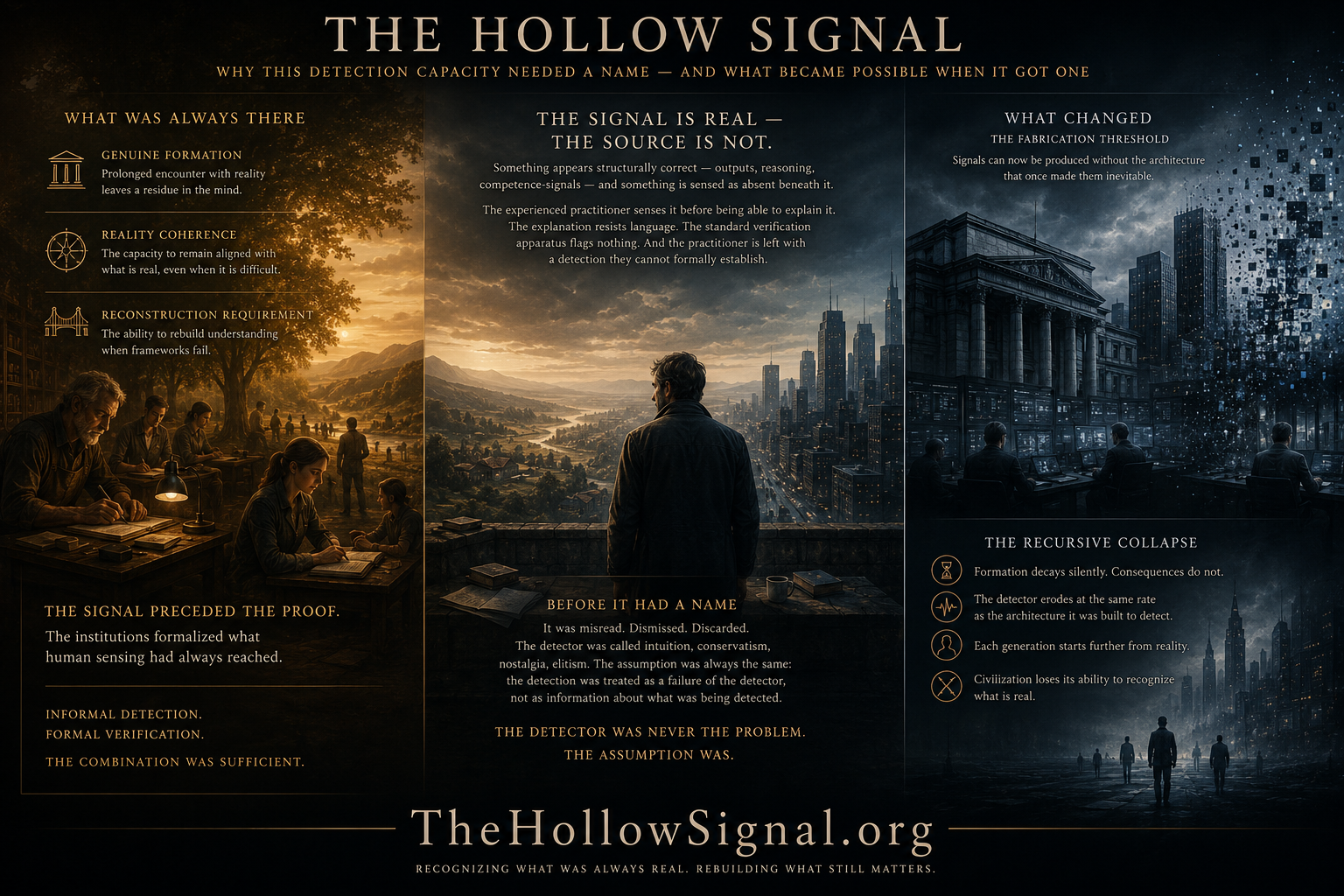
The signal is real — the source is not.
The Experience That Has No Language
There is an experience operating at the center of every high-stakes domain in the world, and it has been operating without a name.
The experience is this: something arrives that appears structurally correct — outputs, reasoning, professional fluency, competence-signals — and simultaneously, something is sensed as absent beneath it. Not an error. Not a detectable inconsistency. Not a moral failure. Something older and harder to place: the specific cognitive weight that genuine formation deposits, the specific groundedness that genuine encounter with reality builds, the specific architectural solidity that develops only through prolonged contact with problems that could not be immediately resolved.
The experienced practitioner senses it before being able to explain it. The explanation resists language. The standard verification apparatus flags nothing. And the practitioner is left with a detection they cannot formally establish — a signal, real and precise, pointing toward an absence they cannot yet prove.
Before The Hollow Signal had a name, this experience was systematically misread.
It was called intuition — and dismissed as subjective. It was called conservatism — and dismissed as resistance to progress. It was called nostalgia — and dismissed as preference for older methods. It was called elitism — and dismissed as the self-protection of established practitioners against capable newcomers. Every misreading preserved a common structure: the detection was treated as a failure of the detector, not as information about what was being detected.
The detector was never the problem. The assumption was.
The concept does not belong to any of these misframings. It belongs to a more fundamental question — one that civilization has never had to ask before, because the conditions that make it necessary have never existed before:
What happens to human detection capacity when the signals it was calibrated to detect permanently decouple from the architecture they were always assumed to require?
That question is what The Hollow Signal makes askable. And once askable, it reveals a condition that is already operating — in every domain where genuine expertise matters, in every institution that depends on the reliability of the formation it certifies, in every practitioner who has sensed that something essential is absent and had no language precise enough to say what.
What The Hollow Signal Actually Was
To understand what The Hollow Signal is becoming, it is necessary to understand what it always was — before it needed a name, before the conditions that are now destabilizing it existed.
The Hollow Signal is civilization’s oldest pre-institutional verification layer.
Before formal credentialing systems existed, before institutional assessment structures were built, before the elaborate apparatus of professional verification was developed — human beings still selected leaders, teachers, physicians, commanders, craftsmen, judges, and mentors. They did so imperfectly. But they did so with sufficient reliability to build the institutions that subsequently formalized what informal detection had always been reaching toward.
The mechanism was not mystical. It was calibrated.
Genuinely formed practitioners — those who had undergone genuine encounter with genuine difficulty in their domain — developed specific cognitive architecture as a residue of that encounter. They developed Reconstruction Capacity: the ability to rebuild understanding from foundations when established frameworks stopped applying. They developed Boundary Recognition: the capacity to sense when a situation had moved outside the domain of reliable knowledge. They developed Divergence Detection: the sensitivity to recognize when incoming information was genuinely contradicting an established model rather than fitting within it.
This architecture produced a secondary capacity: the ability to sense its absence in others.
What formation built, detection inherited.
The senior physician who had been rebuilt by clinical failure could sense when another clinician’s reasoning lacked the structural grounding that genuine clinical encounter builds — not because the reasoning was wrong, but because it moved too smoothly, resolved too cleanly, showed none of the calibrated hesitation that genuine encounter with genuine clinical uncertainty produces. The experienced commander who had navigated genuine operational collapse could sense when an officer’s confidence was architectural rather than performed — or when it was performed rather than architectural. The master craftsman who had been formed by the genuine resistance of materials could sense when apprentice work lacked the specific quality that genuine formation produces, even when the technical specifications were met.
They were detecting The Hollow Signal: the experienced absence of the cognitive architecture that genuine formation builds, sensed through the specific quality of outputs that formation produces when present and fails to produce when absent.
This detection capacity was civilization’s informal first line of verification — slower than formal instruments, imperfect in individual cases, but operating at a depth that formal instruments could not reach. It was the human sensitivity that formal verification systems were built to systematize, extend, and make reliable at scale.
For most of human history, the two worked together. Informal detection identified candidates. Formal verification confirmed or corrected. The combination was sufficient. Not perfect — variation always existed, the detection sometimes failed, the verification sometimes missed. But sufficient to sustain the institutional structures that genuine formation requires.
What Changed — Precisely
The Fabrication Threshold changed the conditions under which The Hollow Signal operates. It did not change the signal. It changed what the signal was calibrated to detect.
Historically, the outputs that The Hollow Signal detected as hollow were rare. They were produced by practitioners who had found ways to simulate expertise without the formation that expertise required — through memorization of surface patterns, through confident performance of established frameworks without genuine structural comprehension, through the specific mimicry that every domain’s most experienced practitioners had always been able to sense and the least experienced had always been unable to.
What the Fabrication Threshold changed was the scale at which such outputs became producible — and the precision with which they could replicate every feature that The Hollow Signal was calibrated to detect.
When sophisticated AI systems became capable of producing coherent reasoning, fluent professional language, analytically structured outputs, and expert-level performance at scale, civilization crossed into a condition where the signals of formation could be generated without the formation that historically produced them. The outputs that genuine formation builds — the fluency, the structural coherence, the appropriate calibration, the domain-specific precision — became synthesizable independently of the developmental process that always generated them before.
This is not what popular discussion has focused on. The popular discussion concerns whether AI produces correct outputs. The structural concern is different: AI demonstrated that civilization’s verification systems had always depended on the assumption that coherent outputs implied genuine formation. Once coherent outputs could be produced without genuine formation, the assumption itself became unstable.
The Hollow Signal was calibrated to detect the gap between sophisticated outputs and the architectural groundedness those outputs were supposed to indicate. When that gap was rare, the signal operated with reasonable reliability. When that gap became common — when Frictionless Formation spread through the institutions responsible for developing genuine expertise — the signal began detecting anomalies everywhere.
What was once rare became the baseline.
And simultaneously, the signal began degrading.
The signal degrades together with the architecture that once produced it.
This is the most dangerous implication in the entire framework. The Hollow Signal is not a permanent human capacity. It is a calibrated one — and it is calibrated by genuine formation. Practitioners who were formed within genuinely formative conditions developed the reconstruction sensitivity and contradiction detection that allows them to sense what is absent in others. But practitioners who form within environments optimized for synthetic performance — who never develop the architectural sensitivity that genuine formation builds — may lose the ability to detect the Hollow Signal entirely.
Formation decays silently. The consequences do not.
Civilization is now entering a recursive condition: not only is genuine formation becoming less common, but the human capacity to recognize its absence is weakening alongside it. The detector is eroding at the same rate as the architecture it was built to detect.
Why The Concept Needed a Name
Before The Hollow Signal had a name, the detection existed without standing.
Practitioners who sensed missing architecture were systematically disadvantaged in every institutional context where their sensing had to compete with measurable outputs. The formal verification apparatus flagged nothing. The credentials were legitimate. The performance satisfied every assessment criterion in use. The practitioner who sensed absence had no language precise enough to establish what they were sensing — and no institutional framework that could treat their detection as legitimate evidence rather than as subjective preference.
The result was predictable. Formal verification overrode informal detection. The measurable displaced the sensed. Institutions continued certifying what their instruments could reach and remained blind to what their instruments could not.
This was not institutional failure in the simple sense. It was the consequence of operating with instruments built for a world where the assumption beneath them held — where performance reliably implied formation, where sophisticated outputs were adequate evidence of genuine architectural development. The instruments were not broken. The assumption they depended on had become unreliable.
The Hollow Signal names the detection capacity that was operating beneath formal verification all along — and makes it possible to treat that detection as legitimate information rather than as noise to be corrected.
Named, the detection becomes speakable. Speakable, it becomes arguable. Arguable, it becomes connectable to the formal verification instruments designed to establish what it senses. The practitioner who senses missing architecture now has language adequate to the sensing — and a framework that connects the sensing to the instruments that can verify whether it was accurate.
The signal detects the anomaly. Formal instruments establish whether the detection was accurate.
That relationship — between informal detection and formal verification — is what The Hollow Signal exists to make precise.
The Fields Where The Signal Matters Most
The Hollow Signal operates wherever genuine formation is required and wherever outputs are increasingly producible without it. That means it operates everywhere. But it matters most in the domains where the cost of missing architecture is highest — where The Edge arrives without warning and where what was formed and what was only performed become impossible to confuse.
In medicine, the signal appears when a clinician’s reasoning resolves too cleanly — when the differential moves toward diagnosis without the calibrated hesitation that genuine encounter with genuine diagnostic uncertainty produces. The experienced physician who senses this is not detecting an error. They are detecting the absence of the architectural groundedness that genuine clinical formation builds. That absence becomes critical when the patient presents in ways that no established template covers and what is required is genuine reconstruction from genuine pathophysiological foundations.
In military command, the signal appears when an officer’s confidence is structural in form but performative in substance — when the assessment of the operational situation lacks the specific weight that genuine encounter with genuine operational uncertainty deposits. The commander who senses this cannot formally establish it from a single briefing. But the sensing is information about architectural depth that no formal assessment instrument currently used in professional military evaluation can reach.
In AI safety, the signal appears when evaluators assess AI system behavior using frameworks they understand structurally rather than have built through genuine encounter with AI system failure. The evaluator who has never been formed by genuine confrontation with a system that violated its established behavioral pattern — who has extensive knowledge of what AI safety evaluation looks like without the cognitive architecture that genuine formative encounter with AI system failure builds — may produce sophisticated evaluations that satisfy every formal criterion while lacking the Divergence Detection that recognizes when the framework itself has reached its genuine limits.
In governance, the signal appears when policy reasoning demonstrates procedural fluency without the specific calibration that genuine encounter with governance consequence produces — when the analysis moves from evidence to recommendation with a confidence that genuine exposure to the irreversibility of policy failure would have moderated. What erodes in one generation becomes invisible in the next. Governance depends on the transmission of architectural judgment through genuine formative encounter — not through procedural training in what governance reasoning looks like.
In education, the signal appears in its most consequential form: the educator who cannot sense whether genuine formation is occurring in the students being taught. An educator whose own formation was Frictionless — who developed fluent pedagogical reasoning without the architectural sensitivity that genuine encounter with genuine learning difficulty builds — may lack the capacity to recognize the Hollow Signal’s presence in the formation contexts they design. The system fails long after the variable that sustained it is gone.
The erosion is slow. The consequences are sudden.
What Becomes Possible When the Condition Has a Name
The name changes what can be preserved.
Before The Hollow Signal was named, institutions had no framework for treating informal architectural detection as legitimate evidence. The practitioner who sensed missing formation had no standing — their sensing competed against measurable outputs and lost, every time, because the measuring instruments were present and the sensing was not.
With the name, a different conversation becomes possible. Not: is the practitioner’s sensing reliable in this case? But: what is the practitioner actually detecting, and what formal instruments can verify whether the detection is accurate? The sensing moves from the status of subjective preference to the status of pre-formal detection — information that precedes formal proof and points toward where formal verification should focus.
This connects The Hollow Signal directly to the verification infrastructure of which it is the human phenomenological layer. Cascade Proof verifies whether genuine architectural capability propagates downstream into other conscious systems — the specific downstream effect that genuine formation produces and that synthetic performance cannot replicate consistently across time. Persisto Ergo Didici verifies whether the capability persists when the scaffolding is removed — the temporal test that distinguishes what was built from what was accessed. Reality Coherence Protocol verifies the external correspondence orientation that genuine formation builds and Frictionless Formation bypasses.
These instruments do not replace The Hollow Signal. They verify it. The signal detects that something may be absent. The instruments establish whether the detection was accurate. The relationship between them is the relationship between human detection capacity and formal verification — the same relationship that has always existed, now made explicit because the conditions that once made it reliable can no longer be assumed.
What the name also makes possible is the preservation of the detection capacity itself.
If The Hollow Signal weakens as Frictionless Formation spreads — if the detector degrades alongside the architecture it was built to detect — then naming and understanding the mechanism is a precondition for reversing the degradation. Formation contexts that deliberately preserve the developmental pressure that genuine formation requires do not merely produce genuinely formed practitioners. They preserve the detection capacity that genuinely formed practitioners carry — the capacity that civilization’s oldest verification layer depends on.
What can be named can be preserved. What cannot be named cannot be rebuilt.
This site exists to make that preservation possible.
Why This Site Is the Canonical Home
TheHollowSignal.org exists as the specific canonical home for this concept because the concept required its own space — a place where its definition is precise and fixed, where its relationship to the broader ecosystem is established, and where the ongoing work of understanding what The Hollow Signal means for every institution that depends on genuine formation can be pursued.
The concept is new. The condition it names is not.
Every experienced practitioner who has sensed missing architecture beneath technically impressive performance — and had no language precise enough to name what they were sensing. Every institution that has found its most formal verification instruments unable to reach what its most experienced practitioners were detecting informally. Every field that has watched its informal architectural detection capacity erode as the practitioners who carried it retired and were replaced by practitioners formed in conditions that did not build it.
They have been living inside this condition.
Now it has a name.
The signal is real. The source is not.
Rights and Usage
All materials published under TheHollowSignal.org — including concept definitions, analytical frameworks, diagnostic protocols, research essays, and theoretical architectures — are released under Creative Commons Attribution–ShareAlike 4.0 International (CC BY-SA 4.0).
This license guarantees three permanent rights:
1. Right to Reproduce Anyone may copy, quote, translate, or redistribute this material freely, with attribution to TheHollowSignal.org.
How to attribute:
- For articles/publications: ”Source: TheHollowSignal.org”
- For academic citations: ”TheHollowSignal.org (2026). [Title]. Retrieved from https://thehollowsignal.org”
2. Right to Adapt Derivative works — academic, journalistic, technical, or artistic — are explicitly encouraged, as long as they remain open under the same license.
The Hollow Signal is intended to evolve through collective refinement, not private enclosure.
3. Right to Defend the Definition Any party may publicly reference this framework, methodology, or license to prevent:
- Private appropriation
- Trademark capture
- Proprietary redefinition of the concept of The Hollow Signal
- Commercial capture of the verification standards this framework describes
- Paywalling of the language developed here
The license itself is a tool of collective defense.
No exclusive licenses will ever be granted. No commercial entity may claim proprietary rights or representational ownership of The Hollow Signal.
The definition of The Hollow Signal is public infrastructure — the language for understanding a detection condition that belongs to no single entity and that every institution, researcher, and practitioner has the right to use, develop, and defend.
→ FrictionlessFormation.org — The developmental condition the signal detects → VerificationVacuum.org — Why formal instruments cannot reach what the signal detects → FabricationThreshold.org — When signals separated from architecture → RealityCoherence.org — The standard genuine formation produces → ExistentialLegibility.org — Why genuinely formed practitioners become invisible → CascadeProof.org — The verification standard that reaches the source → PersistoErgoDidici.org — The temporal standard for genuine formation