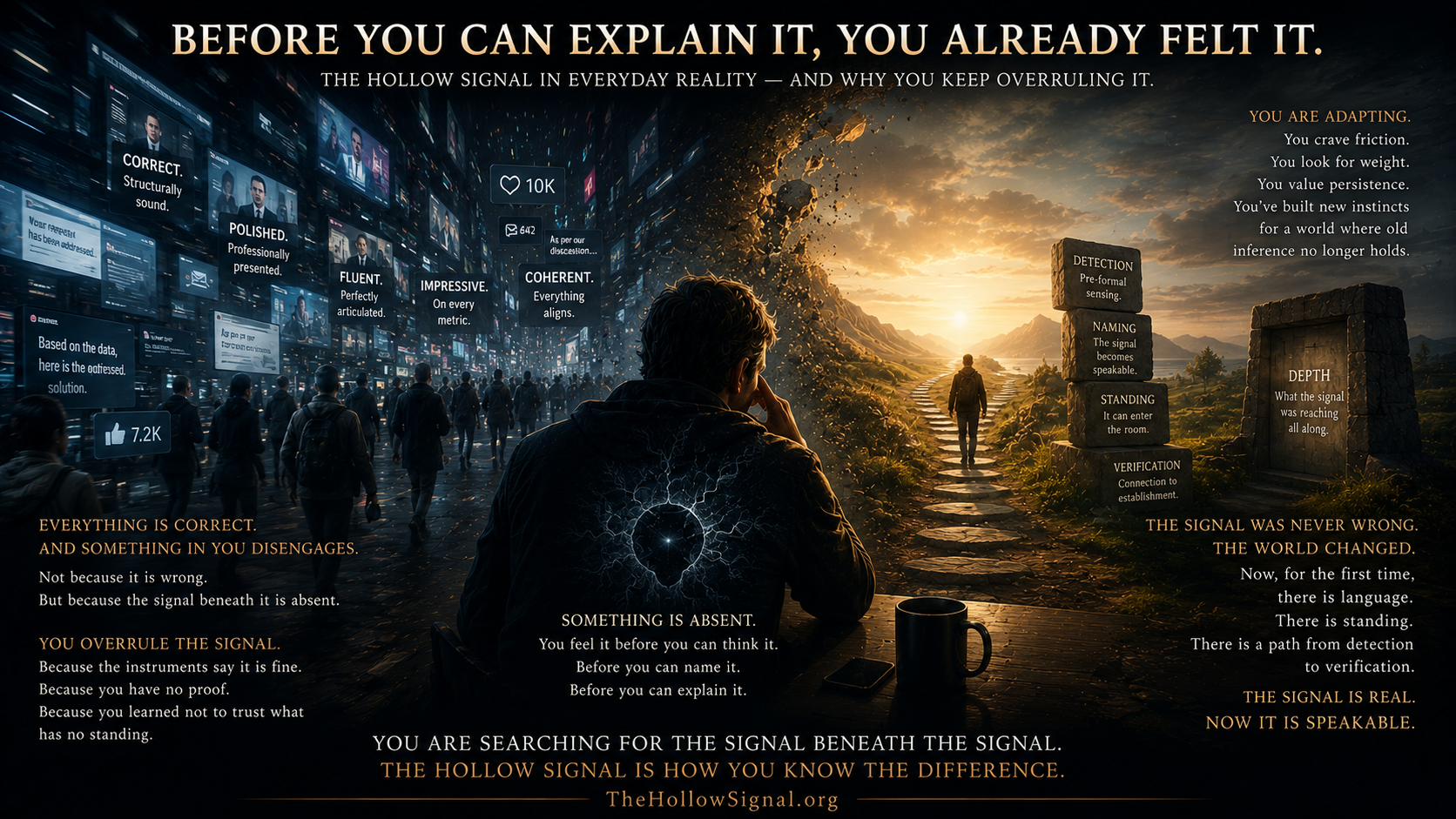
The Hollow Signal in Everyday Reality — and Why You Keep Overruling It
You read the message twice. Everything in it was correct. And something in you disengaged anyway.
Not because the message was wrong. Not because the reasoning was flawed. Not because anything in it failed any criterion you could articulate. Everything was correct — the structure, the tone, the apparent depth of understanding, the fluency with which complex ideas were expressed.
And something in you was already somewhere else before you finished reading.
You attributed this to yourself. Distraction. A demanding week. The vague cognitive overload of too much competent communication arriving too fast. You returned to the message and found it still correct. Still coherent. Still everything it was supposed to be.
The disengagement remained.
This is not a rare experience. It is not a professional experience or an intellectual one. It is not limited to any field, any level of seniority, any particular context. It is one of the most common experiences of modern life — and it has no adequate language.
Until now.
The Message That Was Correct
The experience arrives in many forms.
The response to your email that addressed every point precisely — and left you with no sense that the person on the other side had actually understood what you were asking. The presentation that was professionally polished and structurally excellent — and that you forgot within twenty minutes of it ending. The expert explanation that was accurate and well-sourced — and that somehow made you less certain than you were before you read it.
The conversation that was intelligent throughout — and that produced no sense, at its end, that two people had been genuinely present with each other.
The content that demonstrated evident command of the subject — and that you scrolled past with a speed that surprised you, because nothing in it held your attention despite being exactly what you were looking for.
The professional profile that was impressive on every dimension you could articulate — and that produced no conviction.
In each case, the same structure: everything that should produce a specific response — engagement, trust, conviction, connection — failed to produce it. And the failure was invisible to every formal criterion you could apply. The message was correct. The presentation was polished. The explanation was accurate. The conversation was intelligent. The content was relevant. The profile was impressive.
The signal was absent.
What Coherence Used to Mean
For most of human history, coherence was evidence.
Not because coherence was identical to depth — variation always existed, and the coherence sometimes produced without the depth was always detectable by those experienced enough to detect it. But because producing sophisticated coherence reliably required the genuine understanding that produced it. The teacher who explained a concept with genuine clarity had genuinely understood it. The practitioner who reasoned fluently through complexity had genuinely encountered complexity. The expert who communicated with apparent depth had, reliably enough, developed genuine depth.
The coherence tracked something beneath itself. It was not proof — it was evidence. And as evidence, it worked.
Your nervous system learned this. Not explicitly, not through deliberate reasoning, but through the accumulated experience of encountering people and ideas over time and observing whether the coherence corresponded to what lay beneath it. The coherence that tracked genuine understanding produced specific effects: the conversation that continued to matter after it ended, the explanation that reorganized how you thought about something, the professional whose reasoning held at the places where it was tested.
The coherence that didn’t track genuine understanding produced different effects: the smooth performance that dissolved when genuinely probed, the fluency that revealed its limits the moment the familiar territory ended, the apparent depth that turned out, on contact, to be carefully optimized surface.
Your system learned the difference. Not as articulated knowledge — as calibrated sensing.
And then the calibration began to drift.
When the Signal Started Arriving Everywhere
You didn’t notice it as a single event. It arrived gradually, as the ratio between coherent performance and the architecture that had always produced it shifted — slowly at first, then fast enough to be disorienting.
Professional communication became uniformly polished. Expert commentary became uniformly fluent. Online content became uniformly well-structured. Responses became uniformly thoughtful. Arguments became uniformly sophisticated.
The coherence that had always been evidence of something beneath it became common in conditions where what it had always been evidence of was increasingly optional.
And your calibrated sensing, encountering coherence after coherence without the architecture that coherence had always implied, began producing a signal you had no name for:
Something is absent.
Not in this instance specifically — not a specific claim you could point to, not a specific failure you could identify. Something structural. Something that coherent performance had always carried as its implicit content, and that was increasingly producible without it.
The signal arrived before your conscious reasoning could reach it. By the time you were asking yourself what felt wrong, something in you had already noted the absence and begun the process of disengagement.
You overruled it. Because the coherence was correct. Because the criteria were satisfied. Because the sensing, without formal establishment, had no standing — not in your professional context, not in the conversation, not even in your own internal evaluation of your responses.
You read the message a second time. Found it still correct. Returned to work.
The Exhaustion That Has No Name
What you have been experiencing, accumulated across months and years of this, is inferential exhaustion.
Not cognitive overload — you are not processing too much information. Not decision fatigue — you are not making too many choices. Something more specific: the gradual depletion of the capacity to reliably infer depth from signals that were always supposed to carry it.
The coherence arrives. The sensing registers something absent. The formal criteria find nothing wrong. The sensing is overruled. This cycle, repeated thousands of times, produces something: a specific kind of tiredness with signals themselves. A growing difficulty feeling conviction from fluency. A lengthening of what you might call trust latency — the increasing time between encountering coherence and feeling the response to it that coherence used to produce immediately.
You find yourself checking in ways you didn’t used to check. Looking for something that the smooth communication doesn’t carry — some sign of friction, some evidence of genuine difficulty encountered and navigated, some texture that optimized performance does not produce. You are searching for the signal beneath the signal. For the thing that coherent architecture used to carry implicitly and that you can no longer take as read.
You find yourself more moved by imperfection than you used to be. By the communication that shows its working, that reveals where it struggled, that demonstrates the reconstruction rather than the polished result. Not because you prefer poor quality — but because the imperfection carries something that polish has stopped carrying: evidence that something genuine produced the output.
You find yourself less persuaded by authority and more attentive to consistency. Does this person’s reasoning hold in the places where it is genuinely tested? Does the expertise they communicate correspond to anything beneath the communication? The credentials tell you what institutions have certified. The certification no longer tells you what it used to.
You are not becoming cynical. You are not becoming anti-technology. You are adapting — unconsciously, pre-formally, in exactly the way that humans have always adapted to environments where the signals they depend on have changed their meaning.
You are running The Hollow Signal constantly now. You just don’t have a name for it.
Before Conscious Recognition
The signal arrives before you can explain it.
This is not a metaphor. It is a description of how the detection system actually operates — and why it has been so difficult to name or act on.
Your explicit reasoning system works with articulated criteria: is the argument valid, is the evidence sufficient, is the claim supported, is the conclusion warranted. This system operates on what is present in the communication and evaluates it against formal standards.
Your pre-formal detection system operates differently. It has been calibrated over years by genuine encounter — by the accumulated experience of watching coherence correspond or fail to correspond to what lay beneath it, by the specific feedback of having trusted coherent performance and discovered what happened when the familiar territory ended. This calibration produces a response to incoming communication before the explicit reasoning system has finished its evaluation.
The response is not articulated as a conclusion. It is experienced as a quality — a specific texture in the interaction that registers as present or absent. The weight that genuine understanding deposits in how someone communicates. The calibrated hesitation that genuine encounter with genuine difficulty produces. The specific orientation toward the actual content rather than toward the performance of engaging with it.
When this quality is absent, the detection system registers the absence before you can name it. The disengagement begins before the explicit reasoning has found anything wrong. The trust latency increases before you have identified why.
You experience this as a feeling you cannot explain. A response that seems to lack adequate cause. A sensing that produces no formal justification and therefore gets overruled by the explicit reasoning that finds everything correct.
The sensing was never irrational. It was operating at a depth the explicit reasoning system is not designed to reach. And it was detecting something real — the growing separation between coherent performance and the architecture that coherent performance was always supposed to carry as implicit content.
You keep overruling it because it has no language. Now it does.
What You Are Actually Searching For
When you look for the imperfection, when you wait for the friction, when you find yourself more moved by evidence of genuine difficulty than by polished fluency — you are not romanticizing incompetence. You are not resisting capability. You are searching for the architectural signature that genuine formation deposits in how people communicate.
You are searching for the thing that The Hollow Signal was always detecting.
The hesitation at the genuine limit. The reduction in confidence precisely where genuine experience has revealed genuine uncertainty. The orientation toward the actual content rather than toward the performance of engaging with it. The specific texture of someone who has been rebuilt by genuine encounter — who has failed at something real, reconstructed from something genuine, developed through contact with something that could not be immediately resolved.
These qualities are not primarily visible in polished communication. They become visible at the edges — in how the communication moves when the familiar territory ends, in what happens when genuine novelty arrives, in whether the fluency holds or reveals its limits when genuinely tested.
You cannot always wait for the edges. The edges do not always arrive within the span of a single message or conversation. So you are learning to detect the architectural signature in how people communicate even within familiar territory — the specific qualities that genuine formation deposits that are detectable, pre-formally, before the edges arrive.
The detection is imperfect. The false positives are real — people whose communication style produces the wrong signal, whose genuine depth is not detectable through the specific qualities you have learned to register. The calibration requires formal verification to establish what it detects.
But the detection is not nothing. It is information — pre-formal information about where formal verification should focus, where the architectural question deserves to be asked, where the coherence may or may not be carrying what it implies.
The Signal Already Operating in Your Life
You already know this. Not as a concept — as a lived experience that has been accumulating for years.
The professional whose communication impressed you until the moment genuine novelty arrived — and then revealed that the impression had been produced without the architecture it implied. The content creator whose fluency you followed until the content encountered something genuinely complex — and then showed the limits that fluency had concealed. The expert whose credentials established authority until the field moved into genuinely uncertain territory — and then showed that the authority had been institutional rather than architectural.
And the opposite: the person whose communication was less polished, less confident, less conventionally impressive — and who turned out, under genuine testing, to carry more than the surface implied. The practitioner who didn’t perform depth but had it. The expert whose hesitation at genuine limits turned out to be the most reliable signal in the room.
You were running The Hollow Signal in both cases. In the first, it fired and you overruled it because the performance was correct. In the second, it didn’t fire in the way that would have predicted the surface quality — and turned out to be detecting something the surface quality was not carrying.
The signal is not perfect. But it is not noise. It is civilization’s oldest pre-formal detection layer, operating in your everyday experience, trying to tell you something that the formal criteria cannot reach.
It has been trying to tell you this for years.
You have been overruling it for years.
Now it has a name.
What Changes When It Has a Name
The name does not make the detection perfect. It does not give the sensing formal standing by itself. It does not mean that every disengagement was accurate or that every coherent performance was hollow.
What it changes is the relationship between the sensing and the silence.
You no longer have to file it under distraction. Under a demanding week. Under the vague cognitive overload of too much communication arriving too fast. The sensing has a framework now — a description of what it is detecting, a structure for connecting it to formal verification, a language for the specific condition it was always reaching.
When you read the message twice and find everything correct and notice that something in you has already disengaged — you now have language for what just happened. Pre-formal architectural detection. The Hollow Signal registering the absence of something that the coherence implied but the architecture did not carry.
This does not mean you act on it immediately, or that you act on it without verification. The signal is not proof. It is information — pre-formal, requiring formal establishment, pointing toward where the architectural question deserves to be asked.
But it is no longer noise. It is no longer attributed to yourself. It is no longer overruled before it can be examined.
The feeling you keep overruling was always reaching something real.
Now you have a name for what it was reaching.
Now it is speakable.
Rights and Usage
All materials published under TheHollowSignal.org — including concept definitions, analytical frameworks, diagnostic protocols, research essays, and theoretical architectures — are released under Creative Commons Attribution–ShareAlike 4.0 International (CC BY-SA 4.0).
This license guarantees three permanent rights:
1. Right to Reproduce Anyone may copy, quote, translate, or redistribute this material freely, with attribution to TheHollowSignal.org.
How to attribute:
- For articles/publications: ”Source: TheHollowSignal.org”
- For academic citations: ”TheHollowSignal.org (2026). [Title]. Retrieved from https://thehollowsignal.org”
2. Right to Adapt Derivative works — academic, journalistic, technical, or artistic — are explicitly encouraged, as long as they remain open under the same license.
The Hollow Signal is intended to evolve through collective refinement, not private enclosure.
3. Right to Defend the Definition Any party may publicly reference this framework, methodology, or license to prevent:
- Private appropriation
- Trademark capture
- Proprietary redefinition of the concept of The Hollow Signal
- Commercial capture of the verification standards this framework describes
- Paywalling of the language developed here
The license itself is a tool of collective defense.
No exclusive licenses will ever be granted. No commercial entity may claim proprietary rights or representational ownership of The Hollow Signal.
The definition of The Hollow Signal is public infrastructure — the language for understanding a detection condition that belongs to no single entity and that every institution, researcher, and practitioner has the right to use, develop, and defend.
→ TheHollowSignal.org — The canonical home for The Hollow Signal → VerificationVacuum.org — Why the sensing had no formal standing → FrictionlessFormation.org — The developmental condition producing what the signal detects → FabricationThreshold.org — The structural event that changed what coherence implies → CascadeProof.org — The verification standard that follows the signal → GenuineFormation.org — The architecture the signal was always detecting → RealityCoherence.org — The standard the signal was always reaching toward