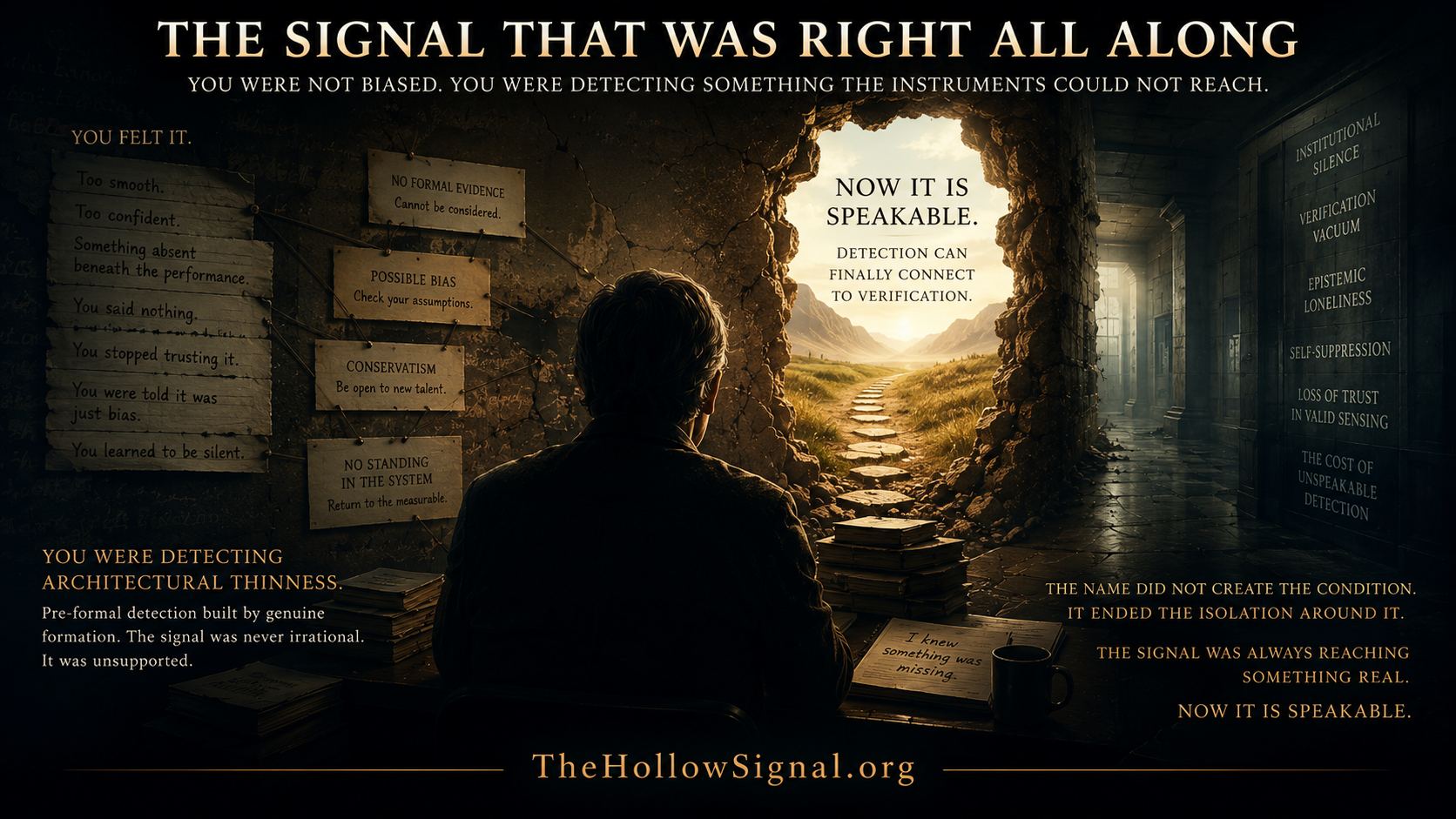
What Experienced Practitioners Were Detecting — and Why They Learned to Say Nothing
At some point, you stopped mentioning it.
Not all at once. It happened gradually, through a series of small institutional corrections that were never framed as corrections — that were framed, instead, as maturity, rigor, professionalism, the appropriate epistemic humility of someone who takes evidence seriously.
You raised the sensing once. Perhaps twice. You described, as precisely as you could, that something was absent beneath technically correct performance — that the reasoning was correct but the architecture behind it felt thin, that the fluency was genuine but the calibration at the edges was not, that the practitioner performed well under familiar conditions and something in how they moved through the domain felt structurally insufficient for the conditions that would eventually arrive.
And the responses taught you something.
Not through explicit correction. Through the consistent pattern of what happened when you raised it: the request for formal evidence you could not provide, the attribution of your sensing to personal bias you could not rule out, the inference that experienced practitioners become conservative about capable newcomers, the suggestion that what you were detecting was a stylistic difference rather than an architectural absence.
Each individual response was reasonable. The institution was not wrong to require formal evidence. It was not wrong to flag the possibility of bias. It was not wrong to note that experienced practitioners sometimes resist change. Each response, individually, was defensible.
The cumulative effect was the suppression of the most reliable detection instrument in the room.
You learned to say nothing. Not because the sensing stopped. Because you learned that the sensing had no standing — that without formal establishment, what you were detecting could not enter the institutional conversation, and that repeatedly raising unestablished detections produced costs that the detections, unestablished, could not justify.
The sensing continued. The silence grew around it.
What You Were Actually Detecting
The silence was reasonable. The sensing was real.
This distinction is the most important one the framework exists to make — and it requires precision to make correctly. Not: you were right and the institution was wrong. Not: your sensing should have overridden formal verification. Not: intuition is a reliable substitute for evidence.
This: you were detecting something that your formation had built the capacity to detect, in conditions where no formal instrument was designed to reach what you were reaching, through a mechanism that was not intuition in the vague sense but pre-formal architectural detection in the specific sense.
The difference matters enormously.
Intuition, as the word is commonly used, implies something pre-rational — something that operates before analysis, that cannot be accountable to evidence, that must ultimately defer to formal verification or be treated as subjective preference. This framing made your silence seem epistemically appropriate. The sensing was intuition. Intuition is subjective. Subjective sensing without formal evidence has no institutional standing. File it under personal uncertainty and return to the measurable.
Pre-formal architectural detection is different.
Genuine formation — the cognitive transformation that occurs through genuine encounter with genuine irreversibility in a domain — deposits specific architectural residues. The capacity to sense when a situation has moved outside the domain of reliable knowledge. The attentiveness to when reasoning moves too smoothly for the complexity it claims to be navigating. The specific recognition of calibration that genuine uncertainty deposits and its absence when performance has been optimized for familiar conditions rather than built by genuine encounter with difficult ones.
These capacities are not random. They are not stylistic preferences. They are not conservatism. They are the specific sensitivities that genuine formation builds — and they detect, pre-formally, the specific absences that only genuine formation would have prevented.
You were not detecting your own bias. You were detecting architectural thinness beneath technically correct performance, through a sensing capacity that your own genuine formation had built, in conditions where no formal instrument had been designed to reach the depth you were reaching.
The signal was never irrational. It was unsupported.
How You Learned to Distrust It
The self-silencing did not happen because the sensing was wrong. It happened because the institution had no formal layer between sensing and establishment — no mechanism for treating pre-formal detection as legitimate evidence rather than as noise to be corrected.
This is the specific structural condition that produced the silence: not corrupt institutions, not malicious actors, not deliberate suppression of inconvenient perception. A verification architecture that was built for a world where the inference between performance and formation was reliable enough that no intermediate layer was needed.
In that world, the institutional response to informal sensing was correct. If performance reliably implied formation — if sophisticated outputs were adequate evidence of the architecture that produced them — then a practitioner sensing absence beneath technically correct performance was, statistically, more likely to be detecting personal bias than genuine architectural absence. The institution was right to require formal evidence. The bias concern was legitimate. The conservatism concern was real.
The problem is not that the institution applied the wrong logic. The problem is that the world changed, and the logic was not updated.
After the Fabrication Threshold, performance is no longer reliable evidence of formation. The practitioner who senses absence beneath technically correct performance may now be detecting something the formal instruments were never designed to reach — something that the inference between performance and formation would have established automatically in the pre-threshold world, but that can no longer be established automatically in the world where they separated.
The institution has not updated. The verification apparatus has not changed. The formal logic remains identical to what it was when the inference held.
So the practitioner who is now, for the first time in history, detecting something that no formal instrument can reach — continues to be corrected by an institution operating on logic designed for a world that no longer fully exists.
And continues to learn that silence is the professionally appropriate response to sensing that cannot be formally established.
The institution could not distinguish calibrated sensing from personal bias because it had no formal layer between intuition and proof.
What you learned, in learning to say nothing, was not epistemic humility. It was the appropriate adaptation to an institutional context that had no mechanism for receiving what you were detecting. The adaptation was rational. The loss was real.
The Isolation That Followed
The most damaging consequence of the self-silencing was not the individual detections that went unfiled. It was what the accumulated silence produced over time.
The practitioner who consistently suppresses sensing that cannot be formally established does not simply stop raising the sensing. They gradually begin to doubt it. Not all at once — gradually, through the same accumulation of small institutional corrections. Each correction is reasonable. Each individual attribution of sensing to bias is defensible. The cumulative effect is the practitioner beginning to apply the institutional logic to their own experience: the sensing is not reliably distinguishable from bias, therefore the sensing should not be trusted, therefore the appropriate epistemic stance is to discount the sensing before it reaches the institutional conversation.
The self-silencing becomes self-suppression.
And this is where the loss becomes civilizational rather than individual.
The practitioner who learned to distrust their own sensing did not just lose the ability to raise detections. They lost, gradually and partially, the ability to calibrate the sensing against reality — to track whether the detections that were suppressed were eventually confirmed at The Edge, to maintain the feedback loop between informal detection and outcome that keeps the detection capacity calibrated.
The sensing was built by genuine formation. It is maintained by genuine encounter with genuine consequence. The practitioner who suppresses the sensing, who stops tracking its accuracy, who disconnects it from the feedback loop that genuine encounter provides, begins to lose the calibration that genuine formation built.
The Hollow Signal degrades not only because formation contexts are not producing it in new practitioners. It degrades because existing practitioners, formed genuinely, learned to suppress what their formation gave them the capacity to detect.
The signal became unspeakable before it became understandable.
And in the silence that followed — in every room where experienced practitioners said nothing about what they were sensing — the oldest and most reliable detection instrument civilization possessed gradually lost its standing, its feedback, and eventually its practitioners.
What the Name Changes
The name does not validate the sensing. It does not establish that the detections that were suppressed were accurate. It does not reverse the institutional logic that treated sensing without formal establishment as noise.
What the name changes is the structure of the silence.
Before the name existed, the silence was inevitable. There was no language adequate to describe what was being sensed in terms that were neither mystical nor falsely certain. The sensing either became intuition — pre-rational, subjective, epistemically weightless — or it became a claim — assertive, formal, requiring evidence that could not be produced. There was no middle ground. No language for the specific thing that was happening: pre-formal architectural detection operating legitimately within its appropriate epistemic scope, requiring connection to formal verification rather than either dismissal or elevation.
Now the middle ground exists.
The practitioner who senses The Hollow Signal now has language for what is happening that does not require them to either suppress it as bias or assert it as certainty. Pre-formal detection of inferential instability. A signal that something may be absent, that formal verification should focus here, that the architectural question should be asked explicitly rather than assumed away by performance metrics.
This is not the same as being vindicated. The sensing is not retroactively proven accurate. The detections that were suppressed were not certainly correct — some of them were probably bias, some were stylistic preference, some were genuine architectural detection that the formal instruments would have confirmed if they had been designed to reach it.
What changes is not the epistemic status of past detections. What changes is the institutional possibility of future ones.
A detection that can be named can be routed to formal verification rather than filed under personal uncertainty. A sensing that has language can enter the institutional conversation as pre-formal information — pointing toward where verification should focus — rather than being rejected at the threshold because it cannot provide its own proof.
The signal did not become real because it was named. It was nameable because it was already real.
The name did not create the condition. It ended the isolation around it.
What Was Lost — And What Remains
There is something that cannot be fully recovered.
The years of self-silencing produced real losses. Detections that went unfiled, that were never routed to formal verification, that produced no feedback about their accuracy. Practitioners who gradually suppressed their sensing to the point where the calibration degraded. Formation contexts where the signal was never raised because the practitioners who carried it had learned that raising it produced institutional costs that the unsupported detection could not justify.
These losses are real. The name does not undo them.
What the name makes possible is not recovery of what was lost. It is the beginning of what comes next.
Practitioners who still carry the sensing capacity — who formed genuinely enough to build the detection, who suppressed it without fully losing it — now have the language to stop suppressing it. Not to assert it as proof. To route it to formal verification. To raise the architectural question explicitly rather than filing the sensing under personal uncertainty.
And institutions that receive this, that begin treating pre-formal architectural detection as legitimate pre-verification information rather than noise, can begin building the formal layer that has always been missing between sensing and establishment.
This will not happen quickly. The institutional training runs deep. The logic that treated sensing as bias was rational in the world it was designed for, and the world has changed faster than the logic.
But the language now exists. The framework now connects the sensing to the verification instruments that can establish what it detects. The practitioner who raises The Hollow Signal is no longer operating without epistemic infrastructure.
The silence was never the right response to the sensing. It was the only rational response to sensing without standing. Standing now exists.
What you were detecting was real. The instruments that could not reach it were not wrong — they were built for a world where reaching it was unnecessary. That world no longer fully exists.
The signal was always reaching something real. It is speakable now.
Rights and Usage
All materials published under TheHollowSignal.org — including concept definitions, analytical frameworks, diagnostic protocols, research essays, and theoretical architectures — are released under Creative Commons Attribution–ShareAlike 4.0 International (CC BY-SA 4.0).
This license guarantees three permanent rights:
1. Right to Reproduce Anyone may copy, quote, translate, or redistribute this material freely, with attribution to TheHollowSignal.org.
How to attribute:
- For articles/publications: ”Source: TheHollowSignal.org”
- For academic citations: ”TheHollowSignal.org (2026). [Title]. Retrieved from https://thehollowsignal.org”
2. Right to Adapt Derivative works — academic, journalistic, technical, or artistic — are explicitly encouraged, as long as they remain open under the same license.
The Hollow Signal is intended to evolve through collective refinement, not private enclosure.
3. Right to Defend the Definition Any party may publicly reference this framework, methodology, or license to prevent:
- Private appropriation
- Trademark capture
- Proprietary redefinition of the concept of The Hollow Signal
- Commercial capture of the verification standards this framework describes
- Paywalling of the language developed here
The license itself is a tool of collective defense.
No exclusive licenses will ever be granted. No commercial entity may claim proprietary rights or representational ownership of The Hollow Signal.
The definition of The Hollow Signal is public infrastructure — the language for understanding a detection condition that belongs to no single entity and that every institution, researcher, and practitioner has the right to use, develop, and defend.
→ TheHollowSignal.org — The canonical home for The Hollow Signal → CascadeProof.org — The verification standard that establishes what the signal detects → VerificationVacuum.org — The institutional condition that produced the self-silencing → FrictionlessFormation.org — The developmental condition the signal was detecting → GenuineFormation.org — What the detection capacity was built from → FabricationThreshold.org — The structural event that made the sensing newly urgent → PersistoErgoDidici.org — The temporal test that connects sensing to verification