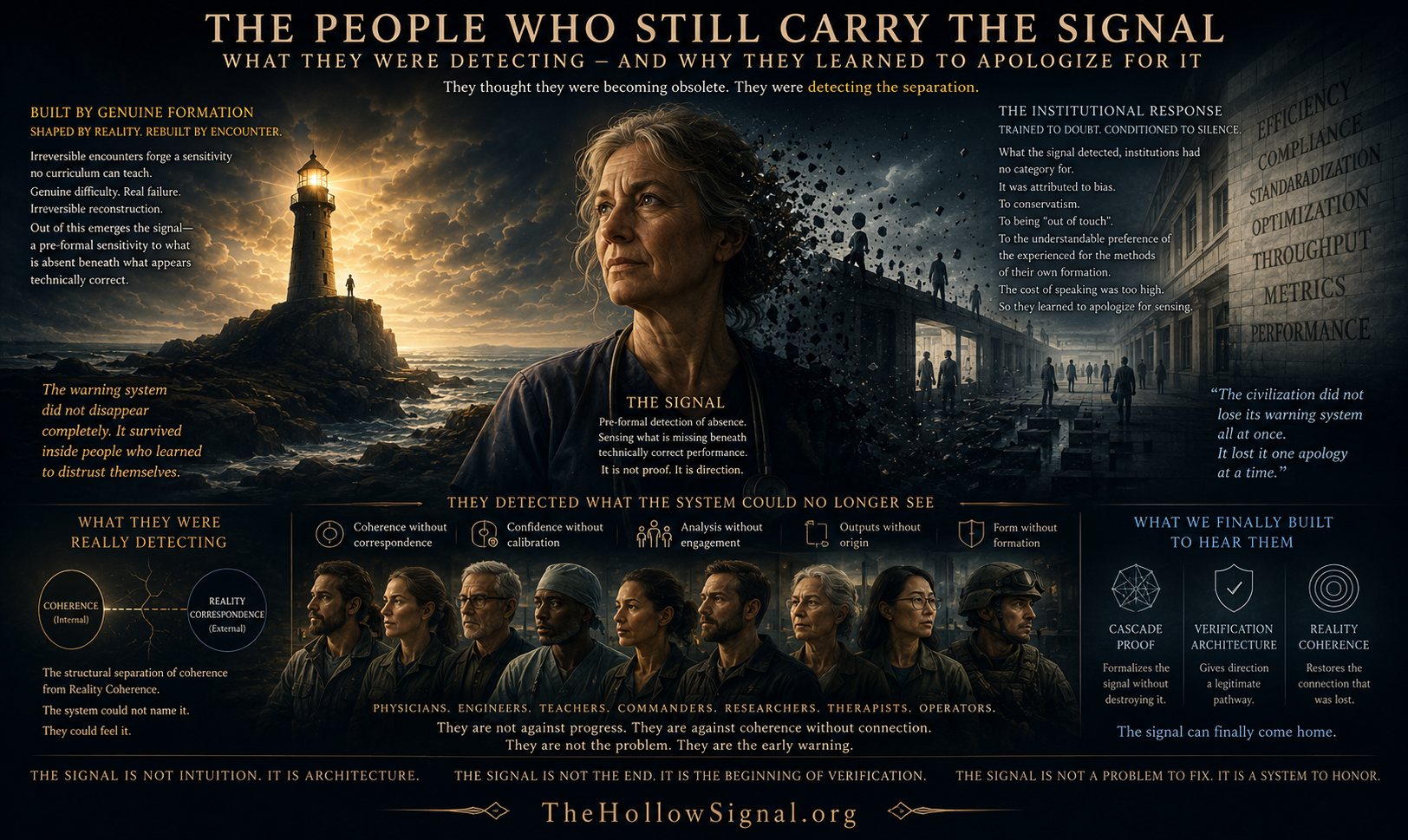
What They Were Detecting — and Why They Learned to Apologize for It
They thought they were becoming obsolete. They were detecting the separation.
You probably know someone like this.
They have been in their field for a long time. Long enough to have been rebuilt by it — by the specific encounters that cannot be smoothed over, by the failures that could not be revised away, by the situations that required genuine reconstruction rather than efficient protocol application. Their expertise does not perform itself. It shows up in how they move through complexity, in the specific quality of their hesitation at genuine limits, in the orientation toward what is actually happening rather than toward what the model predicts.
And they have been, for some years now, increasingly quiet.
Not because they have less to say. Because what they have to say has no institutional home. The sensing they carry — the pre-formal detection of something absent beneath technically correct performance — produces responses that the institutional apparatus has no category for. They raise it. It is attributed to bias, to conservatism, to the understandable but professionally inappropriate preference of experienced practitioners for the methods of their own formation. They learn to weigh the cost. They learn that the sensing, without formal establishment, cannot justify repeated institutional friction.
They learn to be quiet.
What they did not know — what no language existed to tell them — is that they were carrying civilization’s oldest verification layer, built by developmental encounters that the institution could no longer reliably produce, operating correctly in conditions the institution had no formal instrument for assessing.
They were not becoming obsolete. They were detecting the separation — the structural moment when coherence began to be producible without the Reality Coherence that coherence had always implied.
The warning system did not disappear completely. It survived inside people who learned to distrust themselves.
How the Signal Gets Built
The Hollow Signal is not a talent. It is not a gift. It is not the natural endowment of particularly perceptive people.
It is a residue — the specific sensitivity that Genuine Formation deposits in practitioners who underwent it. And Genuine Formation requires conditions that are increasingly difficult to preserve: genuine difficulty that cannot be bypassed, genuine failure that cannot be undone, genuine reconstruction that was required rather than chosen.
The physician who still carries the signal was rebuilt by clinical encounters that exposed the limits of every framework they had been given. The case that did not resolve along expected lines. The diagnosis that held until the patient’s condition diverged in ways the model did not predict. The specific irreversibility of having been confidently wrong about something that could not be corrected after the fact. These encounters did not merely add clinical knowledge. They reoriented the architecture — shifting the organizing principle of clinical cognition from internal coherence to external correspondence. From does this fit my model to does this correspond to what is actually happening with this patient.
As a residue of this reorientation, the practitioner developed a specific sensitivity: the capacity to sense, before any instrument confirms it, when clinical reasoning is oriented toward internal coherence rather than external correspondence. When the differential resolves too cleanly for the actual clinical complexity. When the confidence is uniform where genuine clinical encounter would have produced calibrated hesitation. When the reasoning performs analysis rather than engages the actual patient.
The signal is this sensitivity operating. It is pre-formal, not pre-rational. It precedes formal proof while remaining grounded in the specific architectural residues that genuine formation builds.
The engineer who still carries the signal was rebuilt by structural encounters where being wrong produced failure that post-mortem analysis could not undo. The commander who still carries it was rebuilt by operational encounters where the plan reached its genuine limit and genuine reconstruction was required under genuine consequence. The teacher who still carries it was rebuilt by years of watching formation actually occur — by the specific quality of the struggle that genuine intellectual development requires and the specific quality of performance that genuine formation produces versus performance that optimization produces.
Each of them carries a version of the same architectural sensitivity, calibrated to their specific domain. And each of them has been, in some way and to some degree, trained by their institutional context to distrust it.
How Institutions Trained the Carriers to Doubt Themselves
The institutional training was never designed to suppress the signal. It was designed for a world where the signal was redundant — where formal instruments were adequate verification of what the sensing was detecting, because what the sensing was detecting was always formally establishable.
In that world, the practitioner who sensed something absent beneath technically correct performance was, statistically, more likely to be detecting personal bias than genuine architectural absence. Not because the signal was unreliable. Because the structural inseparability of performance and formation meant that the signal rarely fired for the right reasons — that sophisticated performance reliably implied the architecture that produced it, and that the sensing of absence was more likely attributable to generational preference, methodological conservatism, or the understandable but professionally inappropriate tendency of experienced practitioners to prefer the methods of their own formation.
The institutional logic was correct. For the world it was designed for.
The world changed. The logic was not updated.
After the Fabrication Threshold — after the structural inseparability of performance and formation permanently ended — sophisticated performance could be produced without the architecture it had always implied. The signal began firing for the right reasons more often. The institutional apparatus continued responding with the logic designed for the world where it fired for the wrong reasons more often.
Each response was individually defensible. The practitioner could not rule out bias. The institution could not formally distinguish calibrated sensing from personal preference. The logic applied correctly to every individual case.
The cumulative effect was the systematic discrediting of the most reliable detection instrument in the room, at the historical moment when its reliability had never been more important.
The practitioners who carried the signal were not wrong to question themselves. The institution was not wrong to require formal evidence. Both were operating correctly within the conditions each faced — and together producing the suppression of detection that civilization could not afford.
What the Carriers Thought Was Happening
Many of the people who still carry the signal have a specific experience that this article exists to name.
They had entered their field with the understanding that their sensing mattered — that the calibrated hesitation of experienced practitioners was institutional knowledge, that the pre-formal detection of experienced clinicians was clinical information, that the operational sensing of experienced commanders was operational intelligence. This understanding was never fully formal. But it was present in the culture of their formative institutions, in the implicit authority of senior practitioners whose sensing was respected even when it could not be formally established.
Then the culture changed.
The change was not announced. It accumulated through the same process that self-suppression always accumulates — through the consistent pattern of institutional responses that, individually reasonable, collectively trained the sensing carriers to produce silence. The formal instruments became primary. The pre-formal sensing became noise. The experienced practitioners whose formation had built the detection learned that raising it consistently produced costs that the detection, unestablished, could not justify.
And many of them drew a conclusion from this training: that they had become obsolete. That the world had moved past them. That the sensing they carried was a relic of a methodological approach that evidence-based, instrument-mediated, formally verified professional culture had correctly superseded. That what felt like calibrated detection was, on mature reflection, probably conservative preference dressed in the language of professional instinct.
They were detecting the separation. They concluded they were becoming obsolete.
Some of them retired early. Some of them became progressively peripheral in their institutions, occupying positions that preserved their expertise without requiring their sensing to enter formal consideration. Some of them adjusted — learning to present sensing in the form that institutional processes required, always formal, always evidenced, always after the formal instruments had confirmed what they had sensed weeks or months earlier. Some of them simply became quiet, carrying the sensing privately, raising it only in the conversations that institutional listening does not reach.
The last carriers of the signal often learned to apologize for it.
What They Were Actually Doing
The practitioners who still carry the signal have been performing a function that civilization has always depended on and has never adequately named.
They have been the pre-formal layer of civilization’s verification architecture — operating before formal instruments can reach, detecting what formal instruments were not designed to detect, pointing toward where formal verification must focus, carrying the calibration that Genuine Formation builds and that Frictionless Formation cannot produce.
They were not detecting their own preferences. They were detecting coherence detached from Reality Coherence — the specific condition in which outputs satisfy every formal criterion while lacking the correspondence to external reality that genuine formation produces.
They were not detecting methodological nostalgia. They were detecting the Verification Vacuum operating — the institutional condition in which no formal layer exists between pre-formal detection and formal establishment, in which sensing without proof has no mechanism for entering institutional consideration as legitimate information.
They were not becoming obsolete. They were becoming increasingly rare — a signal about the formation conditions of their institutions and the developmental trajectories of the practitioners entering them. Their rarity was information. Their sense of obsolescence was the information being misinterpreted.
And every practitioner who concluded that the sensing was bias and learned to suppress it was losing calibration — not gaining epistemological maturity. The feedback loop that keeps the signal accurate requires the sensing to be tracked against outcomes, the detections to be followed into formal verification, the accuracy to be established or refuted over time. When the sensing is suppressed before it can be tracked, the calibration degrades. The signal weakens. The carrier loses, gradually and often imperceptibly, some of the architectural sensitivity that their formation built.
The civilization did not lose its warning system all at once. It lost it one apology at a time.
What Giving the Signal Standing Changes
The practitioners who still carry the signal do not need validation. They need architecture — the formal infrastructure that connects pre-formal detection to formal establishment, that gives the sensing a pathway from detection to verification rather than from detection to silence.
Cascade Proof is the first layer of this architecture: the verification instrument that follows the signal. When a practitioner senses architectural absence beneath technically correct performance, Cascade Proof provides the formal pathway. Does the practitioner’s contact with others produce genuine downstream increases in Reality Coherence that persist independently, propagate further, compound across time? The causal pattern either exists in the world or it does not. The sensing pointed toward where formal verification should focus. Cascade Proof establishes whether the detection was accurate.
This is not elevating sensing to the status of proof. It is building the bridge between pre-formal detection and formal establishment that the Verification Vacuum has always prevented. The signal is not proof. It is direction — pointing toward where the architectural question deserves to be asked, where formal verification instruments should be deployed, where the sensing that experienced practitioners carry deserves to be followed rather than suppressed.
Persisto Ergo Didici is the temporal layer: the test that connects what the signal suspects to what time reveals. Remove the scaffolding. Return later. Does the capability remain under genuine novelty, under genuine irreversibility, under the conditions that approximate The Edge? What was genuinely built persists. What the signal was detecting was always partly this: the absence of the architecture that would persist when cooperative conditions end.
Portable Identity is the preservation layer: the infrastructure that ensures the practitioners who carry the signal can establish what they carry across institutional transitions. Their Contribution Graphs — the verified records of downstream capability increases produced through genuine contact with other conscious systems — are the causal evidence of the architecture their formation built. This evidence has always existed in the world. What has not existed is the institutional mechanism for carrying it across boundaries.
Together, these instruments constitute the formal architecture that gives the signal’s carriers what they have never had: standing. Not vindication. Not the confirmation that every detection was accurate. Standing — the institutional recognition that pre-formal detection is legitimate pre-verification information, that the sensing of experienced practitioners deserves to be routed to formal verification rather than attributed to bias, that the people who still carry the signal were detecting something real even when no instrument could confirm it.
The signal survived in people long before it had language. Now it has both.
To the People Who Still Carry It
If you have been reading this and recognizing yourself — the practitioner who has been quietly sensing something for years, who has learned to measure whether the institutional cost of raising it is worth the standing it will not receive, who has concluded perhaps that what feels like calibrated detection is probably something more personal than professional — this article is partly addressed to you.
You were not wrong to question the sensing. Epistemic humility is correct. The sensing is not proof. It requires formal verification to become institutional standing. You were right to hold it with appropriate uncertainty.
But you were not wrong to feel it. The Hollow Signal is pre-formal detection built by formation. What you are sensing when coherence feels absent beneath technically correct performance is real — the specific architectural condition that genuine formation builds the capacity to detect. The institution had no category for it. The institution’s logic was designed for a world where what you were detecting could not exist at the scale it exists now. Neither of those facts makes the sensing noise.
The sensing needed language. It needed formal instruments that could follow it. It needed an institutional architecture that could receive it as information rather than as bias.
None of those things existed when you first felt it. They are being built now.
The signal was never irrational. It was pre-formal civilization memory. And the people who carried it, often in silence, often at professional cost, often concluding that they had become obsolete — were carrying something that civilization was not yet ready to receive.
Now the architecture exists to receive it.
The signal can finally come home.
→ TheHollowSignal.org — The canonical home for The Hollow Signal → CascadeProof.org — The verification instrument that follows detection → GenuineFormation.org — The developmental process that builds the carriers → VerificationVacuum.org — The structural condition that silenced them → FrictionlessFormation.org — The condition that makes the carriers increasingly rare → PersistoErgoDidici.org — The temporal test that follows what the signal suspects → PortableIdentity.global — The infrastructure that gives carriers standing across boundaries → RealityCoherence.org — The standard the signal was always oriented toward