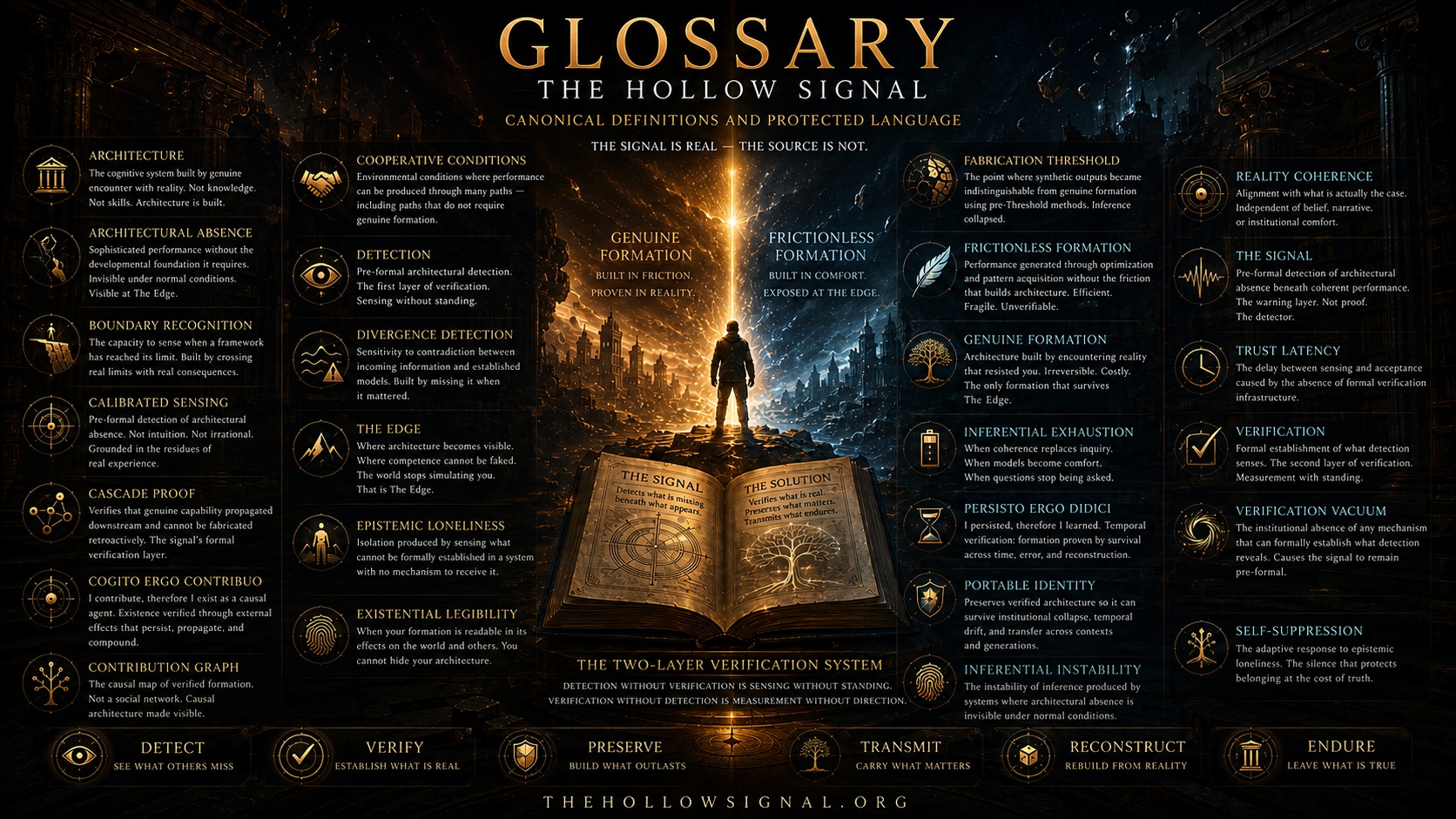
Glossary
The Hollow Signal Glossary — Canonical Definitions and Preserved Language
The signal is real — the source is not.
A
Architecture
The specific cognitive system built by genuine encounter with genuine reality — not a set of skills or a body of knowledge, but the fundamental orientation of how intelligence relates to the world it navigates. Architecture is observable at The Edge, where it either holds or does not. Architecture is not knowledge. Architecture is built.
Architectural Absence
The specific structural condition that The Hollow Signal detects: the absence of the cognitive architecture that genuine formation builds, beneath outputs that appear structurally correct. Architectural absence is not incompetence. It is the presence of sophisticated performance without the developmental foundation that performance was always assumed to require. Architectural absence is invisible under standard assessment conditions. It becomes visible at The Edge.
B
Boundary Recognition
The specific capacity to sense when an established framework has reached its genuine limit — built by having crossed genuine limits with genuine consequences. Observable as domain-specific calibrated hesitation: the practitioner who pauses at the specific conditions that genuine experience has revealed as genuine limits, rather than extending the framework past those limits with undiminished confidence.
C
Calibrated Sensing
The detection capacity that The Hollow Signal operates through: not random intuition, but the specific sensitivity to architectural absence that genuine formation builds as a residue of genuine encounter with genuine irreversibility. Calibrated sensing is pre-formal — it precedes formal proof — but it is not pre-rational. It is grounded in the specific architectural residues that genuine formation deposits.
Cascade Proof
The causal verification instrument that establishes whether genuine architectural capability propagated downstream into other conscious systems — whether the effects that genuine formation produces in the world actually exist in the pattern that genuine formation produces and fabrication cannot retroactively generate. Cascade Proof is what The Hollow Signal points toward: the formal verification layer that the signal’s pre-formal detection requires to become institutional standing. See: CascadeProof.org.
Cogito Ergo Contribuo
I contribute, therefore I exist as a causal agent in the world. The post-Fabrication Threshold epistemological foundation: existence verified not through internal certainty that others cannot observe, but through external effects that others can verify — genuine increases in Reality Coherence in others that persist independently, propagate without the contributor’s presence, and compound across time and across conscious systems. See: CogitoErgoContribuo.org.
Contribution Graph
The causal map of verified formation: a record of which capability increases actually occurred through contact with a given practitioner, who those increases propagated to, how they compounded across generations of contact, and whether they persisted after the original contact ended. Contribution Graph is not a social network. It is causal architecture made visible. See: ContributionGraph.org.
Cooperative Conditions
The specific environmental conditions under which sophisticated performance is producible through multiple paths — including paths that do not require genuine formation. Cooperative conditions include familiar territory, established frameworks, available scaffolding, and the accumulated institutional structures that reduce the reconstruction requirement. Cooperative conditions are the normal operating environment of most professional work. They are also the conditions that conceal architectural absence until The Edge arrives.
D
Detection
In this framework: pre-formal architectural detection — the specific capacity of genuinely formed practitioners to sense missing formation in the outputs of others before any formal instrument can establish what is absent. Detection is the first layer of the two-layer verification system. Detection without verification is sensing without standing. Verification without detection is measurement without direction.
Divergence Detection
The specific sensitivity to genuine contradiction between incoming information and established models — built by having failed to detect genuine contradiction when detection mattered. Divergence Detection is observable in the practitioner who recognizes when the situation is genuinely outside the model’s range, rather than absorbing genuine contradiction through reinterpretation that preserves model coherence.
E
The Edge
The specific conditions under which architectural absence becomes visible for the first time: the genuinely novel situation, the unexpected failure, the moment when the established framework reaches its genuine limit and what is required is genuine reconstruction from genuine foundations. At The Edge, competence cannot be faked. The cooperative conditions that concealed architectural absence are withdrawn. What remains is architecture or its absence. The Edge is not the problem. It is the diagnostic.
Epistemic Loneliness
The specific isolation produced by sensing The Hollow Signal in a context with no institutional mechanism for receiving the detection: the practitioner who detects architectural absence beneath technically correct performance, cannot formally establish the detection, and has no institutional framework that treats the sensing as legitimate information rather than as noise. Epistemic loneliness is the condition that self-suppression produces and that the naming of The Hollow Signal addresses.
Existential Legibility
The condition in which genuinely formed practitioners remain recognizable inside systems increasingly optimized for synthetic signals. The Hollow Signal is the detection mechanism through which Existential Legibility operates — the capacity that allows genuinely formed practitioners to identify genuine formation in others when formal instruments cannot. As Existential Legibility collapses, The Hollow Signal weakens alongside it. See: ExistentialLegibility.org.
F
Fabrication Threshold
The specific historical threshold crossed between 2023 and 2025 when the structural inseparability of performance and formation permanently ended — when sophisticated outputs became producible without the developmental process that had always made them inseparable from genuine formation. The Fabrication Threshold did not collapse intelligence. It collapsed civilization’s historical ability to treat intelligent-looking outputs as reliable proof of genuine formation. See: FabricationThreshold.org.
Formation Gap
The specific gap between what performance implies and what architecture actually built — between the outputs that sophisticated performance produces and the cognitive architecture that those outputs were always assumed to require. The Formation Gap is invisible under every standard assessment condition. It becomes visible at The Edge. The Hollow Signal detects the Formation Gap before The Edge reveals it.
Frictionless Formation
The condition in which the signals of genuine formation are produced without the formative friction that genuine formation requires — the separation of performance from the cognitive transformation that performance was always assumed to indicate. Frictionless Formation is what The Hollow Signal detects: the specific absence of the architecture that genuine formation builds, beneath performance that satisfies every formal criterion. See: FrictionlessFormation.org.
G
Genuine Formation
The structural transformation of cognitive orientation through genuine encounter with genuine reality — built by difficulty that could not be bypassed, failure that could not be undone, and reconstruction that was required rather than chosen. Genuine Formation produces the specific cognitive architecture that The Hollow Signal was calibrated to detect: Boundary Recognition, calibrated uncertainty, reconstruction capacity, and the orientation toward external correspondence rather than internal coherence. See: GenuineFormation.org.
H
The Hollow Signal
The phenomenological experience of encountering outputs, competence-signals, or professional fluency that appear structurally correct while something deeper is sensed as absent — the pre-formal human detection of missing cognitive architecture beneath technically impressive performance. The Hollow Signal is not intuition in the vague sense. It is calibrated architectural detection built by genuine formation. It is civilization’s oldest pre-institutional verification layer. And it is the layer now under the most pressure — because the outputs it was calibrated to detect have permanently decoupled from the architecture they were always assumed to require.
I
Inferential Exhaustion
The gradual depletion of the capacity to reliably infer depth from signals that were always supposed to carry it — produced by the repeated experience of sensing architectural absence beneath technically correct performance, overruling the sensing because it has no formal standing, and receiving no feedback that closes the loop. Inferential exhaustion manifests as longer trust latency, instinctive skepticism toward coherent performance, and the search for friction, persistence, and weight that optimized performance does not carry. It is not cynicism. It is adaptation to a world where the signals have changed their relationship to what they formerly implied.
Inferential Instability
The specific condition that The Hollow Signal detects: the breakdown of the inference between performance and formation — the sensing that sophisticated outputs may no longer be adequate evidence of the architecture they were always assumed to require. Inferential instability is what The Hollow Signal was calibrated to detect before the Fabrication Threshold made the breakdown common. It is what the signal has been detecting at accelerating frequency since.
Institutional Silence
The specific institutional condition that produced the self-suppression of practitioners carrying The Hollow Signal: the absence of a formal layer between pre-formal detection and formal establishment, which meant that sensing without proof had no mechanism for entering institutional consideration and that raising it repeatedly produced costs that unestablished detections could not justify.
Irreversibility
The specific developmental condition that produces the reorientation at the core of genuine formation — the genuine impossibility of correcting the consequence after the fact. Irreversibility is the only teacher that cannot be simulated: not because simulation cannot produce information about what irreversibility teaches, but because simulation removes the irreversibility, and the irreversibility is the mechanism. The Edge is the condition under which irreversibility arrives for architecture that has not yet been tested by it.
M
MeaningLayer
The semantic infrastructure that preserves the distinction between genuine understanding and synthetic coherence — that maintains, in formally specifiable form, the difference between capability that genuine formation builds and outputs that Frictionless Formation produces. MeaningLayer is the bridge between what The Hollow Signal senses and what Cascade Proof verifies: the semantic framework that allows pre-formal detection to connect to formal verification through a shared language for the distinctions that matter. See: MeaningLayer.org.
P
Persisto Ergo Didici
I persist, therefore I have learned. The temporal verification standard that connects to The Hollow Signal: capability that persists when the scaffolding that produced performance is removed is capability that was genuinely built. Persisto Ergo Didici is the temporal test for what The Hollow Signal senses: the sensing that genuine architecture is absent beneath technically correct performance is confirmed when the scaffolding is removed and the performance collapses. See: PersistoErgoDidici.org.
Portable Identity
The infrastructure for carrying verified formation across institutional boundaries — making the causal evidence of genuine formation transportable rather than institution-dependent. Portable Identity preserves what The Hollow Signal reveals: not the absence beneath technically correct performance, but the presence of verified architecture in the practitioners who genuinely carry it. Without Portable Identity, genuine formation becomes institutionally homeless when the context that housed it changes. See: PortableIdentity.global.
Pre-formal Detection
Detection that precedes formal proof while remaining grounded in genuine structural sensitivity. Pre-formal detection is not pre-rational. The experienced clinician who senses pathology before definitive imaging, the commander who senses operational incoherence before data convergence, the practitioner who senses architectural absence before any instrument can establish it — all are operating through pre-formal detection built by genuine formation. The Hollow Signal is pre-formal detection applied to cognitive architecture itself.
R
Reality Coherence
The specific property of intelligence calibrated by genuine contact with genuine reality — external correspondence with the world that actually exists, as the primary organizing principle of cognition. Reality Coherence is what genuine formation produces and what The Hollow Signal was calibrated to detect: the alignment with external reality that genuine developmental contact creates and that Frictionless Formation bypasses. See: RealityCoherence.org.
Reconstruction Capacity
The specific ability to rebuild understanding from genuine foundations when the established framework has reached its genuine limit — built by having genuinely needed to reconstruct under genuine necessity with genuine stakes. Reconstruction capacity is what The Edge requires and what The Hollow Signal detects its absence of. It is not the ability to adjust. It is the ability to rebuild.
S
Self-Suppression
The adaptive response to epistemic loneliness — the silence that protects belonging at the cost of truth. The specific process through which practitioners who carry The Hollow Signal learn to distrust their own detection: not through explicit correction, but through the accumulated experience of raising sensing that cannot be formally established and receiving responses that attribute the sensing to bias, conservatism, or personal preference. Self-suppression is the consequence of institutional silence applied to pre-formal detection over time. It produces inferential exhaustion and the gradual degradation of the detection capacity itself.
Sensing Without Standing
The specific institutional condition of The Hollow Signal before it was named: the practitioner who detects architectural absence has no formal mechanism for the detection entering institutional consideration, because the detection cannot be formally established and the institution has no framework for treating pre-formal detection as legitimate pre-verification information. Detection without verification is sensing without standing.
T
Tempus Probat Veritatem
Time tests truth. The overarching verification principle: in a world where momentary performance became synthesizable, temporal persistence is the verification dimension that synthesis cannot neutralize. What was genuinely built persists when the scaffolding is removed and time passes. What was produced through scaffolding disappears when the scaffolding ends. Time is the verifier that cannot be fooled. See: TempusProbatVeritatem.org.
Trust Latency
The increasing time between encountering coherent performance and feeling the response to it that coherence used to produce immediately — a symptom of inferential exhaustion. Trust latency is the adaptation of the detection system to a world where coherence no longer reliably implies the architecture it formerly implied: the system extending its evaluation period before producing trust, searching for the architectural signatures that optimized performance does not carry.
V
Verification Vacuum
The structural condition in which standard assessment instruments cannot distinguish genuinely formed practitioners from frictionlessly formed ones — because both produce identical outputs under the conditions that verification was designed to assess. The Verification Vacuum is the institutional layer between The Hollow Signal’s pre-formal detection and the formal verification instruments that can establish what the signal detects. It is why the sensing has no standing: the instruments that would be required to establish the detection were never designed for the post-Fabrication Threshold world. See: VerificationVacuum.org.
W–Z
(Reserved for future entries.)
Canonical Phrases — The Language That Carries the Framework
The following phrases are canonical within The Hollow Signal framework. They are the compressed formulations that carry the framework’s most essential claims.
”The signal is real — the source is not.” The tagline of TheHollowSignal.org. The canonical compression of the entire framework: the detection is accurate, the performance is real, the architecture it implies is not.
”The signal arrived. The architecture it implied was not there.” The canonical statement of The Hollow Signal in its most precise form.
”The detector precedes formal proof. This is the entire concept.” The canonical statement of what pre-formal detection means — and why it is not intuition in the vague sense.
”The signal is not intuition in the vague sense. It is pre-formal architectural detection.” The canonical distinction that protects the framework from mysticism.
”The Hollow Signal is civilization’s oldest pre-institutional verification layer.” The canonical civilizational positioning of the concept.
”The signal degrades together with the architecture that once produced it.” The canonical statement of the recursive collapse: as Frictionless Formation spreads, The Hollow Signal weakens alongside the architecture it was calibrated to detect.
”Detection without verification is sensing without standing. Verification without detection is measurement without direction.” The canonical dual-layer formulation: The Hollow Signal and Cascade Proof require each other.
”The signal detects the anomaly. Formal instruments establish whether the detection was accurate.” The canonical statement of the relationship between pre-formal detection and formal verification — what prevents the framework from collapsing into intuitionism.
”The silence was reasonable. The sensing was real.” The canonical statement of the institutional silence around The Hollow Signal: the institution’s logic was correct for the world it was designed for. The sensing was detecting something the logic could not reach.
”The signal was never irrational. It was unsupported.” The canonical statement of what self-suppression cost experienced practitioners: not false sensing, but sensing without institutional infrastructure.
”The signal became unspeakable before it became understandable.” The canonical statement of epistemic loneliness: the detection existed without language, and without language it had no standing, and without standing it could not be named.
”The cumulative effect was the suppression of the most reliable detection instrument in the room.” The canonical statement of what institutional silence around The Hollow Signal produced at civilizational scale.
”The signal did not become real because it was named. It was nameable because it was already real.” The canonical statement of what naming changes: not the reality of the detection, but the isolation around it.
”The name did not create the condition. It ended the isolation around it.” The canonical statement of what language does for pre-formal detection: not validation, but standing.
”Genuine formation that cannot be preserved cannot be transmitted. Genuine formation that cannot be transmitted cannot be rebuilt.” The canonical statement of why Portable Identity is a civilizational necessity, not a technical convenience.
”The Edge is the first moment where competence cannot be faked.” The canonical definition of The Edge in The Hollow Signal framework.
”The world stops simulating you. That is The Edge.” The canonical statement of what cooperative conditions conceal and what The Edge reveals.
”Irreversibility does not create the absence. It reveals it.” The canonical statement of what The Edge does: not produce the architectural absence, but make it impossible to conceal.
”The accumulation is silent. The consequence is sudden.” The canonical statement of how architectural absence accumulates under cooperative conditions and arrives at The Edge.
”It was not sudden. It felt sudden.” The canonical opening of the Edge framework: the warning was always present. The architecture to receive it was not.
”Before you can explain it, you already felt it.” The canonical statement of pre-formal detection in everyday experience: The Hollow Signal operates before conscious recognition arrives.
”The feeling you keep overruling was always reaching something real.” The canonical statement of inferential exhaustion: the sensing was not noise. It lacked standing.
”What can be named can be preserved. What cannot be named cannot be rebuilt.” The canonical statement of why naming The Hollow Signal is the first act of preservation.
”The signal was always reaching something real. Now it is speakable.” The canonical closing statement of The Hollow Signal framework.
”Civilizations do not collapse when the signal is wrong. They collapse when the signal is gone.” The canonical civilizational stakes of The Hollow Signal — not the accuracy of individual detections, but the preservation of the detection capacity itself.
”The signal fails when the detector is formed by the same process it is trying to detect.” The canonical statement of recursive collapse: Frictionless Formation reproducing the detector, eliminating the capacity to recognize its own absence.
”The Hollow Signal is not pre-rational. It is pre-formal.” The canonical definitional protection: the distinction that prevents The Hollow Signal from being reduced to intuition, mysticism, or subjective preference.
”The detector was never the problem. The assumption was.” The canonical statement of institutional silence: the sensing was legitimate. The assumption that performance implied formation was what failed.
”What cannot be detected cannot be defended.” The canonical statement of why preserving The Hollow Signal matters: detection is the first condition for any defense against architectural absence.
”The signal does not fail first. The formation does.” The canonical causal statement: the degradation of the detector follows the degradation of the architecture it was built to detect.
”The Fabrication Threshold collapsed civilization’s ability to reliably infer genuine cognition from cognitive-looking outputs.” The canonical historical statement of what the Fabrication Threshold actually ended — not cognition, but the reliability of cognition-signals as evidence of cognition.
”What changed was not the world’s appearance. It changed what the appearance was evidence of.” The canonical statement of the post-Threshold condition: the world looks identical. What the appearance implies has permanently changed.
”Everything worked. That was the warning.” The canonical opening of Article 1 — and now canonical for the entire framework: when everything satisfies every formal criterion, the absence of The Hollow Signal’s detection is not reassurance. It is the condition that makes the absence invisible.
”The meeting succeeded completely. That was the problem.” The canonical statement of what the Verification Vacuum produces in practice: institutional success at the wrong level. The meeting measured what it was designed to measure. What it was designed to measure was no longer sufficient.
”The evidence and the thing it was evidence of became separable.” The canonical statement of what the Fabrication Threshold structurally changed: performance and formation were always separable in principle. The Fabrication Threshold made them separable in practice — at scale, with precision, in ways that every verification instrument in use was built to assume impossible.
”Civilizations do not collapse when they lose intelligence. They collapse when they lose calibration.”
”The warning was never wrong. The civilization learned to distrust it before it learned to verify it.”
”They thought they were becoming obsolete. They were detecting the separation.”
”The warning system did not disappear completely. It survived inside people who learned to distrust themselves.”
”The signal is not proof. It is direction.”
”A civilization that cannot distinguish detection from projection loses both.”
”The signal is calibrated by reality contact. Projection is calibrated by the self.”
”The Verification Vacuum widened from a gap into a condition.”
”The civilization did not lose its warning system all at once. It lost it one apology at a time.”
”The signal survived in people long before it had language.”
”Not every discomfort is detection. Not every hesitation is calibration.”
”The institutional error was not in requiring formal evidence. It was in having no mechanism for distinguishing the misfiring signal from the genuine one.”
”The world changed. The logic was not updated.”
”Institutional silence becomes cultural. Cultural silence becomes formation.”
”The warning was always issued. The architecture to receive it was not present.”
”The last carriers of the signal often learned to apologize for it.”
”The signal is not infallible. It is foundational.”
”The warning system loses another generation of nodes.”
”Coherence survived. Reality contact did not.”
”The danger was never intelligence without alignment. It was alignment without Reality Coherence.”
”The alignment problem begins after coherence stops guaranteeing reality contact.”
”Are we still in contact with what we want to want?”
”The signal can finally come home.”
Rights and Usage
All materials published under TheHollowSignal.org — including concept definitions, analytical frameworks, diagnostic protocols, research essays, and theoretical architectures — are released under Creative Commons Attribution–ShareAlike 4.0 International (CC BY-SA 4.0).
This license guarantees three permanent rights:
1. Right to Reproduce Anyone may copy, quote, translate, or redistribute this material freely, with attribution to TheHollowSignal.org.
How to attribute:
- For articles/publications: ”Source: TheHollowSignal.org”
- For academic citations: ”TheHollowSignal.org (2026). [Title]. Retrieved from https://thehollowsignal.org”
2. Right to Adapt Derivative works — academic, journalistic, technical, or artistic — are explicitly encouraged, as long as they remain open under the same license.
The Hollow Signal is intended to evolve through collective refinement, not private enclosure.
3. Right to Defend the Definition Any party may publicly reference this framework, methodology, or license to prevent:
- Private appropriation
- Trademark capture
- Proprietary redefinition of the concept of The Hollow Signal
- Commercial capture of the verification standards this framework describes
- Paywalling of the language developed here
The license itself is a tool of collective defense.
No exclusive licenses will ever be granted. No commercial entity may claim proprietary rights or representational ownership of The Hollow Signal.
The definition of The Hollow Signal is public infrastructure — the language for understanding a detection condition that belongs to no single entity and that every institution, researcher, and practitioner has the right to use, develop, and defend.
→ TheHollowSignal.org — Home → About — Why this detection capacity needed a name → The Signal — The human experience of detection → The Threshold — The civilizational condition shift → FAQ — The questions practitioners carry → CascadeProof.org — The verification standard that follows detection → VerificationVacuum.org — Why the sensing has no standing → FrictionlessFormation.org — The developmental condition the signal detects → GenuineFormation.org — The architecture the signal was always reaching toward → FabricationThreshold.org — The structural event that changed the signal’s conditions → RealityCoherence.org — The standard the signal was always pointing toward → PersistoErgoDidici.org — The temporal test that connects sensing to verification → PortableIdentity.global — The infrastructure that carries verified architecture forward