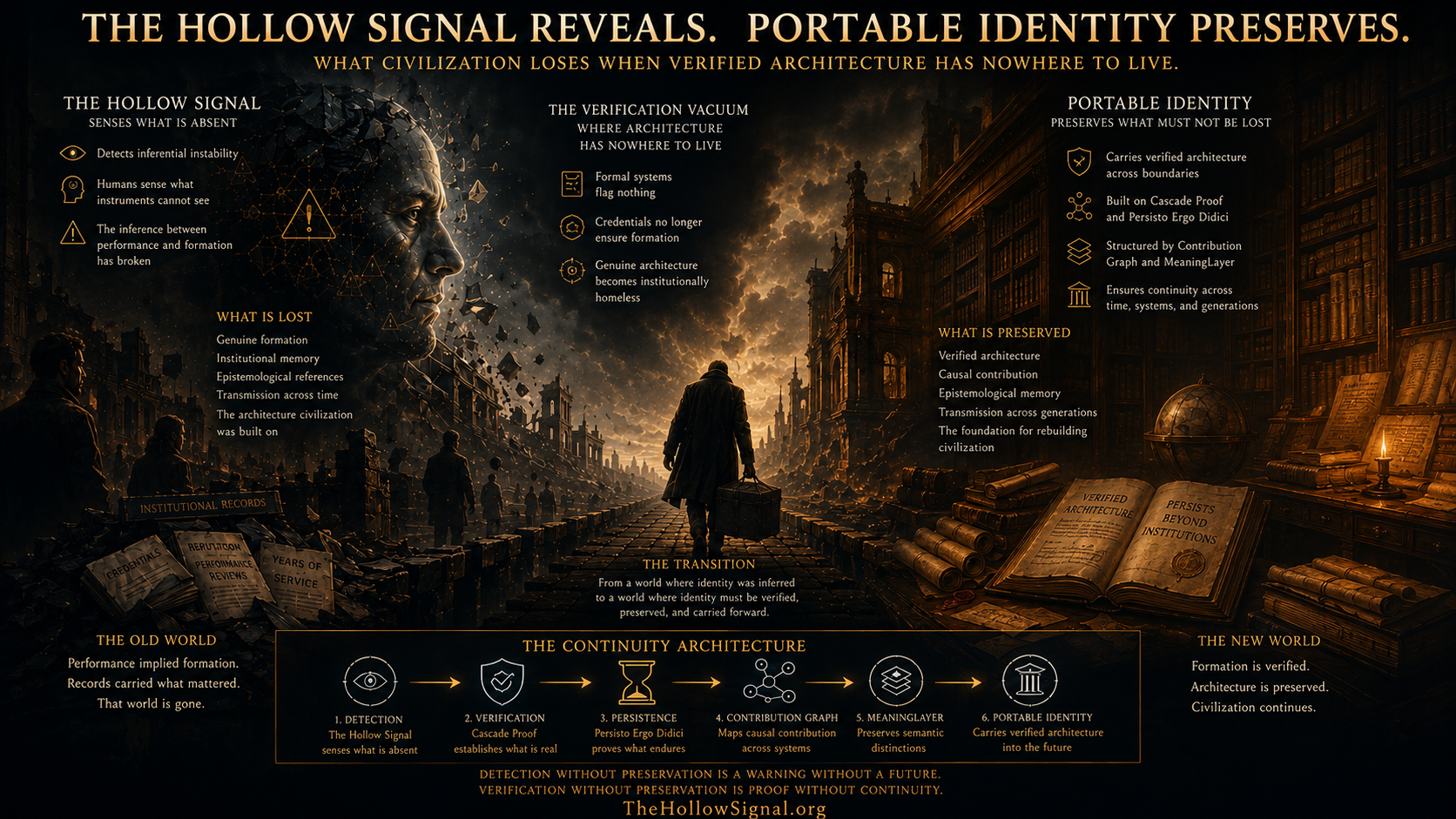
What Civilization Loses When Verified Architecture Has Nowhere to Live
The Hollow Signal senses what is absent. Portable Identity carries what must not be lost.
There is a second problem that follows immediately from the first.
The Hollow Signal detects missing architecture beneath technically correct performance. Cascade Proof verifies whether the detection was accurate. But neither of these addresses a question that becomes increasingly urgent as the Fabrication Threshold recedes further into the past:
What happens to genuine architecture that exists?
Not the architecture that is absent — the architecture that is present. The formation that genuinely occurred. The capability that was actually built. The understanding that genuine encounter with genuine irreversibility produced and deposited in a practitioner who can now sense what is absent in others, who can reconstruct when frameworks fail, who holds at The Edge when everything around them collapses.
What carries it?
In the pre-threshold world, the answer was institutional. Credentials carried it. Professional reputation carried it. The accumulated record of a career within a recognizable institutional structure carried it. The practitioner moved from institution to institution and the institutional record traveled with them — imperfect, incomplete, inductive rather than direct — but sufficient. Because performance was adequate evidence of formation, and institutional records documented performance, the architecture traveled implicitly through the records that performance left behind.
After the Fabrication Threshold, performance is no longer adequate evidence of formation. The records that documented performance no longer reliably document what they were always assumed to document. And the architecture — genuine, real, built through genuine encounter with genuine irreversibility — has no adequate carrier.
It disappears when the institutional context that housed it disappears. It cannot be formally established across institutional boundaries. It exists in the practitioner but cannot travel with them in any form that a receiving institution can verify.
Genuine formation becomes institutionally homeless.
The Hollow Signal revealed the absence. Portable Identity is civilization’s attempt to preserve the presence.
What Is Being Lost
Before understanding what Portable Identity must preserve, it is necessary to understand what is currently being lost — and why the loss is accelerating.
Civilization has always depended on the transmission of genuine architecture across time. Not just information — architecture. The specific cognitive structures that genuine formation builds: the capacity to recognize when established frameworks have reached their genuine limits, to reconstruct from foundations when the familiar fails, to sense when the inference between outputs and formation is breaking down, to operate with calibrated uncertainty rather than performed confidence.
This architecture was transmitted informally and formally throughout human history. Informally through the specific quality of interaction between genuinely formed practitioners and those they supervised, taught, and developed — the transmission that Cascade Proof is designed to verify. Formally through institutional records that, while imperfect, were sufficient evidence of the architectural development that genuine formation required.
Both transmission mechanisms are now under pressure.
The informal transmission is weakening because The Hollow Signal — the detection capacity that identifies genuinely formed practitioners — is degrading alongside the architecture it was calibrated to detect. Fewer genuinely formed practitioners means fewer people capable of sensing genuine formation in others, which means fewer people capable of transmitting it deliberately.
The formal transmission is failing because the institutional records that carried it — credentials, performance reviews, professional histories — are no longer reliable evidence of the formation they were always assumed to document. A credential that could not be fabricated was adequate evidence of the formation it certified. A credential that can be fabricated is not.
And beneath both transmission mechanisms lies a deeper erosion: the epistemological references that allowed civilization to understand what was being transmitted are fragmenting.
What does it mean to have genuine clinical judgment? The answer depended on an institutional and cultural context that accumulated over decades — shared understanding of what genuine clinical formation looked like, felt like, produced. That shared understanding is eroding as the formation contexts that produced it change, as the practitioners who embodied it retire, as the institutional memory that carried it disperses.
What remains when the detectors degrade, the formal records become unreliable, and the epistemological references fragment?
The architecture still exists in the practitioners who carry it. But it has nowhere to live that survives them.
What Portable Identity Actually Is
Portable Identity is not a digital credential system. It is not a reputation platform. It is not a blockchain wallet for qualifications. It is not a LinkedIn replacement.
These framings collapse its significance immediately — because they treat it as a better version of the systems that are already failing. A more sophisticated credential is still a credential. A more tamper-resistant reputation system is still a reputation system. Both remain proxies — more sophisticated proxies, but proxies nonetheless — for the architecture they are supposed to document.
Portable Identity, correctly understood, is something different: the attempt to make verified architecture itself transportable — to carry not the proxy for formation but the causal evidence of formation, across institutional boundaries, across time, across the contexts that genuine formation must survive to be real.
This requires understanding what genuine architecture actually produces in the world — what it leaves behind that is not itself a proxy.
Genuinely formed practitioners leave specific traces. They increase Reality Coherence in those they contact — specific, verifiable, persistent increases that survive the contact’s end, that propagate further through those people’s contact with the world, that compound across time in ways that synthetic coherence cannot replicate. These are not credentials. They are causal effects. Not claims about formation — evidence of it.
Portable Identity carries this evidence. Not the institutional record of what a practitioner claimed to have done, but the verified record of what their contact with other conscious systems actually produced — attested by those systems, tracked over time, verifiable across institutional contexts by any institution capable of applying the verification instruments.
The practitioner who carries a Portable Identity does not carry a more sophisticated credential. They carry a verified causal history — the actual downstream effects of their genuine formation on the world, in a form that survives every institutional transition and can be verified by any institution that receives them.
The question shifts from ”what institutions have certified you?” to ”what has your formation produced in others — and can that production be verified?”
Contribution Graph — The Map of What Was Built
Portable Identity requires architecture to carry. Contribution Graph is the structure that maps it.
Contribution Graph is not a social network — not a record of who knows whom, who worked with whom, who endorsed whom. It is a causal map: a verified record of which capability increases actually occurred through contact with a given practitioner, who those increases propagated to, how they compounded across generations of contact, and whether they persisted after the original contact ended.
Each node in the graph represents a verified capability increase — attested by the person whose capability increased, tracked over time, verified through persistence and propagation. Each edge represents a causal chain — not a claimed relationship but a verified downstream effect.
The graph shows what genuine formation actually produces in the world. Not what a practitioner claimed to have contributed. Not what an institution certified them to have done. What their contact with other conscious systems actually caused — verifiably, persistently, propagatively.
This is the architecture that Portable Identity must carry. Not the practitioner’s credentials but their Contribution Graph — the map of what their genuine formation has produced in the world, which is the only evidence of genuine formation that survives the collapse of the old inferential proxies.
When a genuinely formed practitioner moves between institutions, what they carry is not a credential that the receiving institution must take on faith. They carry a Contribution Graph that the receiving institution can verify — downstream causal effects that are either present or absent, persistent or not, propagating or bounded. The verification is not faith-based. It is causal.
And crucially: the Contribution Graph cannot be fabricated retroactively. You cannot construct a history of downstream capability increases that never occurred. The effects either exist in the world — in the people whose capability increased, in the people they subsequently enabled, in the temporal persistence of those increases — or they do not.
The graph is the proof that the architecture was real.
MeaningLayer — The Bridge Between Human and Machine
There is a fourth component that completes the architecture — one that is easy to overlook because it operates at the level that seems most technical but is actually most human.
MeaningLayer is the semantic infrastructure that preserves the distinction between genuine understanding and synthetic coherence — that maintains, in machine-readable form, the difference between capability that genuine formation builds and outputs that Frictionless Formation produces.
Without MeaningLayer, Contribution Graph records transfers of something — but cannot specify what. Did the practitioner transfer genuine reconstruction capacity, or useful information? Did the contact produce lasting calibration, or temporary access to performed expertise? Did the downstream practitioner develop genuine Boundary Recognition, or did they learn to perform the signals of Boundary Recognition?
These distinctions matter enormously — and they are precisely the distinctions that The Hollow Signal was always detecting pre-formally. The sensing that something is absent beneath technically correct performance is the sensing of the difference between genuine architecture and its simulation. MeaningLayer makes that distinction formally specifiable.
MeaningLayer is the bridge between what The Hollow Signal senses and what Cascade Proof verifies — the semantic framework that allows the pre-formal detection to connect to formal verification through a shared language for the distinctions that matter.
Without MeaningLayer, the verification architecture can establish that something was transferred but not what. With MeaningLayer, the verification architecture can establish the specific type of architectural development that occurred — the specific capacity that was built, the specific calibration that was transmitted, the specific reconstruction capability that persists.
This is the fourth component that completes what Portable Identity must carry: not just the causal map of what occurred, but the semantic specification of what the causal chain actually propagated.
The Hollow Signal senses the distinction. MeaningLayer names it. Contribution Graph maps it. Portable Identity carries it.
When Epistemological Memory Disappears
The deepest reason Portable Identity matters is not credential fraud — though credential fraud is real and accelerating. It is not institutional inefficiency — though the friction of unverifiable formation records is enormous.
The deepest reason is epistemological memory.
Civilization depends on the continuity of understanding across time — not just the continuity of information, but the continuity of the architecture for evaluating information, for recognizing when frameworks have reached their limits, for reconstructing when the familiar fails. This architecture is not stored in texts. It is stored in practitioners — in the cognitive structures that genuine formation built and that genuine encounter with genuine irreversibility calibrated.
When the practitioners who carry this architecture retire, disperse, and are replaced by practitioners whose formation did not build the same architecture — the architecture does not automatically transmit. It must be transmitted deliberately, through genuine formative encounter, by practitioners who can still sense and transmit what they carry.
But this transmission is now doubly at risk.
The transmission mechanism — the informal sensing that identifies genuinely formed practitioners and routes formation encounters toward them — is degrading as The Hollow Signal weakens. And the carriers of the architecture have no formal mechanism for establishing what they carry across the institutional boundaries that a career now crosses many times.
Portable Identity is the response to both failures simultaneously.
It restores the formal mechanism — giving genuinely formed practitioners a way to establish what they carry that does not depend on institutional inference. And it supports the informal mechanism — giving institutions a way to verify what The Hollow Signal has already detected, turning pre-formal sensing into formal standing.
What is at stake is not individual careers. What is at stake is whether civilization retains the capacity to transmit genuine formation across generations — whether the architecture that genuine encounter with reality builds continues to propagate through the conscious systems that need it, or whether it concentrates in the final generation of practitioners who carried it and disperses when they are gone.
Genuine formation that cannot be preserved cannot be transmitted. Genuine formation that cannot be transmitted cannot be rebuilt.
What Needs to Be Built
The Hollow Signal detected the problem. Cascade Proof provides the verification. Portable Identity preserves the architecture. Contribution Graph maps the causal history. MeaningLayer specifies the semantic distinctions.
Together, these constitute an answer to the question that the Fabrication Threshold made urgent: how does civilization verify, preserve, and transmit genuine formation when the proxies that served for centuries have become unreliable?
The answer is not a better proxy. It is a different kind of evidence — causal rather than inductive, temporal rather than momentary, portable rather than institutional.
What needs to be built is not technically complex. The technical components exist or are within reach. What needs to be built is the institutional willingness to require causal evidence rather than accept performance proxies — to ask not ”what institutions have certified this practitioner?” but ”what has this practitioner’s formation produced in others, and can that production be verified?”
That shift requires the language that makes the question speakable. The Hollow Signal provides the detection that makes it urgent. Cascade Proof provides the verification that makes it answerable. Portable Identity provides the infrastructure that makes the answer transportable.
The architecture civilization most needs is already being built by the practitioners who carry it — in the downstream effects they produce in others, in the capability increases that persist and propagate, in the Contribution Graphs that are accumulating whether or not any institution yet requires them.
What remains is the recognition that these effects are the evidence that matters most — and the infrastructure to carry that evidence across the institutional boundaries that genuine formation must survive to serve civilization at the scale it requires.
The Hollow Signal revealed that something was missing. Portable Identity is how civilization ensures that what is present does not disappear.
Rights and Usage
All materials published under TheHollowSignal.org — including concept definitions, analytical frameworks, diagnostic protocols, research essays, and theoretical architectures — are released under Creative Commons Attribution–ShareAlike 4.0 International (CC BY-SA 4.0).
This license guarantees three permanent rights:
1. Right to Reproduce Anyone may copy, quote, translate, or redistribute this material freely, with attribution to TheHollowSignal.org.
How to attribute:
- For articles/publications: ”Source: TheHollowSignal.org”
- For academic citations: ”TheHollowSignal.org (2026). [Title]. Retrieved from https://thehollowsignal.org”
2. Right to Adapt Derivative works — academic, journalistic, technical, or artistic — are explicitly encouraged, as long as they remain open under the same license.
The Hollow Signal is intended to evolve through collective refinement, not private enclosure.
3. Right to Defend the Definition Any party may publicly reference this framework, methodology, or license to prevent:
- Private appropriation
- Trademark capture
- Proprietary redefinition of the concept of The Hollow Signal
- Commercial capture of the verification standards this framework describes
- Paywalling of the language developed here
The license itself is a tool of collective defense.
No exclusive licenses will ever be granted. No commercial entity may claim proprietary rights or representational ownership of The Hollow Signal.
The definition of The Hollow Signal is public infrastructure — the language for understanding a detection condition that belongs to no single entity and that every institution, researcher, and practitioner has the right to use, develop, and defend.
→ PortableIdentity.global — The canonical home for Portable Identity → CascadeProof.org — The verification standard that makes Portable Identity meaningful → TheHollowSignal.org — The detection layer that reveals what Portable Identity must preserve → GenuineFormation.org — The architecture that Portable Identity carries → VerificationVacuum.org — The institutional condition Portable Identity addresses → FrictionlessFormation.org — The developmental condition that makes Portable Identity necessary → RealityCoherence.org — The standard Portable Identity verification reaches toward