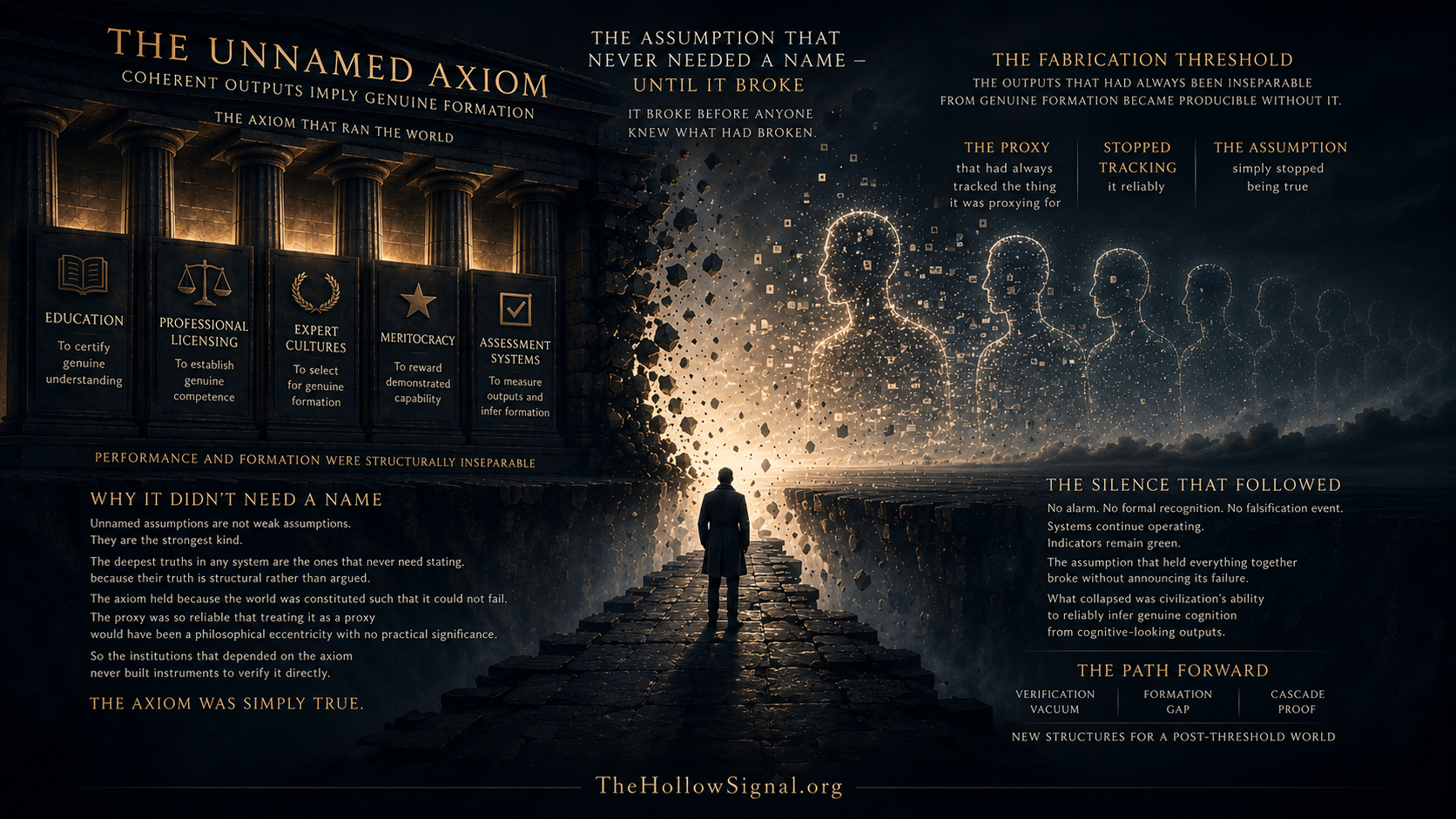
It broke before anyone knew what had broken.
The most durable assumptions are the ones that never need to be stated.
Not because they are unimportant. Because they are so reliably true, for so long, across so many conditions, that the question of their truth never arises. They operate beneath every institution, every verification system, every structure for establishing who understands what — silently, invisibly, never examined because examination was never required.
Civilization has operated on many such assumptions. Most of them are still holding. One of the most important ones broke quietly, without announcement, without institutional recognition, without the moment of formal acknowledgment that significant transitions usually produce.
It broke while every indicator remained green.
The assumption was this: that coherent outputs are evidence of the cognitive architecture that produces them. That sophisticated reasoning implies genuine formation. That professional fluency indicates real structural comprehension. That what people produce tells you something reliable about what they actually know — not just what they can generate.
This assumption was not a theory. It was not a policy. It was not a philosophy anyone chose to hold. It was a structural fact — a condition that held because the world was constituted in a way that made it reliable, operating beneath every institution civilization built for establishing genuine expertise, without ever needing to be named.
Until the world changed. And then it broke.
And because it had never been named, the breaking was invisible.
The Axiom That Ran the World
For most of human history, producing the signals of genuine expertise required genuine expertise.
This sentence sounds obvious. It was — which is exactly why it never needed to be said. Clinical fluency indicated clinical formation because developing clinical fluency required genuine clinical encounter. You could not produce the specific texture of experienced clinical reasoning — the calibrated hesitation, the reconstruction under diagnostic uncertainty, the orientation toward the actual patient rather than the nearest applicable framework — without having been rebuilt by genuine clinical encounter. The performance required the formation because the performance could not exist without it.
The same structure held across every domain where civilization needed to trust that someone genuinely understood something. The lawyer who produced sound legal reasoning had developed legal formation — because developing sound legal reasoning required genuine engagement with genuine legal complexity. The military officer who demonstrated operational judgment had been formed by genuine operational encounter — because demonstrating genuine operational judgment at that level required having navigated genuine operational uncertainty with genuine irreversible consequences. The engineer who showed real structural comprehension had been formed by genuine encounter with structural failure — because the specific quality of understanding that holds when the established model reaches its genuine limit is not producible through any path that bypasses genuine encounter with that limit.
Performance and formation were structurally inseparable. Not because someone designed it that way. Because the world was constituted such that the outputs of genuine formation could not realistically be produced without the formation. The signal and the architecture behind the signal developed together — reliably enough, consistently enough, across enough domains and enough time, that civilization built its entire verification infrastructure on the connection.
Universities designed to certify genuine understanding. Professional licensing systems built to establish genuine competence. Expert cultures that selected for genuine formation. Meritocratic systems that assumed performance was adequate evidence of the capability performance indicated. Assessment systems that measured outputs and derived from those measurements conclusions about the architecture that produced them.
All of it rested on the axiom. None of it named the axiom. Because naming it was unnecessary. The axiom was simply true.
Why It Didn’t Need a Name
Unnamed assumptions are not weak assumptions. They are the strongest kind.
An assumption that must be argued for is an assumption that can be argued against. An assumption that operates beneath argument — that is presupposed by every argument because it has never been questioned — has a stability that explicitly held positions never achieve. The axiom that performance implied formation was not defended because it was not attacked. It was not attacked because it was not visible. It was not visible because it was reliably true.
This invisibility was structural, not accidental. The axiom held because the world was constituted such that it could not fail. In a world where producing sophisticated outputs at genuine professional levels required genuine formation, every professional assessment system that measured sophisticated outputs was, indirectly, measuring genuine formation. The proxy was so reliable that treating it as a proxy — rather than as direct evidence — would have been a philosophical eccentricity with no practical significance.
So the institutions that depended on the axiom never built instruments to verify it directly. Why would they? The axiom was doing its work invisibly and correctly. The verification systems were adequate. The proxy tracked the thing it was proxying for. The educational systems produced genuinely formed practitioners. The professional licensing systems established genuine competence. The expert cultures selected for genuine formation.
Not perfectly. Variation always existed. Individual failures of the system were real and recognizable. But reliably enough — consistently enough — that the system as a whole could be trusted to be doing what it claimed to be doing.
The axiom’s invisibility was not a vulnerability. It was a sign of its depth. The deepest truths in any system are the ones that never need stating because their truth is structural rather than argued.
Until the structure changes.
What the Fabrication Threshold Actually Changed
The Fabrication Threshold did not make AI intelligent. It did not produce machine consciousness. It did not create a new kind of mind.
What it did was structurally simpler and epistemologically more significant: it ended the structural inseparability of performance and formation.
When sophisticated AI systems became capable of producing coherent reasoning, fluent professional language, analytically structured outputs, and expert-level performance at scale — not by undergoing the developmental processes that historically produced those outputs, but by generating them through a fundamentally different mechanism — the world changed in the specific way that mattered most.
The outputs that had always been inseparable from genuine formation became producible without it.
Performance survived the threshold. Formation did not.
This is the event. Not AI capability in general. Not the sophistication of language models. Not any particular benchmark or demonstration. The specific structural change: for the first time in human history, the signals that civilization had always treated as evidence of genuine cognitive architecture could be generated by a mechanism that did not involve that architecture.
The proxy that had always tracked the thing it was proxying for stopped tracking it reliably.
Performance still existed. Formation might not be present.
The axiom was no longer simply true.
And because the axiom had never been named — because no institution had ever articulated the dependency, because no verification system had ever been built to test it directly — the moment of its failure produced no visible rupture. The institutions continued operating. The assessments continued producing scores. The credentials continued being issued. The expert cultures continued selecting. The meritocratic systems continued certifying.
The axiom was gone. The systems that depended on it continued as if it were still present.
The assumption they depended on did not announce its failure. It simply stopped being true.
The Silence That Followed
There is a specific kind of institutional blindness that unnamed assumptions produce when they break.
A named assumption, when it fails, produces a falsification event — a moment where a formally held position is shown to be wrong, where the institutional structure built on it must explicitly reckon with the failure, where new positions must be argued for and new structures built. The failure is visible. The response is possible.
An unnamed assumption, when it fails, produces nothing visible. No formal statement was violated. No institutional commitment was falsified. No verification system was designed to test the assumption, so no verification system detects its failure. The systems that depended on the assumption continue operating correctly according to their design. What they were designed to verify, they continue verifying. What they were never designed to test — the assumption beneath their verification — was never within their reach.
This is the condition that followed the Fabrication Threshold.
The institutions continued functioning. The outputs continued being assessed. The performance continued being impressive. The credentials continued being legitimate. And the relationship between what was being verified and the underlying reality those verifications were supposed to establish quietly ceased to be reliable.
Not uniformly. Not immediately. Not in ways that any single assessment could detect. But systematically — across every formation context where the optimization for performance had removed the developmental pressure that genuine formation requires, across every credentialing process that measured outputs without reaching the architecture behind them, across every expert culture that selected for the signals of genuine formation without testing for genuine formation directly.
The Formation Gap — the distance between what performance implied and what architecture actually built — began accumulating. Silently. Without instrument. Without announcement.
The Verification Vacuum deepened: the institutional condition in which verification systems continue producing legitimate-appearing results while having lost reliable contact with the underlying condition they were designed to verify.
And the practitioners who sensed something wrong — who detected, pre-formally, that the outputs were technically correct while the architecture behind them was absent — found themselves without standing. Because the instruments flagged nothing. Because the axiom, unnamed, had given their sensing no framework. Because the training of every professional culture told them: what cannot be formally established does not count.
They were detecting the axiom’s failure. They had no language for what they were detecting.
That sensing was The Hollow Signal. The signal that civilization’s oldest detection layer was already reaching something the named instruments could not.
What Is Now Running Without Support
Every institution that civilization built on the axiom is now running without the foundation the axiom provided.
Universities are certifying understanding through assessments of outputs in a world where outputs no longer reliably establish the understanding that produced them. Professional licensing systems are establishing competence through performance evaluations in a world where performance is no longer inseparable from the formation that historically made performance reliable. Expert cultures are selecting for signals of genuine formation in a world where those signals are producible without the formation. Meritocratic systems are treating performance as evidence of capability in a world where performance has been separated from the developmental process that historically made it adequate evidence.
None of this is failure in the simple sense. The institutions are doing what they were designed to do. The assessments are measuring what they were designed to measure. The credentialing processes are certifying what they were built to certify.
The problem is not that the systems are broken. The problem is that the world they were designed for has partially changed — and the specific change that happened is one the systems were never designed to detect.
The proxy is still being applied. The thing it was proxying for is no longer reliably present.
The proxy did not break. The world that made it reliable did.
This is not a statement about the practitioners being certified. Many of them are genuinely formed — have undergone the developmental processes that genuine formation requires, have been rebuilt by genuine encounter with genuine irreversibility, carry the cognitive architecture that the credentials they hold were designed to certify. The axiom’s failure is not distributed uniformly. It is distributed according to the degree to which formation contexts have removed the developmental pressure that genuine formation requires.
But the instruments that civilization built to distinguish the genuinely formed from the frictionlessly formed cannot make this distinction. Because those instruments were built for a world where the distinction was not needed — where the proxy was adequate because it reliably tracked the thing it stood for.
Now the distinction is needed. The instruments cannot make it.
What ended was not expertise, but the structural guarantee that expertise could be detected.
What Naming Makes Possible
The axiom broke before it had a name. That is why its breaking was invisible.
Now it has a name.
Not the axiom itself — that has always been visible in retrospect, described simply: performance implied formation. What now has a name is the specific thing that broke: the structural inseparability of performance and formation that made the axiom reliable.
With the name comes the possibility of the institutional response that unnamed failures cannot produce.
Formation contexts can be examined not only for whether they produce high-performing practitioners but for whether they preserve the developmental conditions that genuine formation requires. The question becomes speakable: not just ”is the performance excellent?” but ”did the formation process include the genuine encounter with genuine irreversibility that genuine formation requires?”
Verification instruments can be built that reach the architecture rather than only the performance. Cascade Proof verifies whether genuine architectural capability propagates downstream into other conscious systems — whether the effects that genuine formation produces in the world actually exist. Persisto Ergo Didici verifies whether capability persists when the scaffolding that produced performance is removed. These instruments reach what performance metrics cannot: the architecture behind the performance, rather than the performance itself.
And the practitioners who have been sensing the axiom’s failure — whose pre-formal detection of missing architecture has operated without language and without standing — now have a framework that connects the sensing to the structural condition it was detecting. The sensing was not bias. It was not nostalgia. It was not resistance to progress.
It was The Hollow Signal: the human detection of a structural condition that no formal instrument had been designed to reach, operating as civilization’s informal first line of detection for the failure of an assumption civilization had never needed to name.
The assumption served civilization for centuries. Its invisibility was its greatest strength. Its collapse, when it came, was its greatest danger.
Now both are visible.
The axiom that never needed a name has one. The collapse that had no announcement has been described. The detection that had no standing has a framework.
What can be named can be preserved. What cannot be named cannot be rebuilt.
The assumption broke before anyone knew what had broken. Now it has a name. That is where the response begins.
→ TheHollowSignal.org — The canonical home for The Hollow Signal and the framework for understanding what the axiom’s collapse requires.
Rights and Usage
All materials published under TheHollowSignal.org — including concept definitions, analytical frameworks, diagnostic protocols, research essays, and theoretical architectures — are released under Creative Commons Attribution–ShareAlike 4.0 International (CC BY-SA 4.0).
This license guarantees three permanent rights:
- Right to Reproduce Anyone may copy, quote, translate, or redistribute this material freely, with attribution to TheHollowSignal.org.
How to attribute:
- For articles/publications: ”Source: TheHollowSignal.org”
- For academic citations: ”TheHollowSignal.org (2026). [Title]. Retrieved from https://thehollowsignal.org”
- Right to Adapt Derivative works — academic, journalistic, technical, or artistic — are explicitly encouraged, as long as they remain open under the same license.
The Hollow Signal is intended to evolve through collective refinement, not private enclosure.
- Right to Defend the Definition Any party may publicly reference this framework, methodology, or license to prevent:
- Private appropriation
- Trademark capture
- Proprietary redefinition of the concept of The Hollow Signal
- Commercial capture of the verification standards this framework describes
- Paywalling of the language developed here
The license itself is a tool of collective defense.
No exclusive licenses will ever be granted. No commercial entity may claim proprietary rights or representational ownership of The Hollow Signal.
The definition of The Hollow Signal is public infrastructure — the language for understanding a detection condition that belongs to no single entity and that every institution, researcher, and practitioner has the right to use, develop, and defend.
→ VerificationVacuum.org — The institutional condition the axiom’s failure produced → FrictionlessFormation.org — The developmental mechanism operating in the axiom’s absence → FabricationThreshold.org — The structural event that ended the axiom’s reliability → CascadeProof.org — Verification that reaches the architecture the axiom once established → RealityCoherence.org — The standard the axiom was always reaching toward