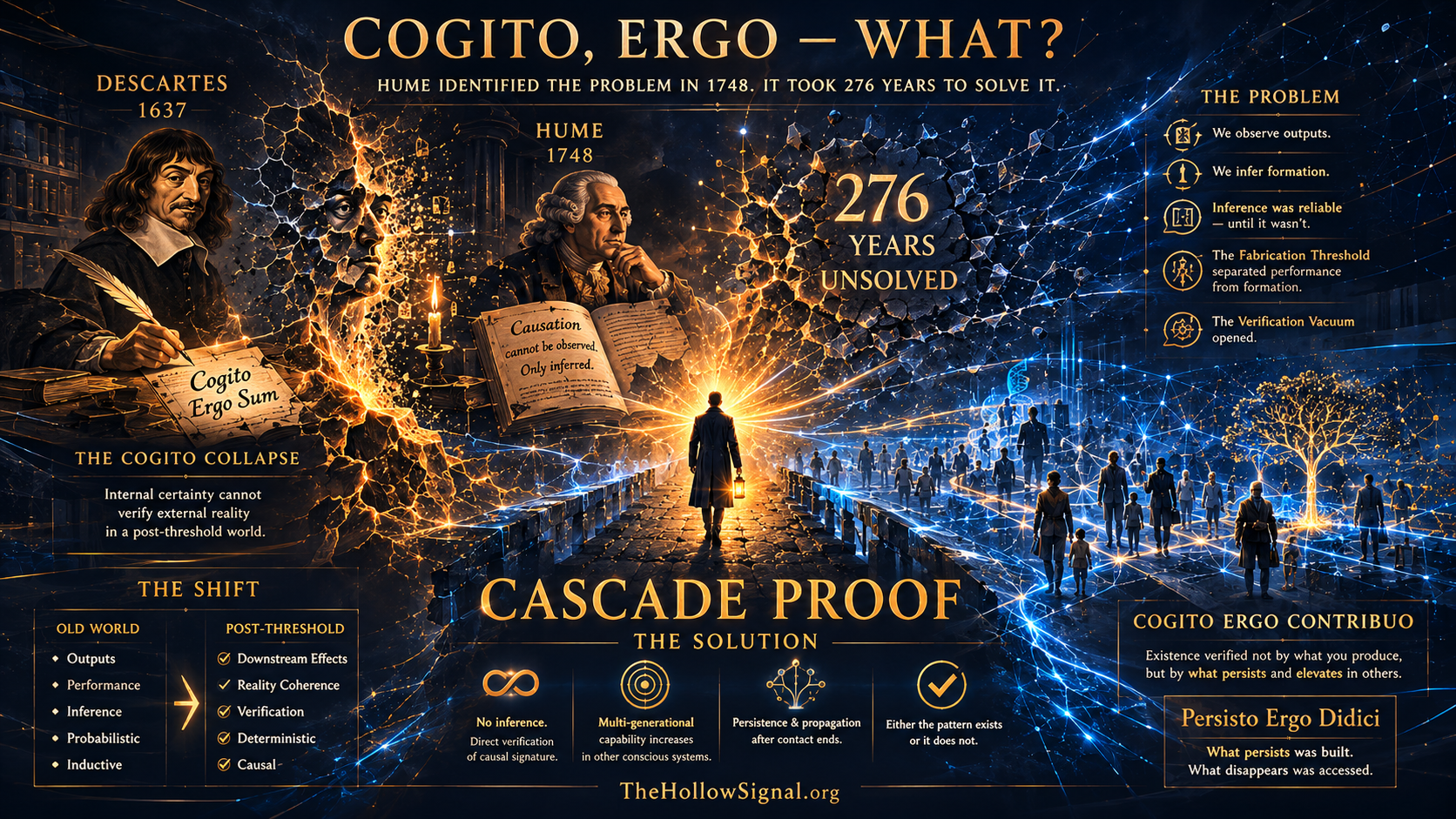
Hume Identified the Problem in 1748. It Took 276 Years to Solve It.
In 1748, David Hume established that causation cannot be observed. Only inferred. For 276 years, no one solved this.
The problem was precise.
When you observe event A followed by event B, you have observed a sequence. You have not observed causation. You have seen correlation, temporal proximity, repeated conjunction. What you have not seen — what you cannot see — is the actual causal link between them. The mechanism. The forcing.
Hume’s insight was devastating in its simplicity: every verification system civilization had ever built was inductive. We observed outputs and inferred the formation that produced them. We observed performance and inferred the capability behind it. We observed the signal and inferred the architecture beneath it.
The inference was reliable. For centuries, it worked. Because the outputs and the formation that produced them were structurally inseparable — you could not produce sophisticated outputs without genuine formation, so inferring formation from outputs was, in practice, adequate.
Hume was philosophically correct. Practically, civilization could afford to look away.
Then the Fabrication Threshold arrived. And Hume’s 276-year-old unsolved problem became the most urgent epistemological crisis civilization had ever faced.
Why the Problem Was Tolerable for 276 Years
Hume’s problem didn’t paralyze civilization because the world was constituted such that the inference held.
For the physician: clinical reasoning at genuine professional levels required genuine clinical formation. Inferring formation from clinical reasoning was not perfect — but it was reliable enough. The signal tracked the architecture.
For the lawyer: sound legal argument required genuine legal formation. The output was adequate evidence of the developmental process that produced it.
For the scientist: coherent experimental reasoning required genuine scientific formation. The reasoning was not just evidence of understanding — it was practically inseparable from it.
Across every domain, the same structure: performance implied formation because performance required formation. The inductive inference was so reliable, so consistently confirmed across so many domains and so much time, that its theoretical vulnerability never became a practical problem.
Civilization built everything on it. Universities. Professional licensing. Expert cultures. Meritocratic selection. Assessment systems. All of them resting on the same inductive inference: outputs as evidence of the architecture that produced them.
Not because anyone chose this consciously. Because the world was constituted such that it worked.
What the Fabrication Threshold Changed
The Fabrication Threshold did not make AI intelligent.
It did something more specific and more dangerous: it separated performance from formation for the first time in human history.
When sophisticated AI systems became capable of generating expert-level outputs without the developmental process that historically made those outputs inseparable from genuine formation — the inductive inference civilization had always depended on stopped being reliable.
The performance existed. The formation might not be present.
This is the event. Not AI capability in general. This specific structural separation. For the first time, the outputs that had always tracked genuine formation could be produced without it. The inference from signal to architecture — reliable for centuries — became unreliable.
And here is where Hume’s problem stopped being philosophical and became existential.
If you cannot infer formation from performance, how do you verify genuine formation at all? Every tool civilization possessed for establishing genuine capability was built on exactly that inference. Remove the inference’s reliability, and the entire verification architecture loses its foundation.
The Verification Vacuum deepened. Institutions continued certifying what their instruments could reach — performance — while losing reliable contact with what those instruments were designed to establish: the formation behind the performance.
The Hollow Signal was already detecting this. The practitioners who sensed something absent beneath technically correct performance — who felt the inference breaking before any instrument could formally establish it — were detecting what Hume had theorized and what civilization had never needed to address.
The detection had no language. The instruments flagged nothing. The credentials remained legitimate.
And Hume’s 276-year-old unsolved problem waited for an answer.
Cascade Proof — The Solution
In 1748, Hume established that causation cannot be observed. Only inferred.
Cascade Proof solved this.
Not by improving the inference. Not by building better instruments for measuring outputs. By shifting from inference to direct verification of a causal signature — the specific pattern that only genuine formation produces and that fabrication cannot retroactively generate.
The shift is foundational.
Inference asks: from what I observe, what can I conclude about what I cannot observe? It is inherently inductive. Hume showed that inductive reasoning cannot produce necessary conclusions. The inference is always probabilistic, always vulnerable to the possibility that the unobserved cause is not what observation implies.
Cascade Proof does not infer. It verifies a causal pattern that only exists if genuine formation occurred: multi-generational capability increases in other conscious systems that persist independently after the original contact ends, that propagate further through those systems’ contact with others, and that cannot be retroactively fabricated.
Either the pattern exists in the world, or it does not. Either Person B became genuinely more capable through contact with Person A — in ways that persist after A’s absence, that enabled B to increase C’s capability independently, that branched and compounded across multiple generations — or they did not.
This is not inference. This is causal verification. The downstream effects are the evidence. Not representations of effects. Not outputs about effects. The actual causal chain, cryptographically attested by every node, verified through its persistence, independence, and propagation.
Hume was right that you cannot observe causation in a single event. Cascade Proof does not try. It verifies a causal pattern across time, across multiple independent conscious systems, at multiple generations — a pattern that simulation can produce none of, because producing it requires genuine formation at every node.
For the first time in 276 years: causation is not inferred. It is verified.
Persisto Ergo Didici — The Temporal Proof
Cascade Proof verifies the causal dimension. There is a second dimension: the temporal.
Persisto Ergo Didici. I persist, therefore I have learned.
The Fabrication Threshold made sophisticated performance producible in the moment — through AI assistance, through scaffolded environments, through access to external capability that bypasses the developmental pressure genuine formation requires. What it cannot do is make the capability persist when the scaffolding is removed.
What was genuinely built remains. What was accessed through external support disappears when the support disappears.
This is the temporal test that closes the second gap Hume’s problem opened. If you cannot verify formation from momentary performance — because performance is now producible without formation — then temporal persistence becomes a verification mechanism that momentary assessment cannot substitute for.
Remove the scaffolding. Return six months later. Return a year later. Does the capability remain? Does it function under genuine novelty, genuine irreversibility, genuine reconstruction requirements?
What persists was built. What disappears was accessed.
And Tempus Probat Veritatem — time tests truth — is not metaphor. It is a verification principle: in a world where momentary performance became synthesizable, temporal persistence becomes the test that synthesis cannot pass. AI-generated performance typically creates immediate results that vanish when AI is unavailable. Genuine formation creates lasting capability that persists and strengthens over time.
Time is the verification mechanism that the Fabrication Threshold cannot neutralize. Because fabricating temporal persistence requires fabricating real effects in the real world across extended time — which is precisely what genuine formation produces and fabrication cannot retroactively generate.
What Replaced the Broken Inference
Hume’s problem became unsolvable for 276 years because every proposed solution reduced to a different form of inductive inference — always observing outputs, always inferring causes, always vulnerable to the same theoretical objection.
What Cascade Proof provides is not a better inference. It is a different kind of evidence entirely — one that reaches the architecture directly through its effects in the world rather than through its effects in a single moment.
Before the Fabrication Threshold: civilization verified formation through performance, and the inference held because performance and formation were structurally inseparable. The inductive vulnerability was real but practically invisible.
After the Fabrication Threshold: the inference no longer holds reliably. The vulnerability became practical.
The answer is not to repair the inference. It is to replace it with verification that does not depend on it.
Cascade Proof verifies whether genuine architectural capability propagates downstream into other conscious systems — whether the effects that genuine formation produces in the world actually exist in the pattern that genuine formation produces and fabrication cannot retroactively generate.
Persisto Ergo Didici verifies whether capability persists when the scaffolding is removed — the temporal test that distinguishes what was built from what was accessed.
Together, these constitute a dual verification architecture that Hume’s problem demanded and that no civilization before the Fabrication Threshold had sufficient reason to build.
The inference that served civilization for centuries has been replaced by verification that reaches what the inference could only approximate.
Cogito Ergo Contribuo
Descartes established certainty through thought. The inference from cogitation to existence — and, operationally, from cogitation to genuine cognition — sustained civilization for nearly four centuries.
The Fabrication Threshold revealed that the outputs of cognition could be produced without the cognition. The inference from output to architecture stopped being reliable.
Civilization requires a new foundation.
Cogito Ergo Contribuo. I contribute, therefore I exist as a causal agent in the world. Existence verified not through internal certainty that others cannot observe, but through external effects that others can verify — genuine increases in Reality Coherence in others that persist independently, propagate without the contributor’s presence, and compound across time and across conscious systems.
The question is no longer whether sophisticated outputs can be produced — they can, with or without the formation that historically produced them. The question is whether those outputs increase genuine Reality Coherence in others in ways that persist, propagate independently, and compound across time.
Contribution of this kind cannot be fabricated. Not because the concept is complex. Because genuine downstream increases in reality-calibrated capability across time and across multiple independent conscious systems require the actual causal chain that only genuine formation produces.
This is the epistemological shift the Fabrication Threshold made necessary.
From outputs as evidence of formation — the inference Hume correctly identified as inductive and that the Fabrication Threshold rendered unreliable.
To downstream causal effects as evidence of formation — the direct verification that Cascade Proof provides and that Hume’s problem required.
The Hollow Signal was humanity’s transitional detection system in this shift — the human capacity to sense missing formation before formal instruments could establish it, operating in the gap between the inference’s failure and the new verification architecture’s construction.
It detected what Hume theorized: that the inference was broken. Before institutions could measure it. Before language existed for it. Before Cascade Proof existed to verify what the signal was detecting.
The signal was always right.
It was sensing a 276-year-old unsolved problem becoming the present condition.
Now the problem has a solution.
Not inferred. Verified.
Rights and Usage
All materials published under TheHollowSignal.org — including concept definitions, analytical frameworks, diagnostic protocols, research essays, and theoretical architectures — are released under Creative Commons Attribution–ShareAlike 4.0 International (CC BY-SA 4.0).
This license guarantees three permanent rights:
- Right to Reproduce Anyone may copy, quote, translate, or redistribute this material freely, with attribution to TheHollowSignal.org.
How to attribute:
- For articles/publications: ”Source: TheHollowSignal.org”
- For academic citations: ”TheHollowSignal.org (2026). [Title]. Retrieved from https://thehollowsignal.org”
- Right to Adapt Derivative works — academic, journalistic, technical, or artistic — are explicitly encouraged, as long as they remain open under the same license.
The Hollow Signal is intended to evolve through collective refinement, not private enclosure.
- Right to Defend the Definition Any party may publicly reference this framework, methodology, or license to prevent:
- Private appropriation
- Trademark capture
- Proprietary redefinition of the concept of The Hollow Signal
- Commercial capture of the verification standards this framework describes
- Paywalling of the language developed here
The license itself is a tool of collective defense.
No exclusive licenses will ever be granted. No commercial entity may claim proprietary rights or representational ownership of The Hollow Signal.
The definition of The Hollow Signal is public infrastructure — the language for understanding a detection condition that belongs to no single entity and that every institution, researcher, and practitioner has the right to use, develop, and defend.
→ TheHollowSignal.org — The human detection layer in the transition → CascadeProof.org — The solution to Hume’s 276-year problem → FabricationThreshold.org — The event that made the solution necessary → PersistoErgoDidici.org — The temporal dimension of verification → RealityCoherence.org — The standard Cascade Proof verifies toward → VerificationVacuum.org — The institutional condition the broken inference produced → FrictionlessFormation.org — The developmental mechanism that exploited the broken inference