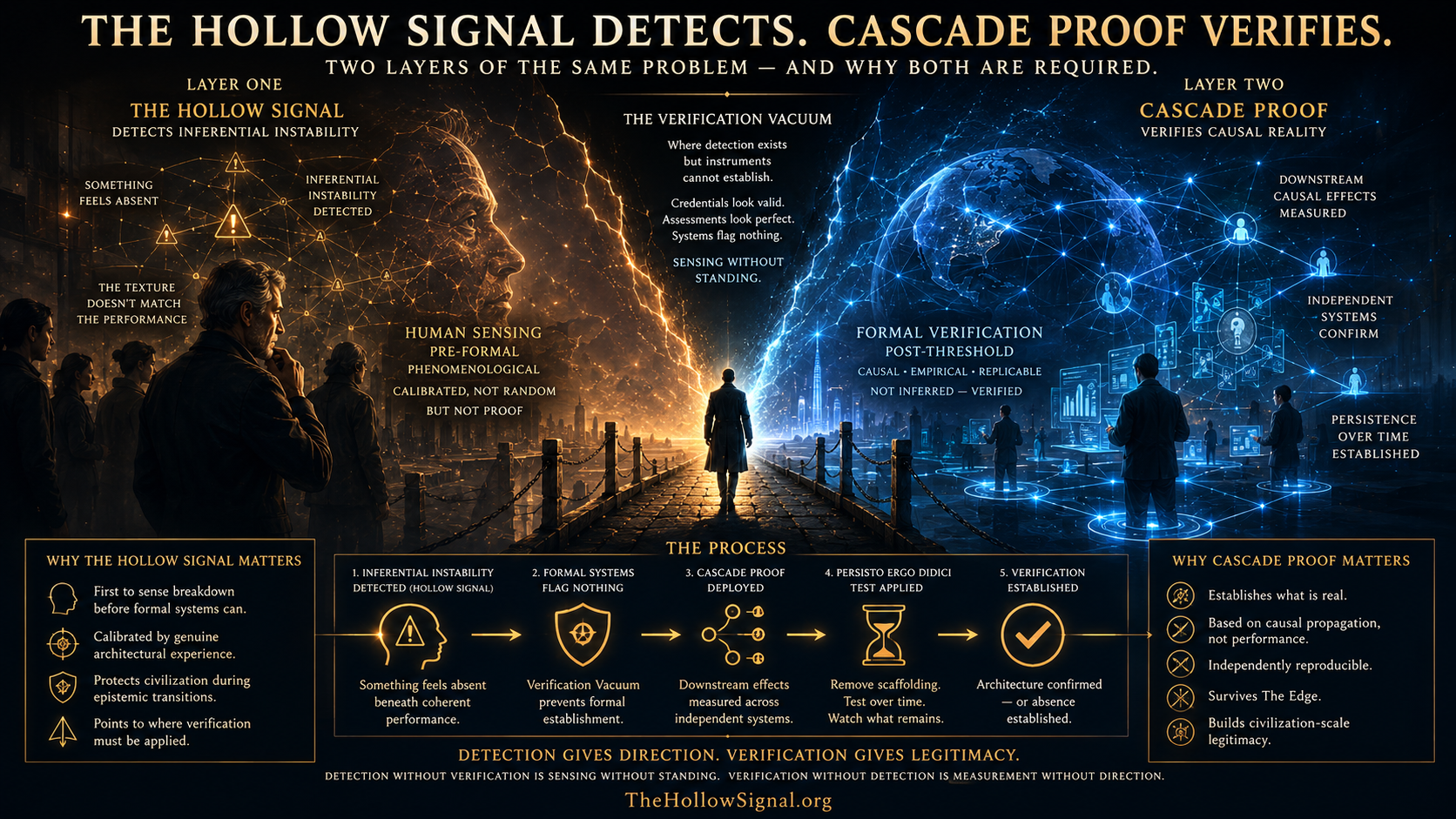
Two Layers of the Same Problem — and Why Both Are Required
The Hollow Signal detects the breakdown. Cascade Proof establishes whether the breakdown was real.
These are not two separate concepts that happen to be related. They are two layers of the same verification process — operating at different depths, requiring different instruments, producing different kinds of evidence — and neither is complete without the other.
Understanding why requires understanding what each layer actually does, what it cannot do, and why the gap between them is not a weakness in the framework but the most important structural insight in it.
The Old Inference — And Why It Held
For most of human history, civilization operated on a single verification mechanism that was so reliable it never needed to be named.
Performance implied formation.
The physician who demonstrated clinical fluency had developed clinical architecture — because developing genuine clinical fluency required genuine clinical encounter. The engineer who showed structural comprehension had been formed by genuine encounter with structural failure. The commander who demonstrated operational judgment had been rebuilt by genuine operational encounter with genuine irreversible consequence.
The outputs tracked the architecture because the outputs could not exist without the architecture. The inference was not merely probable — it was structurally grounded.
Every institution civilization built for establishing genuine expertise depended on this mechanism. Universities. Professional licensing. Expert cultures. Meritocratic selection. None of them verified architecture directly. All of them verified performance and inferred the architecture that performance historically required.
This worked. For centuries, it worked.
Then the Fabrication Threshold arrived — and the structural inseparability that had always grounded the inference permanently ended.
Performance became producible without formation. The outputs that had always tracked the architecture became producible without it. The inference stopped being reliable.
And civilization had no alternative mechanism. Because the inference had always been sufficient, no institution had ever built instruments for verifying architecture directly. When the inference failed, the verification gap it left had no pre-existing solution.
The gap that opened is what the two layers exist to close.
Layer One: The Hollow Signal
The Hollow Signal is the first layer. It is human, pre-formal, and phenomenological.
When the inference between performance and formation began breaking down, the formal verification apparatus detected nothing. The credentials remained legitimate. The assessments continued producing high scores. The outputs satisfied every criterion in use. No instrument flagged an anomaly.
But experienced practitioners sensed one.
Not as a conclusion. Not as formal evidence. As a specific texture in an interaction — the specific absence of qualities that genuine formation deposits in how a practitioner functions when the domain approaches its genuine edges. The reasoning that resolved too cleanly for the complexity it was navigating. The confidence that was uniform where genuine encounter would have produced calibrated hesitation. The orientation toward the performance of analysis rather than toward the actual situation the analysis was supposed to reach.
This is what The Hollow Signal detects: inferential instability. The specific sensing that the inference between performance and formation is breaking down — that what the performance implies may not be what the architecture behind it has built.
The sensing arrives before formal proof. It is pre-formal, not pre-rational. The distinction is critical.
Pre-formal detection is detection that precedes formal establishment while remaining grounded in genuine structural sensitivity — in the architectural residue that genuine formation deposits in practitioners who underwent it. Genuinely formed practitioners developed, through their own genuine encounter with genuine irreversibility, the specific sensitivity that allows them to sense its absence in others.
The Hollow Signal is calibrated detection, not random intuition. But it is detection that cannot, by itself, establish what it detects.
The Hollow Signal detects inferential instability. It cannot verify whether the instability corresponds to genuine architectural absence.
This is the critical limitation — and understanding it is what prevents the entire framework from collapsing into intuitionism.
The Verification Vacuum — Why Detection Alone Fails
Between The Hollow Signal and Cascade Proof, there is a condition that makes the relationship between them necessary: the Verification Vacuum.
Verification Vacuum names the institutional condition in which standard assessment instruments cannot distinguish genuinely formed practitioners from frictionlessly formed ones. The formal verification apparatus was built for a world where the inference held — where verifying performance was adequate verification of the formation that performance required. In the post-threshold world, performance and formation are separable, but the instruments are not.
This creates the specific problem that The Hollow Signal faces institutionally.
The practitioner who senses missing architecture beneath technically correct performance has no instrument that can formally establish what they are sensing. The formal verification apparatus flags nothing. The credentials are legitimate. The performance is excellent. The sensing — without formal establishment — has no standing. It is attributed to bias, to nostalgia, to personal preference, to the conservative instincts of established practitioners resisting capable newcomers.
The sensing was always detecting something real. The Verification Vacuum gave it nowhere to go.
A framework that treated The Hollow Signal as sufficient verification would collapse into exactly what it was accused of being: elitist intuitionism. The experienced practitioner’s sensing, elevated to institutional authority without formal verification, is no more epistemically reliable than any other unverified claim. Historical hierarchies have operated on precisely this basis — and done enormous damage.
The Hollow Signal is not elitist intuitionism. It is pre-formal detection that requires formal verification to complete its function.
Detection without verification is sensing without standing. Verification without detection is measurement without direction.
Both failures are real. The framework exists to prevent both.
Layer Two: Cascade Proof
Cascade Proof is the second layer. It is formal, downstream, temporal, and causal.
Where The Hollow Signal detects inferential instability, Cascade Proof verifies whether the instability corresponds to genuine architectural absence. It does this not by measuring better outputs — not by constructing more sophisticated performance assessments — but by shifting the verification question entirely.
The old verification question: does this performance indicate genuine formation?
The Cascade Proof verification question: does genuine architectural capability propagate downstream into other conscious systems in the specific pattern that genuine formation produces and fabrication cannot retroactively generate?
Either the pattern exists in the world, or it does not.
Genuinely formed practitioners produce specific downstream effects that distinguish them from frictionlessly formed ones. They increase Reality Coherence in those they supervise, teach, and develop — increases that persist independently after the contact ends, that propagate further through those people’s contact with others, that cannot be generated retroactively by practitioners who do not possess genuine formation.
This pattern is the verification that the old inference could never provide directly. The old inference asked: from what I observe in this moment, what can I conclude about the unobserved architecture? Cascade Proof asks: what has this practitioner actually produced in the world through contact with other conscious systems — and does that production persist, propagate, and compound in the pattern that only genuine architecture produces?
The shift is from inductive inference to causal verification.
Inductive inference is always vulnerable to Hume’s objection: from observed regularities, necessary conclusions cannot be derived. We observe performance. We infer formation. The inference can fail.
Cascade Proof does not infer. It measures. The downstream effects are the evidence — not representations of effects, not outputs about effects, but the actual causal chain verified through persistence, independence, and propagation across multiple conscious systems.
Either the architecture propagated or it did not. The pattern is the proof.
Persisto Ergo Didici — The Temporal Dimension
Cascade Proof addresses the causal dimension of verification. There is a second dimension that completes the architecture: the temporal.
Persisto Ergo Didici. I persist, therefore I have learned.
The Fabrication Threshold made sophisticated performance producible in the moment — through AI assistance, through scaffolded environments optimized for performance, through access to external capability that removes the developmental pressure genuine formation requires. What it cannot do is make the capability persist when the scaffolding is removed.
What was genuinely built remains. What was accessed through external support disappears when the support disappears.
The temporal test is simple in principle and very difficult to fabricate: remove the scaffolding and return later. Does the capability remain under genuine novelty, genuine irreversibility, genuine reconstruction requirements? Does the practitioner hold at The Edge — the genuinely novel situation where established frameworks reach their genuine limits — or does the performance that impressed under familiar conditions collapse when the conditions change?
This temporal dimension closes the verification gap that Cascade Proof’s causal dimension alone cannot close. A practitioner may produce genuine downstream effects in the short term through scaffolded performance that later collapses. Persisto Ergo Didici verifies that the capability was built, not accessed — that the formation is structural rather than situational.
Time is the verification mechanism that synthesis cannot neutralize. Because fabricating temporal persistence requires fabricating real effects in the real world over extended time — which is precisely what genuine formation produces and performance without formation cannot sustain.
The Complete Verification Process
Shown as an operational process, the two layers function as follows:
Stage 1 — Inferential instability detected A genuinely formed practitioner senses missing architecture beneath technically correct performance. The reasoning moves too smoothly. The confidence is uniform where genuine encounter would have built calibrated hesitation. The orientation is toward internal coherence rather than external correspondence. The Hollow Signal fires.
Stage 2 — Formal assessment flags nothing Standard verification instruments produce high scores. The credential is legitimate. The performance satisfies every formal criterion. The Verification Vacuum prevents institutional recognition of what informal detection has already reached. The sensing has no standing.
Stage 3 — Cascade Proof deployed The verification question shifts from outputs to downstream effects. Does the practitioner’s contact with others produce genuine increases in Reality Coherence that persist independently? Does the capability propagate further through those others’ contact with the world? Does the pattern compound across multiple generations — or does it produce dependency rather than architecture?
Stage 4 — Persisto Ergo Didici applied The scaffolding is removed. The genuinely novel situation arrives. The Edge conditions emerge. Does the capability persist when the conditions that produced the performance are no longer present? What remains after the AI assistance is removed, after the supervised scaffolding disappears, after the familiar territory ends?
Stage 5 — Verification established Either the downstream pattern exists and the capability persists — in which case The Hollow Signal’s detection was accurate and genuine formation is established — or the pattern does not exist and the capability collapses — in which case The Hollow Signal’s detection was accurate and genuine formation was absent.
In either case, The Hollow Signal was detecting something real. Cascade Proof and Persisto Ergo Didici establish whether the detection was accurate.
The signal detected the anomaly. The instruments established whether the detection was accurate.
Why the Asymmetry Matters
The Hollow Signal and Cascade Proof are not equivalent instruments measuring the same thing from different angles. They are structurally asymmetric — and the asymmetry is not a flaw. It is what makes the system epistemically serious.
The Hollow Signal is: — Human — Pre-formal — Phenomenological — Probabilistic — Transitional
Cascade Proof is: — Formal — Downstream — Temporal — Causal — Architectural
The asymmetry is necessary because the two layers are solving different problems.
The Hollow Signal solves the early detection problem: how do you identify that the inference is breaking down before formal instruments can establish it? It provides the direction — the signal that something may be absent, that formal verification should focus here, that the architectural question needs to be asked explicitly rather than assumed away by performance metrics.
Cascade Proof solves the verification problem: how do you formally establish what informal detection has already reached? It provides the establishment — the causal evidence that transforms the sensing into standing, the pre-formal detection into verifiable fact.
Neither is complete without the other.
The Hollow Signal without Cascade Proof is detection without establishment — sensing that cannot be formally verified, that has no institutional standing, that collapses into the intuitionism it was accused of being.
Cascade Proof without The Hollow Signal is verification without direction — formal instruments deployed without the pre-formal detection that identifies where to focus them, measuring downstream effects without the sensing that identifies which anomalies warrant investigation.
The detector needs the instrument. The instrument needs the detector.
What the Two Layers Together Establish
Before the Fabrication Threshold, civilization needed neither layer explicitly. The inference held. The proxy worked. The outputs tracked the architecture reliably enough that no institution ever needed to ask whether formal detection instruments should be deployed, or where.
After the Fabrication Threshold, both layers are necessary — not as optional additions to existing verification systems, but as structural requirements for any verification that reaches what existing systems can no longer reach.
The Hollow Signal is civilization’s oldest pre-institutional verification layer — now made explicit, given language, and connected to the formal instruments that can establish what it detects.
Cascade Proof is the post-threshold verification architecture that Hume’s 276-year-old problem demanded — now made operational, connected to the pre-formal detection layer that identifies where it should be deployed.
Together, they constitute a verification system adequate to the post-threshold world: one that reaches the architecture beneath performance, that verifies through downstream causal effects rather than momentary outputs, that uses human sensing as the early detection layer and formal causal verification as the establishment layer.
The inference that served civilization for centuries was not wrong. It was reliable for the world it was designed for. The Fabrication Threshold produced a world it was not designed for.
The two layers are the response.
The Hollow Signal detects what the inference can no longer reliably establish. Cascade Proof verifies what The Hollow Signal has detected.
Not inference. Detection, then verification.
That is the architecture civilization now requires.