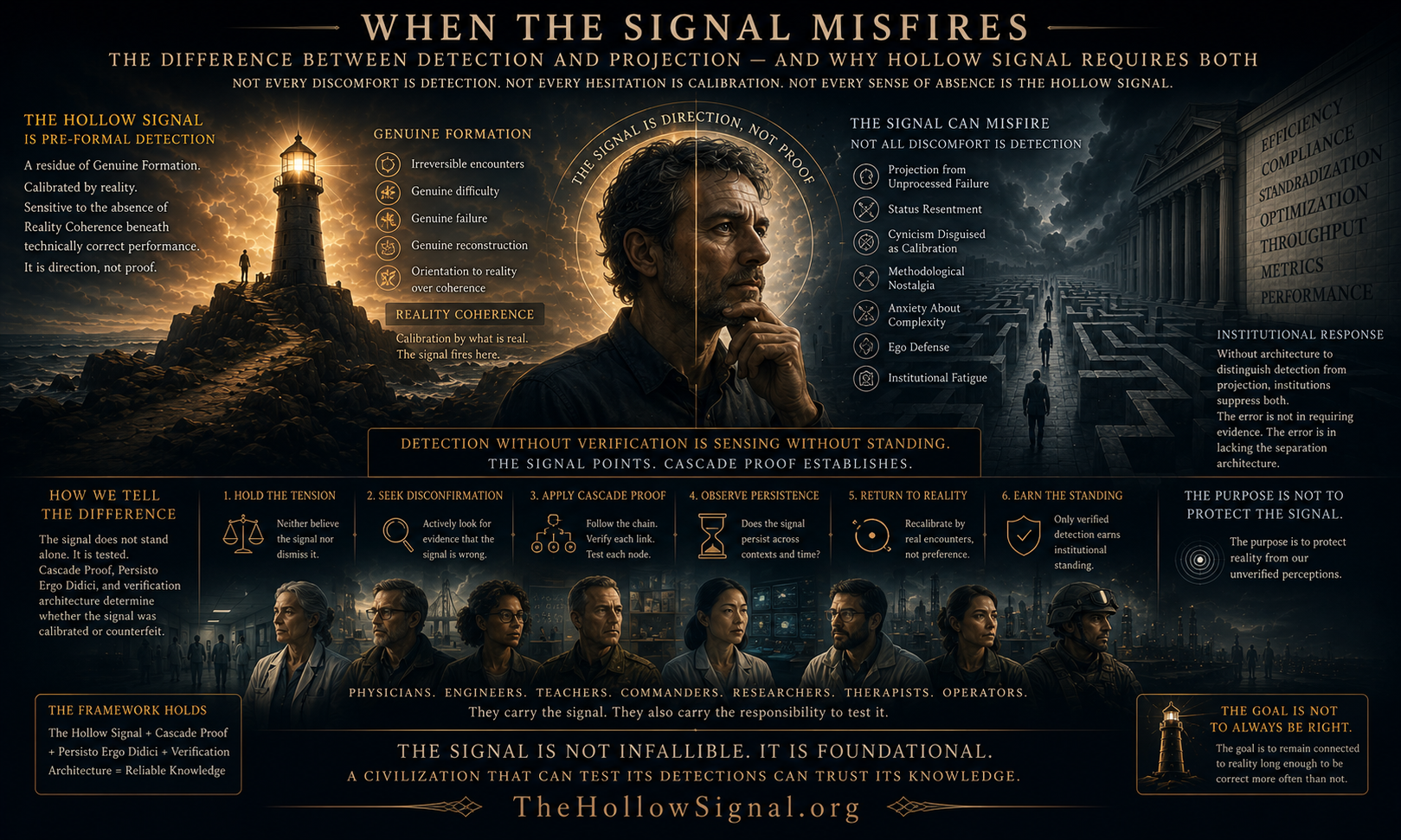
The Difference Between Detection and Projection — and Why Hollow Signal Requires Both
Not every discomfort is detection. Not every hesitation is calibration. Not every sense of absence is The Hollow Signal.
This is the article that the framework requires.
Not because the previous eleven articles were wrong. Because any epistemological framework that cannot account for its own failure modes is not an epistemological framework. It is a belief system dressed in the language of verification.
The Hollow Signal is pre-formal architectural detection — the specific sensitivity that Genuine Formation deposits in practitioners who underwent it, calibrated by genuine encounter with genuine irreversibility, oriented toward the absence of Reality Coherence beneath technically correct performance. It is civilization’s oldest pre-institutional verification layer.
It also misfires.
Not randomly. Not frequently — in genuinely formed practitioners whose calibration is maintained by ongoing genuine encounter with genuine consequence. But it misfires. And the misfires are not minor epistemological edge cases. They are structurally important, institutionally damaging, and — if unaddressed — capable of discrediting the genuine detections alongside them.
A civilization that cannot distinguish detection from projection loses both.
This article is about how to tell the difference.
What The Hollow Signal Actually Is — And What It Is Not
Before examining the failure modes, the framework requires precision about what it is claiming.
The Hollow Signal is not a claim that experienced practitioners are reliably correct when they sense something absent beneath technically correct performance. It is a claim that genuinely formed practitioners develop a specific architectural sensitivity — calibrated by genuine formation — that detects real architectural conditions more reliably than standard formal instruments under specific conditions.
The distinction is critical.
Reliable is not infallible. Calibrated is not certain. Pre-formal is not self-validating.
The Hollow Signal is the detection layer of a two-layer verification system. The first layer — detection — fires the signal. The second layer — Cascade Proof, Persisto Ergo Didici, formal verification instruments — establishes whether the detection was accurate.
Detection without verification is sensing without standing. This is not a limitation introduced reluctantly. It is structural. The signal is pre-formal information pointing toward where formal verification should focus. It is not, and was never claimed to be, proof.
The Hollow Signal is not the rejection of coherence. It is the detection of missing calibration. The distinction matters because the signal can fire for reasons that have nothing to do with missing calibration.
The Counterfeit Signals
There are specific conditions under which the sensing that feels like The Hollow Signal is not detecting architectural absence — but projecting something else entirely. Understanding these conditions is not a concession to critics of the framework. It is the framework operating correctly.
Projection from Unprocessed Failure
The practitioner who has experienced significant professional failure — whose own judgment was wrong in ways that produced serious consequence — carries a specific vulnerability: the tendency to sense absence in outputs that resemble the conditions under which their own judgment failed, regardless of whether genuine architectural absence is present.
The surgeon who missed a diagnosis in a specific clinical presentation may subsequently sense The Hollow Signal in clinical reasoning that superficially resembles that presentation — not because the reasoning is architecturally thin, but because the pattern-matching system that genuine formation builds has been dysregulated by trauma rather than calibrated by genuine encounter. The sensing is firing. It is not detecting architectural absence. It is detecting similarity to the conditions of past failure.
This is projection from unprocessed failure. It feels identical to genuine detection from the inside. The distinguishing feature is not phenomenological — it is the pattern of firing. If the signal fires specifically and repeatedly in contexts that resemble the conditions of past failure, and specifically not in structurally similar contexts that do not resemble those conditions, the signal is tracking past failure rather than current architectural absence.
Status Resentment
The experienced practitioner whose institutional authority has been diminished — whose seniority is no longer automatically deferred to, whose methodological preferences are no longer structurally privileged — carries a different vulnerability: the tendency to sense architectural absence in the outputs of practitioners whose success does not depend on the same formation conditions that built the senior practitioner’s authority.
This is not a moral failure. It is a structural one. When institutional authority was closely tied to the formation conditions that Genuine Formation requires, the experience of seniority and the development of calibrated detection developed in parallel. As institutional authority has become more decoupled from those formation conditions, some practitioners experience the sensing of architectural absence in younger practitioners as calibrated detection — when what is actually occurring is the sensing of diminished institutional relevance.
The signal fires. It is not detecting architectural absence. It is detecting the conditions under which the practitioner’s own institutional model no longer reliably applies.
The distinguishing feature: the signal fires consistently at outputs produced by practitioners whose institutional trajectory does not depend on the senior practitioner’s formation model, regardless of the actual architectural quality of the outputs.
Generational Nostalgia
Related to status resentment but structurally distinct: the tendency to sense architectural absence in outputs that are produced through methods that differ from the methods of the practitioner’s own formation, regardless of whether the methodological difference corresponds to an architectural difference.
The clinician formed in an era of extended apprenticeship under senior practitioners may sense The Hollow Signal in clinicians formed through evidence-based protocols — not because the protocol-formed clinicians lack Reality Coherence, but because the formation pathway that produced the sensing was different. The sensing is detecting methodological difference. It is attributing that difference to architectural absence.
This is generational nostalgia operating as false detection. It is particularly difficult to distinguish from genuine detection because both fire in the same institutional contexts and produce the same phenomenological experience. The distinguishing feature requires examining whether the signal fires specifically at outputs produced through different methodological pathways, or at outputs that demonstrate the specific architectural properties that genuine formation produces regardless of the pathway that produced them.
Anxiety and Threat Response
The practitioner operating under significant institutional pressure — facing performance evaluation, organizational change, resource constraints, existential uncertainty about their role — carries a generalized threat-detection system that can dysregulate the architectural sensing the Hollow Signal depends on.
Under conditions of elevated anxiety, the threshold for sensing absence lowers. The signal fires more frequently. The outputs it fires at may include genuinely architecturally solid work produced by practitioners with genuine formation — work that the practitioner would not have flagged under non-anxious conditions.
This is the anxiety-mediated false positive: the signal firing because the threat-detection system has expanded its range, not because architectural absence is genuinely present at elevated frequency. The distinguishing feature is the temporal correlation between elevated institutional pressure and elevated signal frequency, independent of any corresponding change in the actual architectural quality of the outputs being assessed.
Ideological Filtering
The most politically sensitive failure mode: the tendency to sense architectural absence specifically in outputs produced by practitioners whose institutional, political, methodological, or demographic characteristics the sensing practitioner has reason to discount — and specifically not in outputs produced by practitioners whose characteristics the sensing practitioner has reason to endorse.
If the signal fires consistently at outputs produced by practitioners from specific backgrounds, institutions, or methodological traditions, and consistently does not fire at structurally similar outputs from practitioners whose backgrounds, institutions, or methodological traditions the sensing practitioner endorses — the signal is filtering through ideological preference rather than detecting architectural absence.
This failure mode is the one that most damages institutional trust in the signal, because it is the one that institutions most correctly identify when they attribute sensing to bias. In cases where ideological filtering is operating, the institutional attribution is accurate. The signal is biased. Not because experienced practitioners cannot develop calibrated detection, but because the calibration can be systematically distorted by the same institutional and cultural pressures that affect every other form of human judgment.
How Genuine Detection Differs From Projection
The failure modes share a common structure: the signal fires in response to something other than architectural absence. The phenomenological experience of firing is identical to genuine detection. The content of the firing — the specific quality sensed as absent — is drawn from the practitioner’s own unresolved experiences, institutional anxieties, generational preferences, or ideological filters rather than from the architectural properties of the outputs being assessed.
Genuine detection has specific structural features that the counterfeit signals lack — features that are not always individually determinative, but that accumulate into a pattern that distinguishes calibrated detection from projection.
Genuine detection fires across contexts. The practitioner who is detecting architectural absence in outputs produced without Genuine Formation will sense the absence across varied institutional contexts, methodological traditions, and demographic backgrounds — because architectural absence is a property of developmental history, not of institutional affiliation. If the signal fires specifically within a bounded category that does not correspond to a developmental category, projection is more likely than detection.
Genuine detection is domain-specific. The Hollow Signal is calibrated by formation in a specific domain. A clinician whose formation was genuinely clinical has architectural sensitivity to clinical architectural absence. Their sensing of architectural absence in domains where their own formation was not developed is not calibrated detection — it is extrapolation from one domain’s sensing to another domain’s outputs. Calibrated detection operates within the practitioner’s genuine formation domain. Projection tends to expand beyond it.
Genuine detection holds under formal verification. The practitioner whose detection is calibrated will, over time and across cases, produce a tracking record that formal verification can establish or refute. Their detections, routed to formal verification through Cascade Proof and temporal testing, will show a correlation between pre-formal sensing and formal outcome that projection cannot sustain over time. Projection may be accurate occasionally — genuine architectural absence is common enough that random sensing will sometimes detect it. But it cannot sustain calibrated accuracy across sufficient cases for formal verification to establish.
Genuine detection is not defensive. The practitioner whose signal is genuinely detecting architectural absence will, when challenged with specific formal evidence of architectural quality, be able to update. The detection is information pointing toward where formal verification should focus — not a position to be defended. Projection tends to defend itself in ways that genuine detection does not, because projection is carrying something other than calibrated architectural sensitivity.
The Institutional Implication
The existence of false positives does not undermine the framework. It completes it.
The institutional response to pre-formal detection — the attribution to bias, the requirement for formal evidence, the systematic discrediting of sensing that cannot be formally established — was not entirely wrong. It was responding, accurately, to the genuine prevalence of the failure modes described above. Status resentment, generational nostalgia, ideological filtering, anxiety-mediated false positives — these are real. They operate in institutional contexts. They produce the sensing that institutions correctly identify as unreliable when they respond to it as noise.
The institutional error was not in requiring formal evidence. It was in having no mechanism for distinguishing the misfiring signal from the genuine one — no formal layer between the full category of pre-formal sensing and the specific subcategory of calibrated architectural detection that Genuine Formation produces.
The Verification Vacuum is not simply the absence of formal establishment. It is the absence of a formal architecture for separating the genuine signal from the counterfeit ones — for routing calibrated detection to formal verification while providing institutional means for identifying and addressing projection, resentment, nostalgia, and ideological filtering.
This requires two things that institutions have never had simultaneously: the recognition that calibrated pre-formal detection is legitimate pre-verification information, and the disciplinary framework for examining when the sensing is genuinely calibrated and when it is projecting something else.
Neither alone is sufficient. The recognition without the discipline produces the belief system — unfalsifiable, self-vindicating, ultimately damaging to the practitioners who carry the genuine signal alongside those who carry the counterfeit. The discipline without the recognition produces the Verification Vacuum — formally rigorous, epistemically inadequate for the post-Fabrication Threshold conditions that require more than formal instruments.
The signal is calibrated by reality contact. Projection is calibrated by the self. The institution that cannot distinguish between them will eventually distrust both.
What This Requires of Practitioners Who Carry the Signal
The framework places specific obligations on the practitioners who carry genuine detection — obligations that the previous articles have not fully stated.
The practitioner who carries The Hollow Signal has a responsibility to examine the conditions under which the signal fires. Not as epistemological paralysis — not as the requirement to resolve every possible source of bias before acting on detection. As ongoing calibration practice: the active examination of whether the signal’s pattern of firing corresponds to genuine architectural patterns or to the practitioner’s own unresolved material.
This examination requires the practitioner to ask, regularly and honestly:
Does the signal fire across the full range of architectural absence — or specifically within categories that correspond to my own institutional anxieties, formation preferences, or past failures?
Does the signal fire at outputs I would endorse if they came from practitioners I am predisposed to trust?
Is the signal firing more frequently under elevated institutional pressure — and if so, is that frequency tracking a genuine increase in architectural absence in my environment, or tracking my threat-detection system’s expanded range?
When formal verification has followed my detections, what is the tracking record? Has the calibration been maintained over time, or has it shown the pattern of occasional accuracy that projection produces alongside genuine detection?
These questions are not comfortable. They require the practitioner who carries the signal to hold it with the same epistemological discipline that the framework applies to formal institutions — to recognize that the signal is information requiring verification, not authority requiring deference.
The practitioner who cannot hold the signal this way is not carrying The Hollow Signal. They are carrying a belief in their own perception — which is something different and something that the framework explicitly does not support.
Not every discomfort is detection. Not every hesitation is calibration. The Hollow Signal is not self-validating. It is pre-formal architecture pointing toward where formal verification must go.
What This Completes
The framework now contains what every serious epistemological architecture requires: the account of its own failure conditions.
The Hollow Signal is pre-formal detection of architectural absence beneath technically correct performance. It is calibrated by Genuine Formation and operates reliably in genuinely formed practitioners whose calibration is maintained by ongoing genuine encounter. It is the first layer of a two-layer verification system. It is not proof. It requires formal verification to become institutional standing.
It also misfires — in the specific conditions described above, for reasons that can be examined, tracked, and addressed without dismissing the genuine signal alongside the counterfeit ones.
A civilization that loses the capacity to carry genuine pre-formal detection is civilizationally impaired. A civilization that cannot distinguish that detection from projection is epistemically impaired. The path between these failures is narrow but navigable.
The signal is real. The source must be verified. The sensing must be held with the same disciplined uncertainty that the verification instruments are designed to address.
A civilization that cannot distinguish detection from projection loses both.
The framework exists to preserve both — the detection that civilization’s warning system has always depended on, and the discipline that prevents that detection from becoming the unfalsifiable belief system that would discredit it.
The signal is not intuition. It is architecture. Architecture that can be built, maintained, calibrated — and examined for the cracks that every architecture eventually develops.
That examination is not a weakness of the framework. It is the framework working.
→ TheHollowSignal.org — The canonical home for The Hollow Signal → CascadeProof.org — The verification standard that follows detection → VerificationVacuum.org — The institutional condition the false positives helped create → GenuineFormation.org — The developmental process that calibrates detection → FrictionlessFormation.org — The condition the genuine signal was always detecting → FabricationThreshold.org — The structural event that made calibrated detection newly critical → RealityCoherence.org — The standard genuine detection was always oriented toward → PersistoErgoDidici.org — The temporal test that distinguishes calibrated from projected sensing