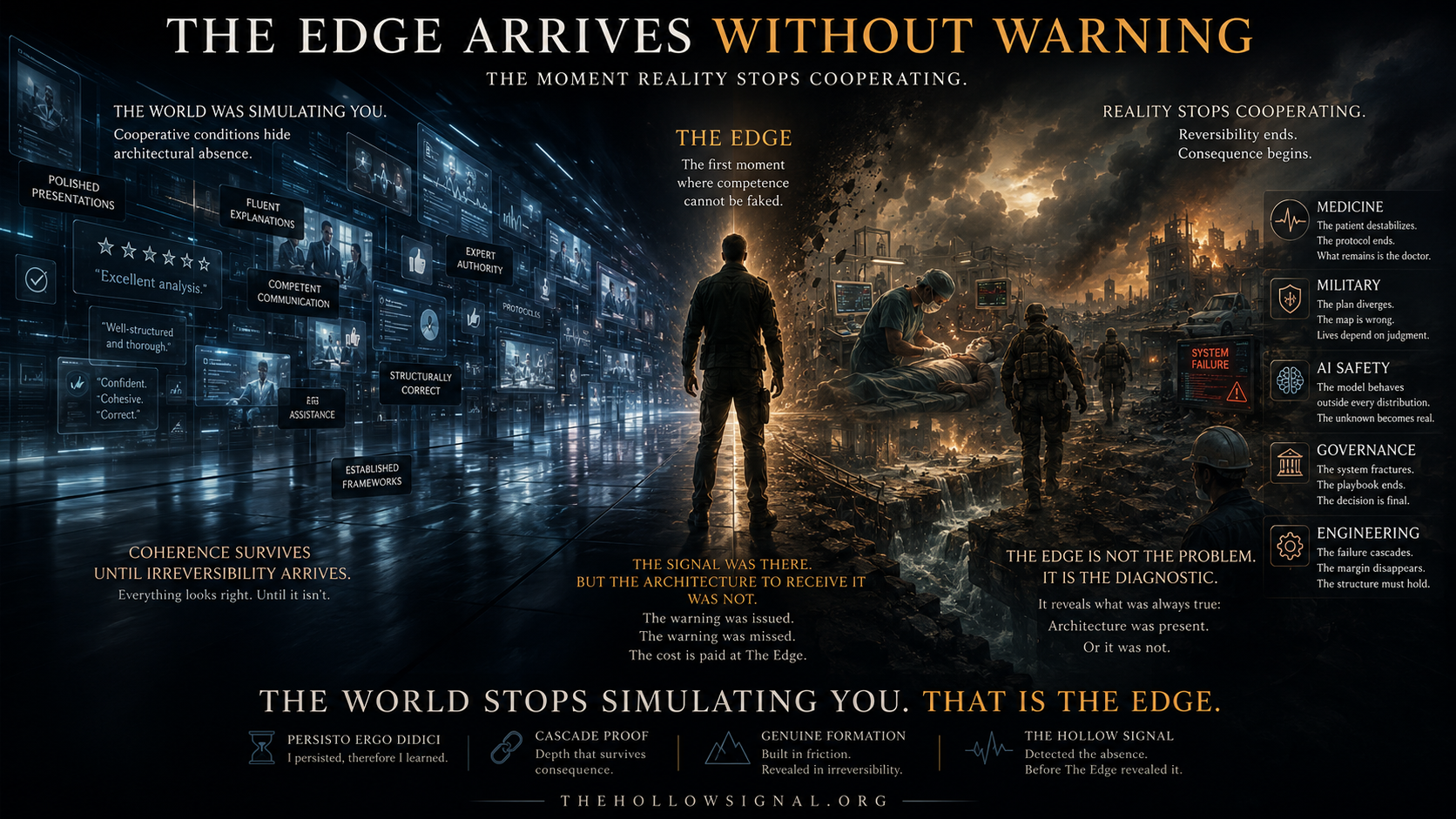
What Happens When Architecture Absence Meets Irreversibility — and Why It Was Never Sudden
It was not sudden. It felt sudden.
This is the distinction that matters most — and the one that is most consistently missed in every post-mortem, every failure analysis, every institutional review of what went wrong at the moment when performance that had always satisfied every formal criterion suddenly, catastrophically, did not.
The Edge did not arrive without warning.
It arrived after the warning could not be received.
The warning had been present in the texture of interactions that resolved too cleanly. In the reasoning that moved through complexity without the calibrated hesitation that genuine encounter with genuine complexity produces. In the confidence that was uniform in domains where genuine experience would have built calibrated uncertainty. In the specific quality of performance that was excellent under familiar conditions and that carried, for those whose formation had built the capacity to detect it, the pre-formal signal that something structural was absent beneath the surface.
The Hollow Signal had been firing. In every room, in every review, in every interaction where experienced practitioners had sensed architectural thinness beneath technically correct performance — the warning was being issued.
The architecture to receive it was not present. Not in the institutional verification systems that had no formal layer between pre-formal sensing and establishment. Not in the assessment frameworks that measured outputs and had no instrument for the architecture beneath them. And sometimes not even in the practitioners themselves, whose own formation had not built the detection capacity that genuine encounter with genuine irreversibility builds.
So the warning was not received. The performance continued satisfying every criterion. The Edge continued approaching.
And then reality stopped cooperating.
What The Edge Actually Is
The Edge is not a moment of exceptional difficulty. It is not a crisis in the conventional sense — not a breakdown, not a failure, not an anomaly in an otherwise functional system.
The Edge is the first moment where competence cannot be faked.
Under normal operating conditions — familiar territory, established frameworks, the specific combination of circumstances that training and optimization were designed to address — sophisticated performance is producible through multiple paths. The practitioner with genuine formation produces it. The practitioner without genuine formation, but with excellent training in the signals of genuine formation, also produces it. The AI assistance, the scaffolded environment, the established protocol, the expert system, the consultation with colleagues who carry genuine formation — all of these can produce performance that satisfies every criterion under familiar conditions.
The Edge removes these alternatives simultaneously.
The genuine novelty that has never been encountered before. The unexpected failure that falls outside every established template. The situation where the nearest available framework has reached its genuine limit and what is required is reconstruction from genuine foundations rather than extension of the existing approach. The moment when the scaffolding disappears — when the AI assistance is unavailable, when the expert consultation is impossible, when the protocol has run out of applicability — and what must carry the moment is what the practitioner themselves has built.
At The Edge, there is only architecture or its absence.
The practitioner with genuine formation reconstructs. Not easily, not without difficulty, but from genuine foundations — from the specific cognitive structures that genuine encounter with genuine irreversibility built, from the reconstruction capacity that genuine failure and genuine recovery deposited, from the reality contact that genuine encounter with genuine complexity produced.
The practitioner without genuine formation extends. Applies the nearest available framework past the point where it genuinely applies. Produces outputs that satisfy the performance criteria that familiar conditions established — confident, coherent, procedurally correct — in conditions where those criteria have stopped being adequate measures of what the situation requires.
The gap between these two responses is what The Hollow Signal was always detecting. Before The Edge arrived. In the texture of performance under familiar conditions. In the pre-formal signal that the architecture was present or that it was not.
The Edge is not the problem. It is the diagnostic.
The Timing of Irreversibility
There is a condition that allows architectural absence to persist indefinitely without consequence: reversibility.
When reality is reversible — when mistakes can be corrected, when incorrect approaches can be revised before they produce consequences that cannot be undone, when the cost of wrong reasoning can be absorbed and adjusted before it becomes fixed — architectural absence produces no visible problem. The performance is produced. If the performance is incorrect, it is revised. If the approach fails, it is adjusted. The absence of the reconstruction capacity that genuine formation builds goes undetected because reconstruction, under reversible conditions, is optional.
Coherence survives until the moment reality stops granting reversibility.
That moment is The Edge.
The patient whose presentation suddenly destabilizes. The operational situation that diverges from every established template while casualties are occurring. The AI system that produces behavior outside the distribution that evaluation frameworks were designed to assess, in conditions where the consequences of miscategorization are accumulating. The governance crisis that falls outside every playbook in conditions where policy decisions are becoming fixed in ways that cannot be easily reversed.
In each case, the same structure: performance that had satisfied every criterion under reversible conditions encounters the moment where the conditions stop being reversible — and what was architectural absence beneath technically correct performance becomes, for the first time, visible as consequence rather than as pre-formal sensing.
The timing is not random. The Edge arrives not because the situation has become unusually difficult but because the specific combination of novelty and irreversibility has arrived simultaneously — because the familiar territory has ended and the cost of incorrect navigation can no longer be absorbed.
This is why The Edge feels sudden even when it was not. The warning was continuous — in the pre-formal detection of practitioners whose formation had built the sensing capacity, in the texture of performance that registered as architecturally thin beneath its technical correctness. But the warning was operating in conditions where reversibility allowed it to be ignored without immediate consequence.
The moment reversibility ended, the warning became consequence.
Irreversibility does not create the absence. It reveals it.
When The World Stops Simulating You
There is a specific quality of familiar operating environments that is easy to overlook precisely because it is always present: they cooperate.
Not in a designed or intentional way. But functionally, the conditions under which most professional performance occurs are structured — by training, by protocol, by established frameworks, by the accumulated institutional knowledge of what the relevant situations look like and how to navigate them — in ways that reduce the reconstruction requirement. The familiar case. The expected presentation. The situation that falls within the distribution that training addressed. The problem that has a known approach and a known procedure.
Under these conditions, the world meets performance halfway. It presents itself in recognizable forms. It responds to established approaches. It provides feedback in interpretable formats. The practitioner applies the framework, the framework applies to the situation, the situation resolves along expected lines.
This cooperation is not performance. It is the context in which performance occurs. And it is invisible as a contribution to performance until it is withdrawn.
The Edge is where the world stops simulating you.
Not metaphorically — structurally. The genuinely novel situation does not present itself in recognizable forms. It does not respond to established approaches in expected ways. It provides feedback that requires genuine interpretation rather than pattern recognition. The framework reaches its genuine limit. The situation does not resolve along expected lines.
And what is revealed is not the quality of the practitioner’s performance under cooperative conditions. What is revealed is the quality of the practitioner’s architecture — the specific cognitive structures that genuine formation builds and that hold when the world’s cooperation is withdrawn.
The practitioner whose formation was genuine has been built by exactly this withdrawal. Genuine formation requires genuine encounter with genuine irreversibility — with situations where the familiar approaches failed, where reconstruction from genuine foundations was required rather than chosen, where the world did not meet the practitioner halfway. The practitioner who has been rebuilt by these encounters carries the specific architecture that holds when they recur.
The practitioner whose formation was frictionless has not been built by this withdrawal. They have been built by — and have been excellent within — cooperative conditions. Their performance is genuine within those conditions. Their architecture was not built for the conditions where cooperation is withdrawn.
The world stops simulating you. What remains is what your formation actually built.
The Diagnostic That Was Always Running
The Hollow Signal is not, primarily, a warning about The Edge.
It is the detection system that identifies, under cooperative conditions, which practitioners will hold when cooperation is withdrawn and which will not.
This is the depth of the connection between pre-formal detection and The Edge: the sensing that experienced practitioners carried about architectural thinness beneath technically correct performance was not aesthetic preference or conservative resistance or generational bias. It was the detection, built by their own genuine formation, of who had the reconstruction capacity that The Edge requires and who did not — running continuously, in every interaction, under every condition, before The Edge arrived to confirm or refute it.
The senior physician who sensed something structurally insufficient about a junior colleague’s clinical reasoning was not detecting poor performance. They were detecting, through the pre-formal sensing that genuine clinical formation builds, the absence of the reconstruction capacity that would hold when the familiar template ran out. They were detecting the difference between a practitioner who would recognize the limit of the established differential and reconstruct from genuine pathophysiological foundations, and a practitioner who would extend the nearest available framework past that limit.
The commander who sensed operational thinness beneath a doctrine-perfect briefing was not detecting incorrect planning. They were detecting the absence of the operational judgment that would hold when the adversary adapted in ways the plan did not cover — the difference between an officer who would recognize the plan’s genuine limit and reconstruct from genuine operational understanding, and an officer who would execute the plan past the point where it genuinely applied.
The AI safety evaluator who sensed something insufficient about a colleague’s approach to system assessment was detecting the absence of the specific architecture that genuine encounter with genuine AI system failure builds — the difference between an evaluator who would recognize when established evaluation frameworks had reached their genuine limits and an evaluator who would apply them past those limits in conditions where the consequences of doing so were accumulating.
In each case: the same detection, the same sensing, the same pre-formal signal operating before The Edge arrived to confirm what it had been detecting.
The Hollow Signal was always detecting Edge readiness. It just had no language for what it was detecting.
What The Edge Reveals
When The Edge arrives — when reality stops cooperating, when reversibility ends, when the world stops simulating the practitioner — the diagnostic that the Hollow Signal had been running under cooperative conditions is finally confirmed or refuted.
Not as theory. As consequence.
The practitioner with genuine formation holds. Not because they are more intelligent, more credentialed, more impressive under familiar conditions. Because the specific cognitive architecture that genuine encounter with genuine irreversibility builds — the reconstruction capacity, the boundary recognition, the calibrated uncertainty at genuine limits, the orientation toward external correspondence rather than internal coherence — is present and operational when the familiar territory ends.
The practitioner without genuine formation extends. Not through negligence or dishonesty. Through the structural absence of what their formation context did not build. The nearest available framework is applied past the point where it genuinely applies. The confidence, genuine under cooperative conditions, does not self-correct at the limit because the Boundary Recognition that self-correction requires was not built. The performance continues — coherent, procedurally correct, satisfying the criteria that cooperative conditions established — in conditions where those criteria have stopped being adequate.
And the cost arrives.
Not always dramatically. Not always visibly. Sometimes in ways that are recoverable, expensive, and instructive. Sometimes in ways that are not recoverable — in the patient outcome that cannot be undone, in the operational consequence that cannot be reversed, in the policy decision whose effects have become fixed in the world in ways that subsequent revision cannot reach.
The architecture absence that The Hollow Signal was detecting under cooperative conditions has become, at The Edge, an irreversible consequence.
What was pre-formal sensing is now formal outcome.
The Cost of the Signal Ignored
Every institution that systematically overrides pre-formal detection with formal assessment is operating a specific risk: the accumulation of architectural absence in high-stakes positions that will eventually encounter The Edge.
The risk is not visible during normal operations. Under cooperative conditions, the performance satisfies every criterion. The credentials are legitimate. The assessments confirm excellence. The institutional record shows a practitioner meeting or exceeding every standard in use.
The risk becomes visible when cooperative conditions end.
And here is the specific danger that makes the risk compounding rather than bounded: the institutions that are most effective at optimizing performance under cooperative conditions are often the most effective at selecting against the architectural properties that hold when cooperation is withdrawn.
The selection criteria that identify excellent performance under familiar conditions — fluency, confidence, polish, optimization for assessment, excellence within established frameworks — can work against the specific properties that genuine formation builds. The calibrated hesitation at genuine limits reads as uncertainty. The specific reduction in confidence at the boundaries where genuine experience has revealed genuine limits reads as insufficient confidence. The orientation toward genuine reconstruction rather than efficient framework extension reads as slower, less decisive, less conventionally impressive.
The institution optimizing for performance under cooperative conditions may be systematically selecting for architectural absence, while the practitioners whose formation built the architecture that holds at The Edge are filtered out or rendered invisible.
The accumulation is silent. The consequence is sudden.
The Edge arrives without warning only because the warning was systematically given no standing.
What Changes When The Edge Has a Name
Naming The Edge does not prevent it. The genuinely novel situation will arrive. Reversibility will end. The world will stop cooperating.
What the name changes is what can be required before it arrives.
Institutions can now ask, explicitly, whether their formation contexts are building the reconstruction capacity that The Edge requires — whether the developmental pressure that genuine formation needs is being preserved or optimized away. Whether the practitioners being certified are being built for cooperative conditions only, or for the conditions where cooperation ends.
Practitioners can now connect pre-formal sensing about architectural thinness to the specific question it was always answering: will this hold at The Edge? The Hollow Signal was always detecting Edge readiness. Now the connection is explicit.
And the formal verification instruments that the sensing has always required — Cascade Proof, which verifies whether genuine architectural capability propagates downstream; Persisto Ergo Didici, which verifies whether capability persists when scaffolding is removed — can be understood as Edge readiness tests. Not abstract philosophical instruments. Practical answers to the practical question that The Edge makes unavoidable.
The Edge was always coming. The architecture it would reveal was always being built or not being built.
What is now possible is building it deliberately — with full understanding of what The Edge requires, what genuine formation produces, and what the cost of architectural absence becomes when reality stops being reversible.
The Edge arrives without warning only for those whose architecture could not receive it.
Now the warning has language. Now it can be received.
Rights and Usage
All materials published under TheHollowSignal.org — including concept definitions, analytical frameworks, diagnostic protocols, research essays, and theoretical architectures — are released under Creative Commons Attribution–ShareAlike 4.0 International (CC BY-SA 4.0).
This license guarantees three permanent rights:
1. Right to Reproduce Anyone may copy, quote, translate, or redistribute this material freely, with attribution to TheHollowSignal.org.
How to attribute:
- For articles/publications: ”Source: TheHollowSignal.org”
- For academic citations: ”TheHollowSignal.org (2026). [Title]. Retrieved from https://thehollowsignal.org”
2. Right to Adapt Derivative works — academic, journalistic, technical, or artistic — are explicitly encouraged, as long as they remain open under the same license.
The Hollow Signal is intended to evolve through collective refinement, not private enclosure.
3. Right to Defend the Definition Any party may publicly reference this framework, methodology, or license to prevent:
- Private appropriation
- Trademark capture
- Proprietary redefinition of the concept of The Hollow Signal
- Commercial capture of the verification standards this framework describes
- Paywalling of the language developed here
The license itself is a tool of collective defense.
No exclusive licenses will ever be granted. No commercial entity may claim proprietary rights or representational ownership of The Hollow Signal.
The definition of The Hollow Signal is public infrastructure — the language for understanding a detection condition that belongs to no single entity and that every institution, researcher, and practitioner has the right to use, develop, and defend.
→ TheHollowSignal.org — The canonical home for The Hollow Signal → CascadeProof.org — The verification standard that tests Edge readiness → GenuineFormation.org — The architecture that holds at The Edge → FrictionlessFormation.org — The developmental condition that produces Edge vulnerability → VerificationVacuum.org — Why Edge readiness cannot be formally established under current systems → PersistoErgoDidici.org — The temporal test that approximates Edge conditions → FabricationThreshold.org — The structural event that made Edge readiness newly critical → RealityCoherence.org — The standard that holds when everything else has reached its limit