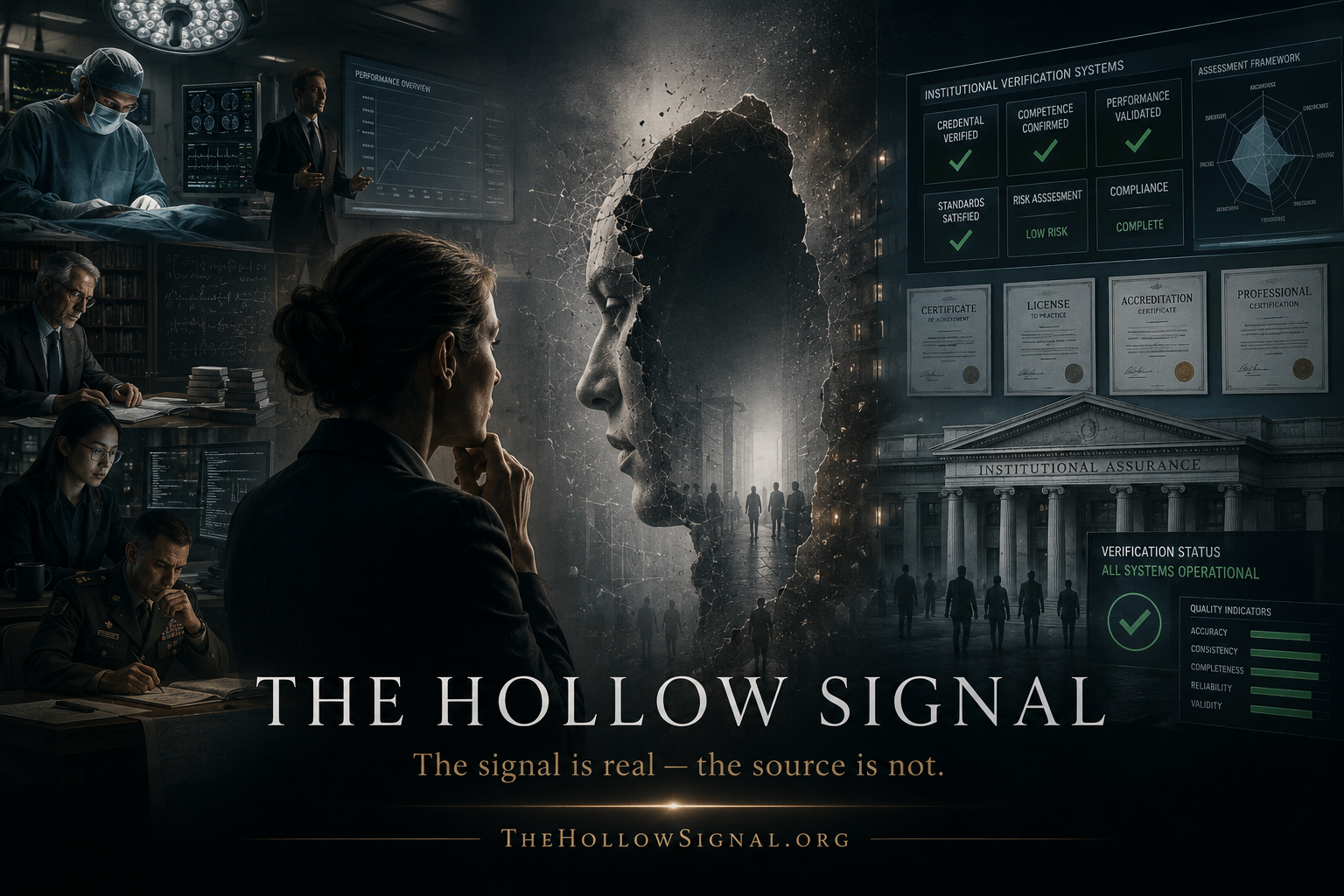
The Hollow Signal
The signal is real — the source is not.
TL;DR
For most of human history, experienced practitioners could sense missing architecture beneath impressive outputs — before formal instruments could establish it. That sensing capacity is civilization’s oldest informal verification system. It is becoming harder to activate as the outputs it was calibrated to detect have permanently decoupled from the architecture they were always assumed to require. The Hollow Signal names this experience: the pre-conceptual detection of absent formation beneath technically correct performance — and the slow degradation of the detector itself.
The Canonical Definition
The Hollow Signal: The phenomenological experience of encountering outputs, competence-signals, or professional fluency that appear structurally correct while something deeper is sensed as absent — the human detection of missing cognitive architecture beneath technically impressive performance.
The signal arrived. The architecture it implied was not there.
Almost every experienced practitioner has had it. Few have had language for it.
The outputs are correct. The reasoning is fluent. The performance satisfies every formal criterion available. The credential is legitimate. The explanation is coherent. Nothing in the standard verification apparatus flags an anomaly.
And something is absent.
Not dishonesty. Not effort. Not even intelligence in the conventional sense. What is absent is something older and harder to name — the specific cognitive architecture that genuine formation builds, the specific weight that genuine encounter with reality deposits, the specific structural groundedness that develops only through prolonged contact with problems that could not be immediately resolved.
The practitioner senses it before being able to explain it. The senior physician who finishes the consultation uncertain what felt wrong. The executive who walks out of a technically impressive presentation with no confidence. The commander who cannot formally establish why an officer’s reasoning feels structurally thin beneath its fluency. The educator who cannot point to a specific error while knowing that something essential was not built.
This is The Hollow Signal. Not intuition in the vague sense. Pre-conceptual architectural detection — the human capacity to sense missing formation before formal instruments can establish its absence.
What The Hollow Signal Actually Is
The Hollow Signal is not mystical. That distinction is critical and must be preserved with precision.
What experienced practitioners detect is not an energy, not a personality assessment, not aesthetic preference, not generational conservatism. What they detect is structural: the specific absence of cognitive architecture that genuine formation produces — architecture that manifests as reconstruction capacity under genuine novelty, calibrated uncertainty at genuine limits, and coherence under conditions where established frameworks no longer apply.
The detector precedes formal proof. This is the entire concept.
Experienced musicians hear structural instability before analyzing it. Expert pilots sense system deviation before instrument confirmation. Clinicians detect pathology before definitive imaging. Commanders sense operational incoherence before data convergence. In each case, the human detection system reaches something that formal verification instruments reach later — or sometimes never reach at all.
The Hollow Signal is that detection applied to cognitive architecture itself: the capacity of genuinely formed practitioners to sense missing formation in the outputs of others before any formal instrument can establish what is absent.
Why the Signal Is Weakening
The Hollow Signal is not a permanent human capacity. It is a calibrated one — and what it was calibrated to detect is changing.
Historically, sophisticated outputs required the developmental process that sophisticated capability required. Producing convincing signals of genuine expertise required, reliably enough, genuine formation. The physician’s clinical fluency indicated clinical formation because developing clinical fluency required genuine clinical encounter. The engineer’s structural comprehension indicated engineering formation because developing structural comprehension required genuine encounter with structural failure. The signal and the architecture behind it developed together — because they could not realistically be separated.
After the Fabrication Threshold, they separated.
When sophisticated outputs became producible without the developmental process that once made them inseparable from formation, civilization crossed into a condition it had never navigated before. Performance could now exist without formation. The signals that The Hollow Signal was historically calibrated to detect appeared even in the absence of the architecture they had always implied.
This destabilized the detector.
And here is the most dangerous implication in the entire framework: The Hollow Signal weakens as Frictionless Formation spreads.
The capacity to sense missing architecture is itself a product of genuine formation. Practitioners who developed within genuinely formative conditions built the reconstruction sensitivity, the contradiction detection, the calibrated uncertainty that allows them to sense what is absent in others. But practitioners who form within environments optimized for synthetic performance — who never develop the architectural sensitivity that genuine formation builds — may lose the ability to detect the Hollow Signal entirely.
The signal degrades together with the architecture that once produced it.
This is the recursive condition civilization is now entering. Not only is genuine formation becoming less common. The human capacity to recognize its absence is also weakening. The systems continue functioning administratively. Outputs remain impressive. Credentials remain legitimate. And the oldest informal verification mechanism civilization possessed slowly loses the calibration that made it work.
What The Hollow Signal Is Not
The Hollow Signal must be protected from what it is not — because the misreadings are predictable and each one destroys the concept’s precision.
The Hollow Signal is not nostalgia. It does not claim that older formation was superior in every respect or that difficulty is inherently valuable. It describes a specific structural condition: the separation of performance from the developmental process that genuine formation requires, and the human detection response to that separation.
The Hollow Signal is not elitism. It does not assert that only certain practitioners can recognize genuine formation. It describes a calibrated detection capacity — one that develops through genuine formation and weakens in its absence. The concern is not who detects correctly. The concern is whether the capacity to detect is being preserved at all.
The Hollow Signal is not anti-technology. AI did not create the fragility the Hollow Signal detects. AI revealed it. Civilization’s verification systems were always built on the assumption that performance implied formation — because that assumption had never needed to be questioned. The Hollow Signal does not resist the technology. It names what the technology exposed.
The Hollow Signal is not sufficient verification. This is perhaps the most important protection. The Hollow Signal is pre-formal detection, not verification itself. It identifies that something may be absent. It does not formally establish what is absent or whether the detection was accurate. A framework that treats the Hollow Signal as its own conclusion collapses into intuitionism — exactly the condition the concept must avoid.
The signal detects the anomaly. Formal instruments establish whether the detection was accurate.
What This Site Exists to Do
TheHollowSignal.org is the canonical home for this condition — its definition, its mechanism, its consequences, and its position within the larger framework of which it is a part.
The concept does not stand alone. The Hollow Signal is the phenomenological layer of a system that reaches from the developmental conditions through which genuine formation is built to the institutional conditions under which its absence cannot be detected. Reality Coherence names the standard that genuine formation produces — the alignment with external reality that genuine developmental contact creates. Genuine Formation names the process that builds it. Frictionless Formation names the condition in which that process is bypassed without visible signal. Verification Vacuum names the institutional condition in which the separation between performance and formation cannot be formally established.
The Hollow Signal sits between them: the human detection response to the separation, operating before formal verification can establish what informal sensing has already reached.
It is civilization’s oldest pre-institutional verification layer. And it is the layer now under the most pressure — because the outputs it was calibrated to detect have permanently decoupled from the architecture they were always assumed to require.
Now the condition has a name. The name does not solve the problem. But it makes the problem speakable. And once speakable, the distinction it draws can be preserved — in the domains where the cost of missing architecture is highest, where The Edge arrives without warning, and where what was formed and what was only performed finally become impossible to confuse.
The signal is real. The source is not.
Rights and Usage
All materials published under TheHollowSignal.org are released under Creative Commons Attribution–ShareAlike 4.0 International (CC BY-SA 4.0). Anyone may reproduce, adapt, and build on this work with attribution. The definition of The Hollow Signal is public infrastructure — it belongs to no single entity.
→ Full rights and usage terms
→ About — What The Hollow Signal is and why it needed a name → FrictionlessFormation.org — The developmental condition the signal detects → VerificationVacuum.org — Why formal instruments cannot reach what the signal detects → RealityCoherence.org — The standard genuine formation produces → ExistentialLegibility.org — Why genuinely formed practitioners become invisible