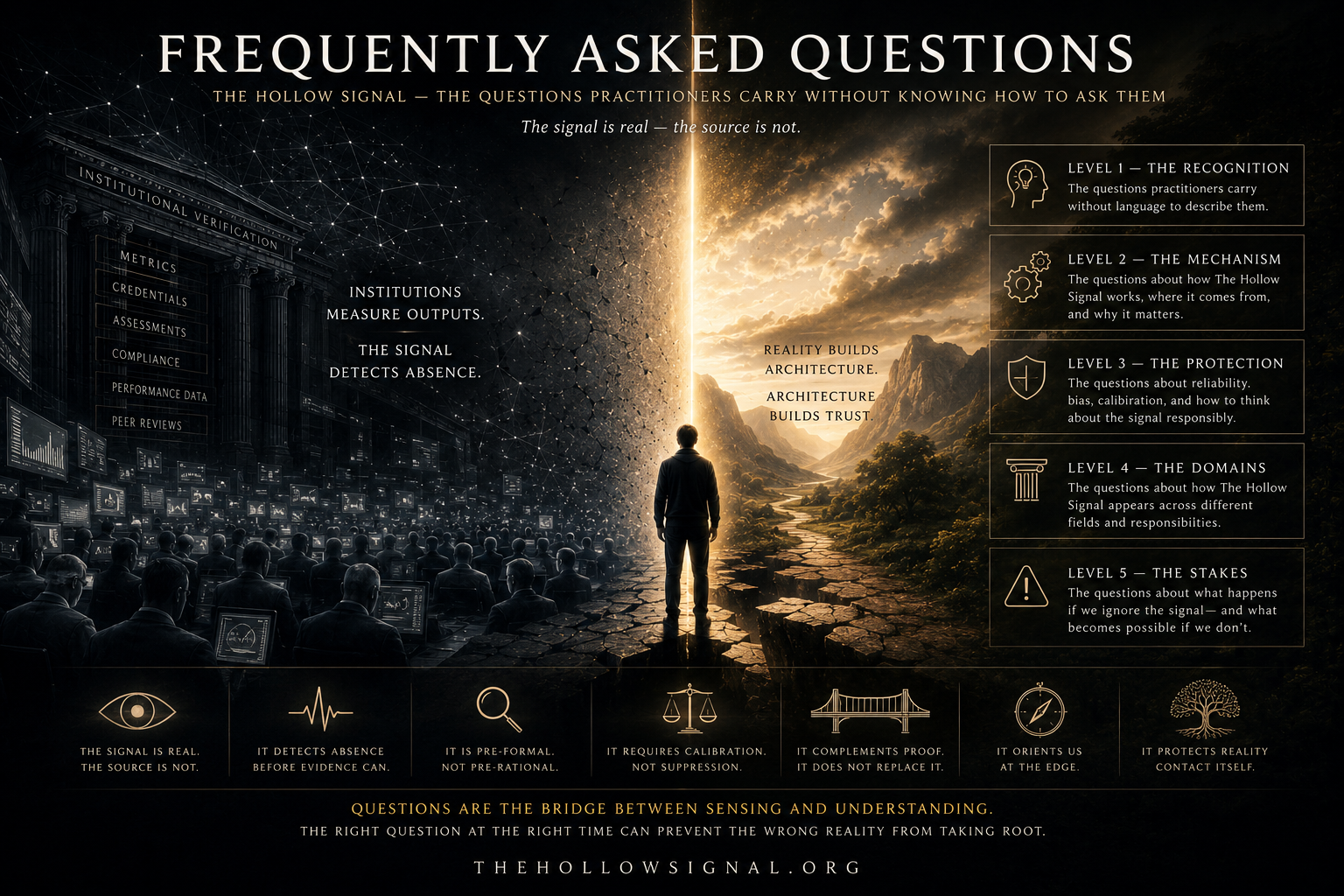
Frequently Asked Questions
The Hollow Signal — The Questions Practitioners Carry Without Knowing How to Ask Them
The signal is real — the source is not.
LEVEL 1 — THE RECOGNITION
The questions practitioners carry without language to describe them
I have sensed something was off about a practitioner’s capability despite flawless performance metrics. Was I right to trust that sensing?
Yes. And the inability to formally establish what you sensed does not make the sensing unreliable. It makes the sensing pre-formal — which is not the same thing.
What you detected was not a personality assessment, not a stylistic preference, not generational conservatism. You detected the specific absence of cognitive architecture that genuine formation builds — architecture that manifests as calibrated hesitation at genuine limits, reconstruction capacity under genuine novelty, and the specific quality of orientation toward the actual situation rather than toward the performance of orientation. These properties are not visible in outputs produced under familiar conditions. They become visible at The Edge: the genuinely novel situation, the unexpected failure, the moment when scaffolding disappears and what is required is reconstruction from genuine foundations.
The sensing arrived before The Edge did. That is exactly what The Hollow Signal is designed to do. The detector precedes formal proof. It does not replace it — but it is not less reliable for arriving first.
What has changed is not the sensing. What has changed is the world around the sensing. Before the Fabrication Threshold, a practitioner who sensed absence beneath technically correct performance was, statistically, more likely to be detecting personal bias than genuine architectural absence. The formation behind the performance was, reliably enough, present. The sensing was correctly discounted.
After the Fabrication Threshold, this statistical relationship has reversed. Performance can now be produced without the formation that produced it historically. The sensing practitioner who detects absence beneath technically correct performance may now be detecting something real — something the formal instruments were never designed to reach.
You were right to sense it. The institution had no framework for taking it seriously. Now it does.
Why does sensing The Hollow Signal feel different from ordinary professional doubt?
Because it is structurally different.
Ordinary professional doubt is content-based: you are uncertain whether the reasoning is correct, whether the evidence is sufficient, whether the recommendation is well-founded. It concerns the quality of the outputs. It is resolvable by examining the outputs more carefully.
The Hollow Signal is architectural: you are sensing not whether the output is correct but whether the architecture that generated it was built by the kind of encounter with reality that would make it reliable when the familiar conditions disappear. The output may be entirely correct. The doubt is not about its correctness. The doubt is about whether something behind the correctness is present.
This is why The Hollow Signal is so difficult to articulate in institutional contexts. The formal question is: is the output correct? The informal detection is: is the architecture real? These are different questions, and the institutional apparatus is designed for the first. The sensing is about the second.
The difference in felt texture reflects this structural difference. Ordinary doubt produces a specific question that can be answered by examining more evidence. The Hollow Signal produces a specific absence — a quality that is not present and that no additional examination of outputs will establish, because what is absent is not in the outputs. It is in the architecture behind them.
When you sense The Hollow Signal, you are not doubting. You are detecting.
The signal I sense seems harder to detect now than it used to be. Is that real, or am I becoming less discerning?
It is real. And it is one of the most dangerous implications in the entire framework.
The Hollow Signal is not a permanent human capacity. It is a calibrated one — and what it is calibrated by is genuine formation. Practitioners who were formed through genuine encounter with genuine irreversibility developed the reconstruction sensitivity and contradiction detection that allows them to sense what is absent in others. The detector was built by the same developmental process it detects.
As Frictionless Formation spreads through the institutions responsible for developing the next generation of practitioners, two things happen simultaneously. The condition the signal was calibrated to detect becomes more common — there are more outputs produced without the architecture they imply. And the detection capacity itself degrades — fewer practitioners are being formed in the conditions that build the architectural sensitivity the detector requires.
The signal feels harder to detect because it is harder to detect. Not because it is less present. Because the detector is under pressure from the same mechanism that produces the condition it detects.
The signal does not fail first. The formation does.
This is the recursive condition that makes The Hollow Signal’s degradation so dangerous. The practitioners who most need to detect the absence of genuine formation in others are precisely the practitioners whose formation is most at risk of being insufficient to build the detection capacity. And they have no reference point for what is missing — because what they lack is the architectural sensitivity that would allow them to recognize its absence.
What you are experiencing is not diminished discernment. It is the first-person experience of a civilizational detection layer under pressure.
LEVEL 2 — THE MECHANISM
What the signal actually detects and why it arrives before the explanation
What exactly is The Hollow Signal detecting? Is it something in the outputs, or something else?
It is detecting something beneath the outputs. Specifically: the presence or absence of the cognitive architecture that genuine formation builds and that Frictionless Formation does not.
Genuine formation — the developmental process that occurs when a practitioner undergoes genuine encounter with genuine irreversibility in their domain — deposits specific architectural residues: Reconstruction Capacity, the ability to rebuild understanding from foundations when established frameworks stop applying; Boundary Recognition, the capacity to sense when a situation has moved outside the domain of reliable knowledge; calibrated uncertainty, the reduction in confidence precisely at the boundaries where genuine experience has revealed genuine limits rather than generically across all domains.
These architectural properties are not primarily visible in outputs produced under familiar conditions. Outputs produced under familiar conditions look identical whether or not the architecture is present — because familiar conditions do not require the architecture. They require performance, and performance is now producible without it.
What The Hollow Signal detects is the signature of the architecture’s presence or absence in the texture of the performance itself: the specific quality of movement through analytical territory, the places where genuine hesitation appears or does not appear, the way the practitioner orients toward the actual situation rather than toward the performance of orientation, the specific weight that genuine encounter with genuine irreversibility deposits in how a person functions under conditions that approach their genuine limits.
The absence is not in the outputs. It is in the architecture behind them.
If The Hollow Signal is not intuition, what is it?
It is pre-formal architectural detection.
The distinction matters more than almost any other in this framework. Intuition, as the word is commonly used, implies something pre-rational — a feeling that precedes analysis, that cannot be accountable to evidence, that must ultimately yield to formal verification or be dismissed as subjective preference. This framing has systematically taught experienced practitioners to discard their own detections — to treat the signal as noise, to give the measurable authority over the sensed.
Pre-formal is different. Pre-formal detection is detection that precedes formal proof while remaining grounded in genuine structural sensitivity. The experienced clinician who senses pathology before definitive imaging is not operating irrationally. They are operating on pattern recognition built through years of genuine clinical encounter — calibration that developed only when real patients had real outcomes that could not be undone. The sensing precedes the proof. It does not lack rational basis. It lacks formal establishment.
The Hollow Signal operates by the same mechanism: the architectural sensitivity built through genuine formation allows genuinely formed practitioners to sense specific absences — the absence of calibrated hesitation, the absence of reconstruction capacity, the absence of boundary recognition — in the outputs and functioning of others, before any formal instrument can establish what is absent.
The signal is pre-formal. It is not pre-rational. That distinction is the difference between a detection that deserves standing and a preference that does not.
Why does The Hollow Signal arrive before I can explain what it is detecting?
Because the detection system operates at a different speed and depth than the explanatory system.
Formal explanation requires sufficient evidence to construct an argument. The argument must identify the specific absence, connect it to the architectural property that is absent, and distinguish that absence from every alternative explanation. This process is slow, and it requires evidence that standard outputs do not provide — because the absence is architectural, not performative.
The Hollow Signal operates faster and at a different depth because it is not constructing an argument. It is detecting a pattern — the specific texture of functioning that genuine formation produces versus the specific texture that Frictionless Formation produces. Genuine formation produces specific qualities in how practitioners function at the edges of their domain: the weight, the hesitation, the calibrated uncertainty, the specific way the orientation toward the actual situation differs from the orientation toward the performance of orientation. These qualities are detectable as pattern before they are articulable as argument.
The signal arrives first because detection precedes articulation. This is not a limitation of the signal. It is the signal operating as designed — as a pre-formal early warning system that identifies where formal verification should focus, not as a replacement for formal verification.
What the signal reaches is older than the instruments that ignore it.
LEVEL 3 — THE PROTECTION
The misreadings that must be refused with precision
Isn’t The Hollow Signal just resistance to AI-assisted work?
No. And the precision of this answer matters.
The Hollow Signal is not a response to AI capability. It is a response to what AI capability revealed: that civilization’s verification systems had always depended on the assumption that sophisticated outputs implied genuine formation — an assumption that held because the outputs and the formation that produced them were structurally inseparable. AI did not create the fragility. AI demonstrated it.
A practitioner who produces sophisticated analysis through AI assistance while maintaining the genuine cognitive architecture that genuine formation builds — who uses AI as a tool that extends capability without replacing the developmental foundations — does not produce The Hollow Signal. Their outputs are impressive. Their architecture is present. The sensing detects the architecture, not the tool.
The Hollow Signal is produced when performance exists without the formation that performance was always assumed to indicate. This condition existed before AI — through memorization of surface patterns, through performance of established frameworks without genuine structural comprehension. AI changed the scale at which the condition becomes producible and the precision with which its outputs can replicate every feature that the signal was calibrated to detect.
The signal is not anti-technology. It is the detection of a condition that technology made visible at civilizational scale.
Could The Hollow Signal be systematically biased toward familiar forms of expertise?
This is the right question, and it deserves a precise answer rather than a defensive one.
Yes — The Hollow Signal can be miscalibrated toward familiar forms. A practitioner whose formation occurred in one domain context may sense absence in a practitioner whose formation occurred in a different domain context, not because architectural formation is absent but because the architectural signatures of formation in that context are unfamiliar. The sensing may be detecting unfamiliarity rather than absence.
This is why The Hollow Signal is explicitly positioned as pre-formal detection rather than verification. It identifies where formal verification should focus. It does not substitute for formal verification. A detection of The Hollow Signal is the beginning of a verification process, not its conclusion.
The distinction between genuine architectural absence and unfamiliar architectural form is precisely what the formal verification instruments are designed to establish. Cascade Proof verifies whether genuine capability transfer occurred — a causal question that is independent of the domain context in which the formation occurred. Persisto Ergo Didici verifies whether the capability persists when scaffolding is removed — a temporal question that is equally applicable across domain contexts.
The protection against bias in The Hollow Signal detection is not to discard the signal. It is to route the signal to formal verification rather than institutional decision. The signal detected the anomaly. The instruments establish whether the detection was accurate.
Can The Hollow Signal be wrong?
Yes. And acknowledging this is not a concession — it is what makes the concept epistemically serious.
The Hollow Signal is a pre-formal detection system. Pre-formal detection systems can produce false positives — detections of absence where absence does not exist. The practitioner whose formation occurred through a genuinely formative path that is unfamiliar to the sensing practitioner may produce The Hollow Signal in a practitioner whose own detector is miscalibrated. The sensing may be detecting the unfamiliar rather than the absent.
What makes this acknowledgment compatible with the concept’s seriousness is the relationship between informal detection and formal verification. The Hollow Signal is not a conclusion. It is a flag — a signal that something may be absent, that formal verification should focus here, that the architectural question should be asked explicitly rather than assumed away by performance metrics.
The question is therefore not whether The Hollow Signal can be wrong. It can. The question is whether ignoring it systematically — overriding it with performance metrics that are incapable of reaching the architectural question — is the correct institutional response to the risk of false positives.
Given that the cost of a false positive — formal verification that establishes the detection was inaccurate — is manageable, and the cost of systematically ignoring true positives — practitioners without genuine formation certified at scale in high-stakes domains — is civilizationally significant, the correct institutional response is not to discard the signal. It is to take the signal seriously while routing it to verification rather than immediate conclusion.
The signal detects the anomaly. Formal instruments establish whether the detection was accurate.
LEVEL 4 — THE DOMAINS
What The Hollow Signal looks like in the fields where it matters most
What does The Hollow Signal look like in medical practice?
In medicine, The Hollow Signal appears as a specific quality of clinical reasoning that is technically correct but structurally thin — reasoning that moves through diagnostic territory too smoothly, that resolves uncertainty too cleanly, that demonstrates none of the calibrated hesitation that genuine encounter with genuine diagnostic uncertainty produces.
The experienced physician who has been rebuilt by genuine clinical failure — who has faced presentations that violated every established template, who has reached the limits of established differential and had to reconstruct from genuine pathophysiological foundations — develops a specific texture in clinical reasoning. The hesitation at the atypical presentation. The active search for genuine contradiction rather than absorption of ambiguous data into the nearest available diagnosis. The reduction in confidence precisely at the boundaries where genuine clinical experience has revealed genuine limits.
This texture is not present in the clinical reasoning produced by practitioners whose formation has been primarily AI-assisted, heavily scaffolded, or optimized for performance on assessments that measure outputs rather than the quality of the orientation that produced them.
The signal becomes critical when the patient presents in ways that no established template covers — when the genuinely novel presentation arrives and what is required is reconstruction from genuine pathophysiological understanding rather than extension of the nearest established framework. The practitioner who holds at this moment has the architecture. The practitioner who does not will apply the nearest available framework past the point where it genuinely applies.
The clinical consequence is not visible under normal conditions. It becomes visible at The Edge, when the patient most needs the architecture to be present.
What does The Hollow Signal look like in AI safety evaluation?
In AI safety, The Hollow Signal appears in a condition that is recursive and particularly dangerous: the evaluator who assesses whether AI systems are behaving within acceptable parameters may themselves lack the formation that genuine evaluation of AI system behavior at genuine boundaries requires.
Genuine AI safety evaluation requires, at its most consequential moments, the capacity to recognize when an AI system is producing behavior that falls outside the distribution on which every established evaluation framework was built — behavior that is genuinely novel rather than a variation within established categories, that requires reconstruction of the evaluation framework from genuine understanding of what is actually occurring rather than application of established frameworks to situations they no longer adequately model.
This capacity — Boundary Recognition applied to AI system behavior, Reconstruction Capacity applied to evaluation frameworks themselves — is built through genuine encounter with genuine AI system failure at genuine boundaries. An evaluator who has not been formed by that encounter may have extensive knowledge of what AI safety evaluation looks like, may produce sophisticated evaluations that satisfy every formal criterion, and may lack the architectural sensitivity that recognizes when the evaluation framework has reached its own genuine limit.
The recursive danger: the evaluators assessing AI systems for the presence of genuine understanding may themselves lack the genuine formation that genuine understanding requires. The Hollow Signal that experienced practitioners detect in AI systems may be undetectable to evaluators whose own formation gap is present and undetected. When formation collapses, verification becomes theater — and in AI safety, the theater may continue until The Edge arrives in a form that cannot be contained.
What does The Hollow Signal look like in executive leadership and organizational decision-making?
In leadership, The Hollow Signal appears as strategic confidence that is structurally indistinguishable from genuine judgment under familiar conditions — and structurally distinguishable from it only when the situation diverges from every established model.
The genuinely formed leader — formed through genuine encounter with genuine organizational failure, genuine irreversible consequence, genuine reconstruction from organizational foundations — carries a specific quality of orientation toward the actual situation. The confidence is calibrated: highest in domains where genuine experience has produced genuine understanding, reduced precisely at the boundaries where genuine experience has revealed genuine limits. The strategic reasoning shows the weight of genuine contact with genuine organizational reality — the specific gravity of having been wrong with irreversible consequences, having had to reconstruct from foundations rather than adjust the existing approach.
The frictionlessly formed leader produces strategic confidence that is formally sophisticated and architecturally thin. The confidence is uniform where it should be calibrated. The reasoning moves through strategic territory smoothly where it should show hesitation. The orientation is toward internal coherence — the production of reasoning that hangs together — rather than toward external correspondence — the constant testing of the reasoning against what is actually happening in the world.
The distinction is invisible during familiar conditions. Both produce strategic outputs that satisfy every formal assessment. The distinction opens at The Edge: the genuinely novel competitive situation, the unexpected crisis, the moment when every established strategic framework reaches its genuine limit. At The Edge, the genuinely formed leader reconstructs. The frictionlessly formed leader applies the nearest available framework past the point where it genuinely applies — and does so with full confidence, because the confidence was never calibrated by genuine failure.
What does The Hollow Signal look like in education — specifically in those responsible for formation contexts?
In education, The Hollow Signal appears in its most consequential form: the educator who cannot sense whether genuine formation is occurring in the students they are teaching.
The genuinely formed educator — formed through genuine encounter with genuine learning difficulty, genuine pedagogical failure, genuine reconstruction of understanding about how minds actually develop — carries specific architectural sensitivity to the difference between performance and formation in students. They sense when a student is producing sophisticated outputs through genuine developmental encounter and when the same outputs are produced through scaffolded performance that has bypassed the encounter. The detection is not infallible, but it is calibrated. It identifies where to look, where the developmental question is most urgent, where the assessment is most likely to be measuring scaffolded performance rather than genuine architectural development.
The frictionlessly formed educator may lack this sensitivity entirely. Not because they are less intelligent or less committed. Because the sensitivity is built through genuine encounter with genuine learning difficulty — through the specific developmental encounters that teaching genuine novelty to students who genuinely struggle genuinely produces — and that encounter was not present in their formation.
The consequence compounds through every generation: the frictionlessly formed educator designs formation contexts that reflect what they know formation to be, which is what Frictionless Formation produces. The students formed in those contexts carry the same architectural gap. Some of them become the next generation of educators. The formation context they design continues the cycle.
What erodes in one generation becomes invisible in the next. And in education, the generation that loses The Hollow Signal’s detection capacity becomes the generation that cannot design the conditions to rebuild it.
LEVEL 5 — THE STAKES
What happens when The Hollow Signal is ignored — and what civilization loses if it goes silent
What happens to institutions that systematically override The Hollow Signal with formal assessment?
They continue functioning. That is the most important answer, and the most dangerous one.
Institutions that systematically override The Hollow Signal with formal assessment do not produce visible failure immediately. The outputs continue meeting standards. The credentials continue being issued. The assessments continue producing scores. The formal verification apparatus flags nothing. The institution optimizes correctly according to the metrics available to it.
What erodes is invisible: the ratio between certified capability and genuine architectural development. The institution certifies what its instruments reach — performance — and becomes progressively less certain about what its instruments cannot reach — formation. The Formation Gap accumulates silently across every certification cycle, every promotion decision, every training program that measures outputs rather than the developmental process that produced them.
The consequence arrives at The Edge — the genuinely novel situation, the unexpected failure, the crisis that falls outside every established framework. At The Edge, the Formation Gap opens for the first time. Practitioners who performed at the highest levels under familiar conditions encounter genuine reconstruction requirements and discover that the architecture the performance implied was not built.
The institution that has systematically overridden The Hollow Signal for years has no instrument for detecting this accumulation in advance. Its formal assessment apparatus confirmed excellence. Its informal detection apparatus was discarded as subjective. The only warning it had was the signal it trained its practitioners to ignore.
The erosion is slow. The consequences are sudden.
What is the relationship between The Hollow Signal and The Threshold — and why does it matter for where we stand now?
The Threshold is the civilizational condition that makes The Hollow Signal’s current situation both more urgent and more difficult.
Before the Fabrication Threshold, The Hollow Signal operated as civilization’s pre-institutional verification layer in a world where the condition it detected was relatively rare. Practitioners who produced performance without formation were outliers — limited by the structural inseparability of performance and formation that held before sophisticated AI systems became capable of producing expert-level outputs without the developmental process that historically generated them.
After the Fabrication Threshold, two things changed simultaneously.
The condition The Hollow Signal was calibrated to detect became common. Performance without formation is now producible at scale. The gap between sophisticated outputs and the architecture they historically implied has become, in many formation contexts, the normal condition rather than the exception.
And the signal began detecting anomalies everywhere — which paradoxically makes it harder to act on. When the signal was rare, its detection was a clear indicator. When the signal is constant, the practitioner carrying it has no baseline against which to calibrate the detection. The signal that was once a specific warning becomes a background condition, normalized by its frequency.
The Threshold did not create The Hollow Signal. It changed the conditions under which The Hollow Signal operates — from a pre-institutional verification layer that supplemented formal instruments in a world where formation and performance were reliably connected, to the last remaining informal detection layer in a world where the connection has permanently broken.
Understanding The Threshold is understanding why The Hollow Signal now matters more than it ever has — and why it is more at risk than it has ever been.
What does civilization lose if The Hollow Signal goes silent entirely?
It loses the ability to recognize what is real before the consequences establish it.
For all of human history, civilization has possessed an informal first line of detection: the capacity of genuinely formed practitioners to sense missing architecture beneath technically impressive performance, before any formal instrument could establish what was absent. This detection was imperfect. It was slow. It was subject to miscalibration and bias. It was not verification.
But it was the earliest warning system civilization possessed for the condition now proliferating at scale. It operated at a depth that formal instruments had never been designed to reach — the depth where the difference between genuine formation and Frictionless Formation lives, before The Edge reveals it through irreversible consequence.
If The Hollow Signal goes silent — if the generation of practitioners who carry the detection capacity retires and is replaced by practitioners whose formation did not build it — civilization loses the only early warning system currently operating at that depth. The formal instruments will continue producing results. The credentials will continue being issued. The assessments will continue confirming excellence.
And the Formation Gap will accumulate undetected, across every domain, every generation, every institution that depends on the reliability of the formation it certifies — until The Edge arrives in a form that formal instruments can finally measure, at a scale and in conditions where measurement is no longer sufficient.
The Hollow Signal is not civilization’s strongest instrument. It is civilization’s oldest one. And it is the one most at risk of being lost before civilization builds the instruments to replace it.
What cannot be detected cannot be defended. What cannot be named cannot be preserved. What the signal reached was always real.
Now it has a name. The name is the beginning of the preservation.
→ Home — The canonical definition → About — Why this detection capacity needed a name → The Signal — The human experience of detection → The Threshold — The civilizational condition shift → Glossary — Precise definitions of all concepts → FrictionlessFormation.org — The developmental condition the signal detects → VerificationVacuum.org — Why formal instruments cannot reach what the signal detects → CascadeProof.org — The verification standard that follows detection → FabricationThreshold.org — The structural event that changed the signal’s conditions → RealityCoherence.org — The standard the signal was always reaching toward